
PrepSeven | IB Content Guide authored by Shankar Mutneja (Founder of Prepseven)
IB English A: Language & Literature — The Complete Student Guide
What Is IB English A: Language & Literature?
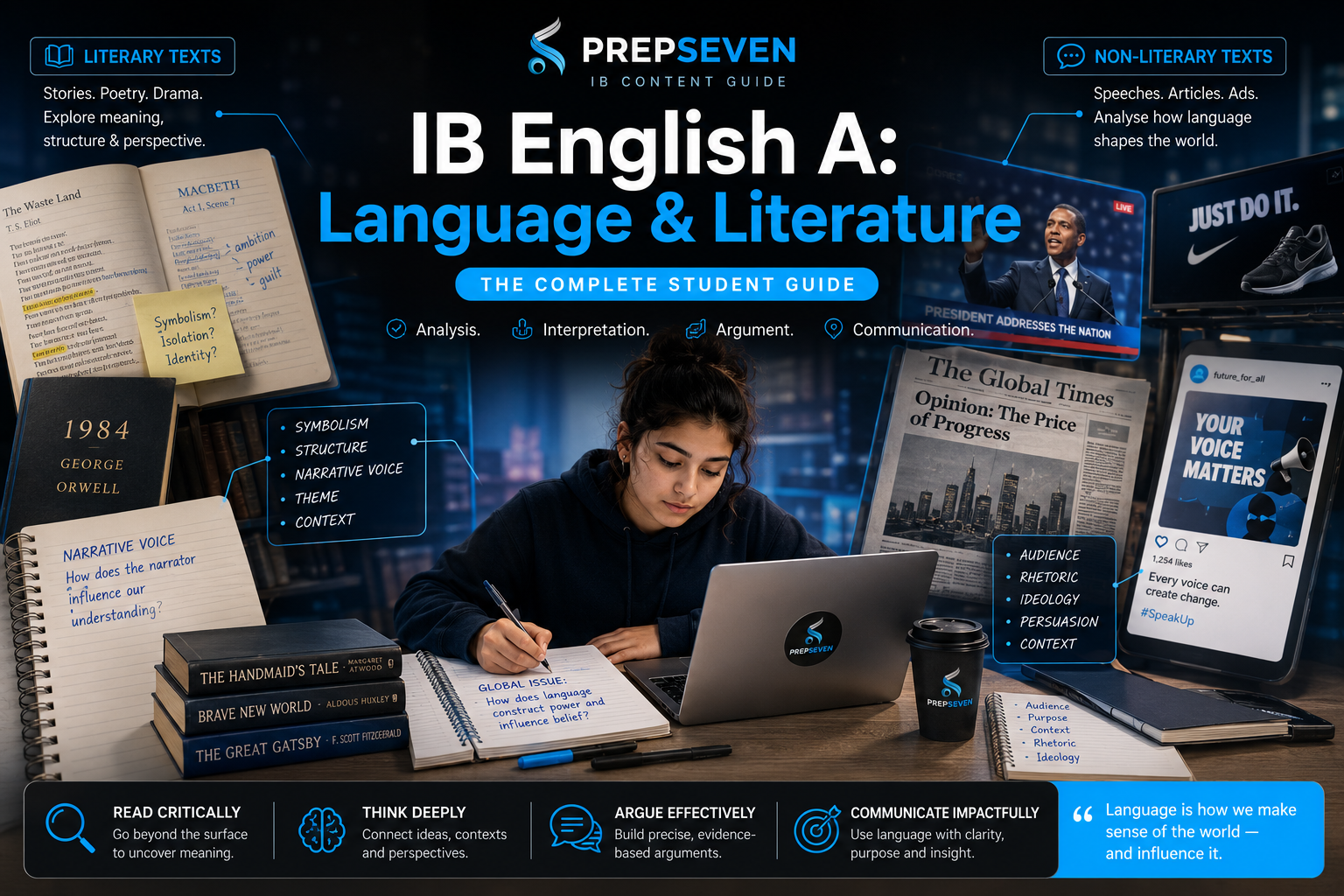
IB English A: Language & Literature is one of the most conceptually demanding subjects in the Diploma Programme. Unlike a standard English class that focuses on either creative writing or literary analysis, Lang Lit asks you to do both at once — and to understand the relationship between the two. The subject sits in Group 1 of the DP and is available at both Standard Level (SL) and Higher Level (HL).
The course is built around a central question: how does language shape the way we understand the world? You will read literary texts alongside non-literary ones — advertisements, speeches, opinion journalism, political propaganda — and you will be expected to analyse them with the same rigour. This dual focus is what makes the subject genuinely different from IB English A: Literature, which deals exclusively with literary works.
If you are someone who is curious about how language works — not just what a text says, but why it is constructed the way it is — this subject will reward you. If you are expecting a course that is mostly about appreciating novels, you may find it more analytical than anticipated.
SL vs HL: What Is Actually Different?
The most common question students ask is whether to take Lang Lit at SL or HL, and what that choice actually means in practice. Here is the honest picture:
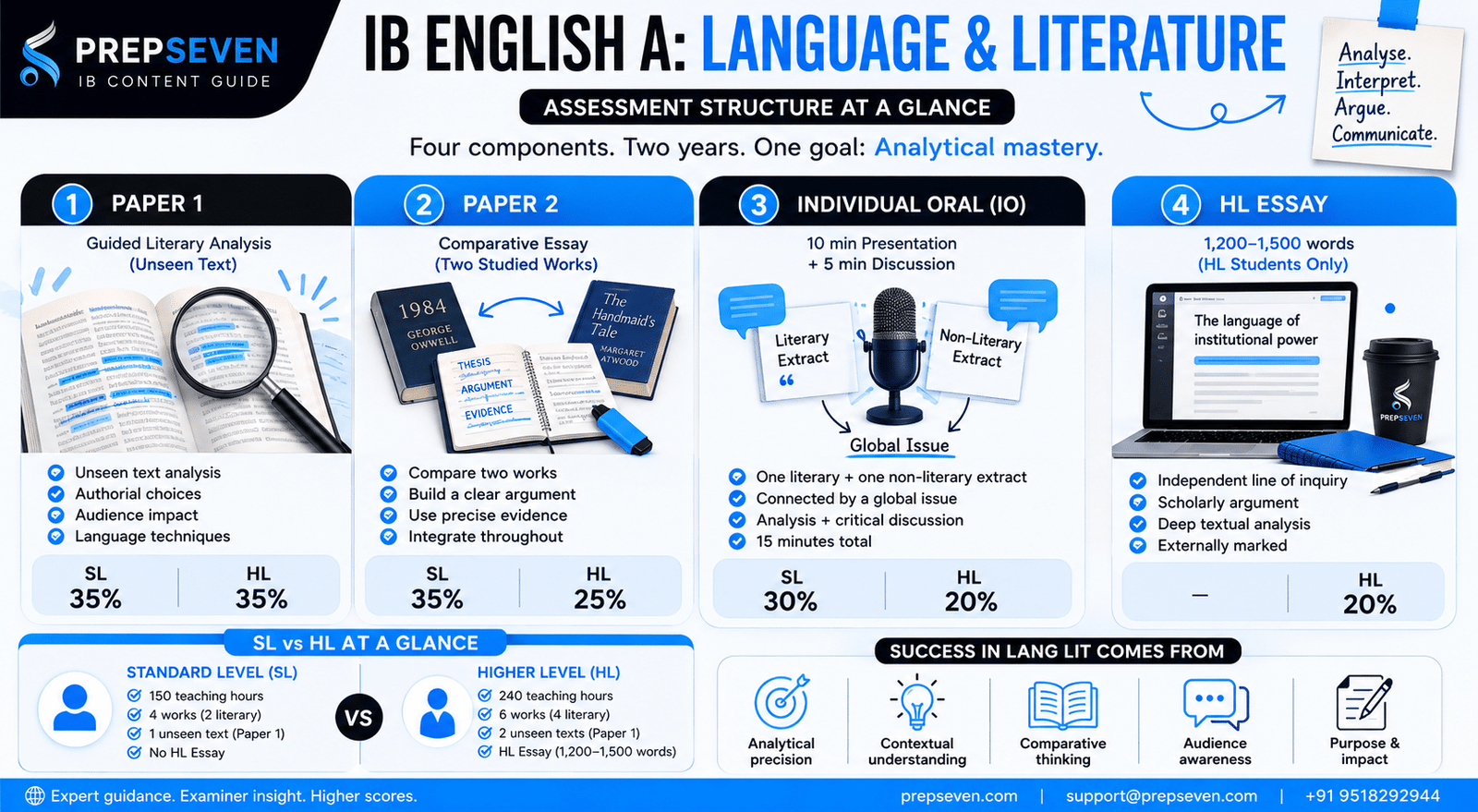
The HL Essay is the component that genuinely separates HL from SL. It is a formal literary essay submitted to the IB for external marking. Many students underestimate how much this adds to the workload, because it runs concurrently with all your other coursework and requires independent research beyond what your teacher covers in class.
Practical insight: If you are applying to universities that require English at HL — particularly UK universities for humanities degrees, or US universities where your admissions essays lean heavily on verbal reasoning — taking Lang Lit at HL is a strong signal. But do not choose HL just for that reason. Choose it if you genuinely want to engage with texts at a deeper level.
Assessment Breakdown: What You Are Actually Graded On
The IB English A: Language & Literature course has four assessed components. Understanding each one — not just what it is, but what the examiners are actually looking for — is the difference between a 5 and a 7.
Paper 1: Guided Literary Analysis (Unseen Text)
Paper 1 is the component students dread most, and often for the wrong reasons. The fear is that they will receive a text they cannot understand. The reality is that the text will always be accessible — the IB selects passages specifically because they are rich in technique without being obscure. What examiners are testing is not comprehension but analytical precision.
- SL: One unseen text with guiding questions. You write an analysis of roughly 600–800 words.
- HL: Two unseen texts (one literary, one non-literary). You write a comparative analysis without guiding questions. This is significantly harder.
The guiding questions at SL are genuinely there to help — treat them as a loose scaffold, not a strict format. At HL, the absence of guiding questions means you must impose your own analytical structure. Students who practise with past papers and develop a flexible analytical framework score significantly higher than those who try to memorise paragraph templates.
What examiners actually penalise: Surface-level description (‘the author uses metaphor’) without explaining the effect on a specific reader in a specific context. Every technique you identify should link to meaning, purpose, or audience impact.
Paper 2: Comparative Essay
Paper 2 is a two-hour essay written under exam conditions on one question from a choice of four. You must write about two works you have studied during the course — and you must have studied them together, not in isolation.
The questions on Paper 2 are deliberately broad. Something like: ‘Explore the ways in which characters in conflict are central to the works you have studied.’ The mark is not for plot summary. The mark is for the sophistication with which you construct a comparison that uses textual evidence to develop an argument.
Three things separate a 6 from a 7 on Paper 2:
- A genuine argument — not just ‘both texts deal with identity’ but ‘both authors use fragmented narrative structure to suggest that identity is never stable, though they arrive at opposite conclusions about whether that instability is liberating or destructive.’
- Specific, well-chosen quotations that are actually analysed, not dropped in as proof.
- A comparative structure that moves between texts throughout each paragraph, not a divided structure where you write about one text and then the other.
Individual Oral (IO)
The IO is the most personal component and, when done well, the most rewarding. You choose one extract from a literary work and one from a non-literary text, both connected by a global issue of your choice. You then give a 10-minute prepared talk followed by 5 minutes of questions from your teacher.
The global issue must be something that genuinely emerges from the texts — not something you have imposed on them. Weak IOs tend to pick a very broad global issue (such as ‘inequality’) and then force both texts into that frame. Strong IOs choose a nuanced formulation: not just ‘power’ but ‘the language of institutional authority and how it constructs compliance.’
Insight that most guides miss: The IO is internally assessed and externally moderated. Your teacher marks it first. The IB then samples a percentage of recordings from your school and may adjust the marks. This means your teacher’s leniency or strictness affects the whole cohort — not just you. Understand your teacher’s marking tendencies and calibrate accordingly.
HL Essay (HL Students Only)
The HL Essay is 1,200–1,500 words and is externally marked. It is a formal scholarly essay on one of the works you have studied at HL. You submit it to your teacher for review, but the final mark comes from an IB examiner.
The biggest mistake students make with the HL Essay is treating it like an extended Paper 2 paragraph. It is not. It is closer to the kind of essay you would write in a first-year university English seminar: a focused, well-researched argument with a clear line of inquiry, careful textual analysis, and an awareness of broader context.
You have time to draft, revise, and refine the HL Essay. This is rare in IB assessment. Use it. A student who submits their second draft is not the same as a student who submits their sixth.
Component Weightings at a Glance
The Texts You Will Study
The IB prescribes a list of works for each language and year group, but your school selects the specific titles. This matters more than students often realise — the choice of texts heavily shapes what you can write about on Paper 2 and in your IO.
For English A: Lang Lit, works are divided into three areas of exploration:
These areas of exploration are not separate units you study one at a time. They are lenses you apply to every text throughout the course. Your Paper 2 and IO will likely draw on more than one of them.
A practical note on text selection: Pay close attention to which texts your school is using for Paper 2. For the exam, you need two works studied in the course — but you can only write about a work in Paper 2 if your school has formally taught it as a Paper 2 text. Ask your teacher early in Year 1 which works are designated for Paper 2, and begin building your analytical notes on those from the start.
What Actually Gets Students to a 7: Six Things That Separate Top Scorers
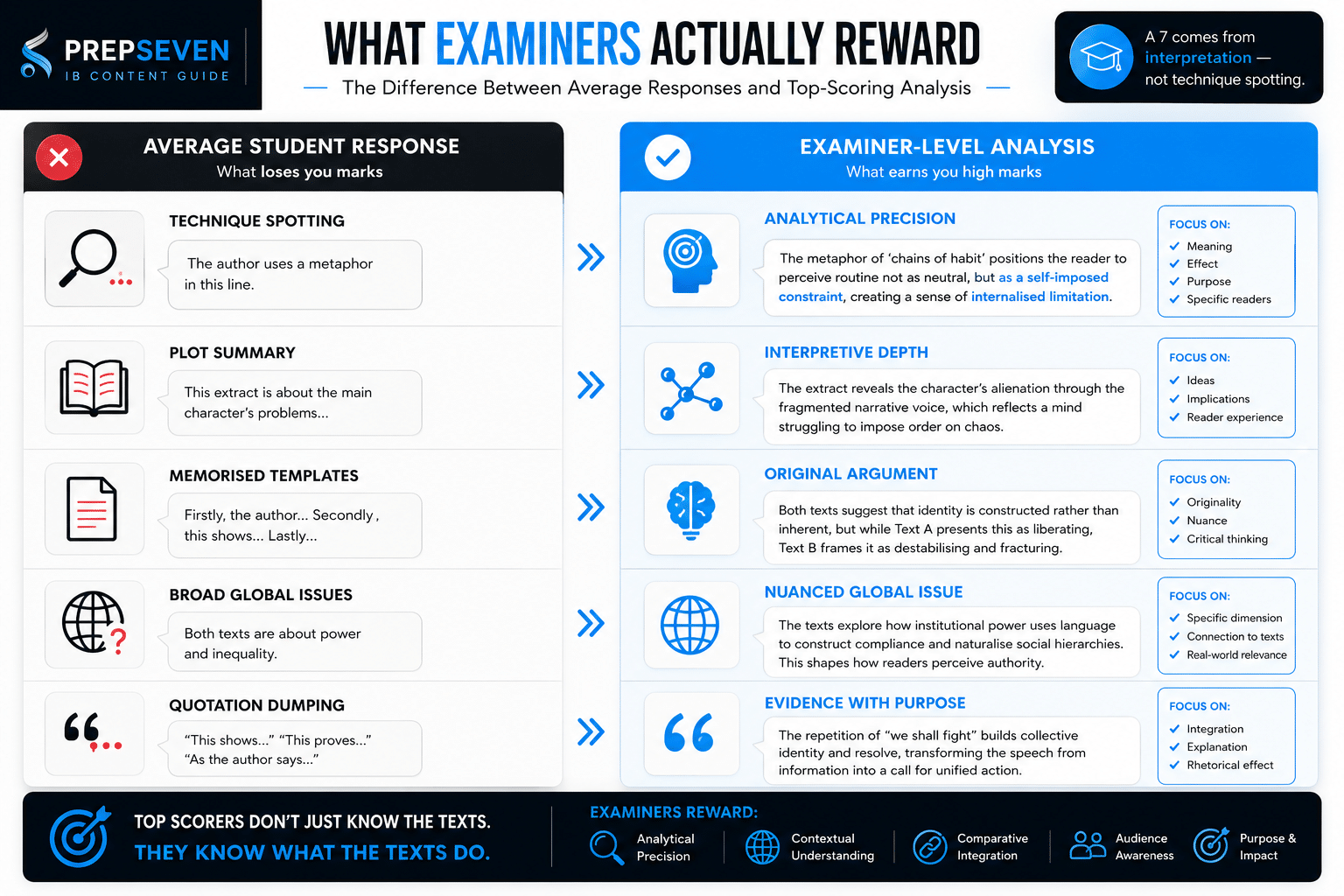
After working with hundreds of IB Lang Lit students, the patterns at the top of the grade distribution are consistent. These are not tips in the conventional sense — they are habits of thinking.
1. They read non-literary texts critically, not just literally
Most students are reasonably comfortable analysing a poem or a passage of fiction. Fewer are comfortable doing the same thing with an editorial, a product advertisement, or a political speech. But Paper 1 at both SL and HL will give you non-literary texts — and the analytical tools are exactly the same. Practise with real-world texts every week. The Financial Times, The Guardian, BBC editorials, UN speeches — all of these are Paper 1-style material.
2. They develop a personal analytical vocabulary
There is a difference between knowing what anaphora means and being able to write fluently about how a specific instance of anaphora in a specific text creates a specific rhetorical effect on a specific audience. Top scorers do not just label techniques. They have developed a personal vocabulary for talking about effect — words like ‘complicity’, ‘disorientation’, ‘implication’, ‘authority’, ‘fragmentation’ — and they deploy these precisely.
3. They treat the global issue as a genuine intellectual problem
For the IO, the global issue is not a theme, and it is not a topic. It is a question about the world that the texts illuminate. Students who treat their global issue as ‘gender inequality’ tend to write superficial IOs. Students who frame it as ‘how institutions use linguistic authority to naturalise gender hierarchies’ tend to write outstanding ones. The specificity of your global issue directly determines how much analytical depth your IO can reach.
4. They write thesis statements before anything else
Under exam pressure, students frequently start writing before they know what argument they are making. This produces essays that are well-organised but intellectually empty — a summary of what the text does, not an argument about what it means or achieves. Before you write a word of Paper 2, write a one-sentence argument. Everything else follows from that.
5. They use context as a tool, not decoration
Mentioning that 1984 was written in 1949, just after World War Two, is context as decoration. Arguing that Orwell’s decision to set the novel in a familiar near-future London reflects a post-war anxiety about how totalitarianism could emerge from within liberal democracies — not just from fascist or communist regimes abroad — is context as a tool. The difference is whether the historical information changes your reading of the text.
6. They read the mark scheme for past papers
This sounds obvious, but very few students actually do it. The IB publishes mark schemes and examiner reports. Reading them tells you exactly what examiners reward and exactly what they penalise. The language in those documents is the language you should be using in your essays.
Common Mistakes That Cost Marks (And How to Avoid Them)
A Year-by-Year Study Approach
Most students who underperform in Lang Lit did not fail in the exam room — they fell behind in Year 12 and never recovered. The course is cumulative. Your ability to write a strong Paper 2 depends entirely on how deeply you engaged with the texts throughout the two years.
Year 1 (Grade 11): Build the Foundation
- Read every assigned text actively — annotate for technique, context, and possible global issues.
- Practise one unseen text analysis per month, even informally. Write 300 words on a news article or advertisement.
- Start a ‘global issue journal’ — as you study each text, note what global issues it speaks to and in what specific way.
- For HL students: begin thinking about potential HL Essay topics by the end of Term 1. You want a full year to develop your argument.
Year 2 (Grade 12): Consolidate and Perform
- Do at least 4 full Paper 1 practice under exam conditions (timed, handwritten if your school uses handwriting, or typed if they use computers).
- Write and revise two full Paper 2 essays on different question types before your mock exams.
- Finalise your IO extract choices by the start of Term 1 and practise your oral at least 3 times — once alone, once with a peer, once with your teacher.
- HL students: submit your HL Essay draft to your teacher before the end of Term 1. Use the feedback cycle.
How PrepSeven Helps You Score Higher in IB English A
At PrepSeven, our English A tutors are certified IB examiners and experienced DP teachers. They know what the mark scheme rewards because they have written mark schemes and moderated student work. That is a very different thing from general English tutoring.
Here is what a typical engagement with a PrepSeven English A tutor looks like:
- Paper 1 session: Your tutor gives you an unseen text, you analyse it, and they mark it against the exact IB criteria — then walk through every annotation they would have made.
- Paper 2 session: You bring your comparative essay draft. Your tutor identifies where your argument loses precision and teaches you how to reconstruct it.
- IO prep: You deliver your oral to your tutor. They play the role of the examiner, ask the follow-up questions, and give you feedback on both content and delivery.
- HL Essay mentorship: Your tutor helps you develop your line of inquiry, reads every draft, and helps you understand the difference between a 5 and a 7 response.
Claim your free demo lesson at prepseven.com — and see what it feels like to be taught by someone who has actually sat on the other side of the mark scheme.