
PrepSeven | IB Content Guide authored by Shankar Mutneja (Founder of Prepseven)
IB Economics
What Is IB Economics?
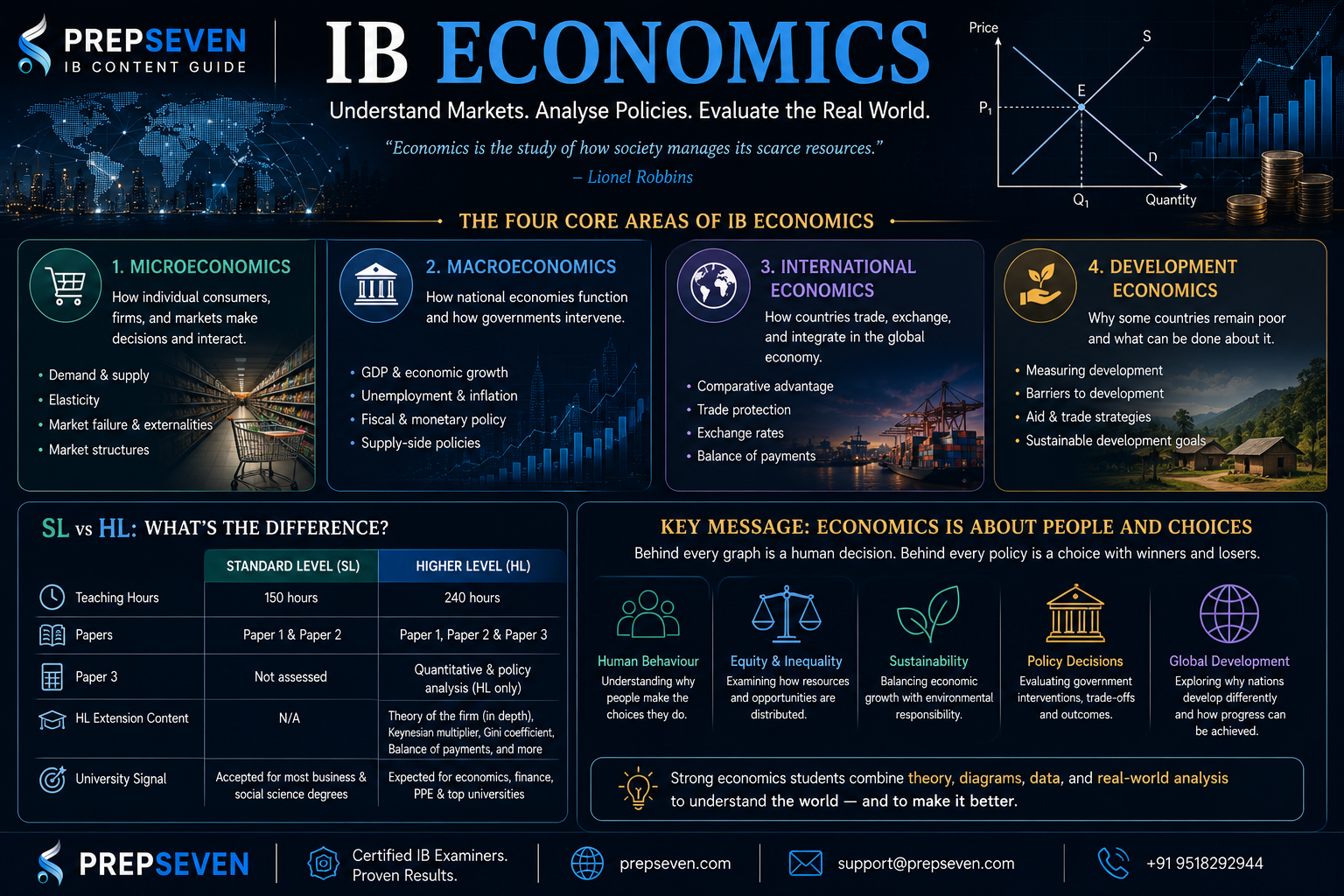
IB Economics is a course about understanding how the world allocates resources, and why that process produces outcomes that are sometimes efficient, sometimes deeply unfair, and almost always contested. It sits in Group 3 of the Diploma Programme alongside History, Geography, and Psychology, and it is available at both Standard Level and Higher Level.
The course is built around four broad areas: microeconomics, which examines how individual consumers, firms, and markets make decisions; macroeconomics, which examines how national economies function and how governments intervene; international economics, which explores trade, exchange rates, and globalisation; and development economics, which asks why some countries remain poor and what can be done about it. Each of these areas is taught through a combination of theory, diagrams, and real-world application.
What makes IB Economics distinctive is its insistence that economic analysis always has a human dimension. The course is not purely technical. Every topic connects to questions about equity, sustainability, and wellbeing that go beyond what a graph can show. Students who engage with that dimension, who treat economics as a way of thinking about the world rather than a set of models to memorise, consistently perform better than those who approach it as pure content recall.
IB Economics is one of the most diagram-heavy subjects in the Diploma Programme. Students who do not invest time in learning to draw, label, and explain diagrams accurately and fluently will struggle in both Paper 1 and Paper 2 regardless of how well they understand the underlying concepts. The diagram is not a decoration. It is a core form of economic communication.
SL vs HL: What Is Actually Different
The difference between Economics SL and HL is more substantial than in some other IB subjects. HL students cover additional content in each of the four sections, but more importantly, they are assessed with a third exam paper that tests quantitative skills and extended analytical thinking at a level that SL students are never required to demonstrate.
If you are targeting an economics, finance, PPE, or business degree at a selective university, Economics HL is worth taking seriously. Many competitive programmes, particularly at UK universities, list Economics HL as a recommended or required subject. The additional content at HL, particularly the theory of the firm and the quantitative skills tested in Paper 3, also gives you a genuine head start in first-year university economics.
One thing students rarely consider when choosing between SL and HL: Paper 3 at HL is a skills paper, not a content paper. It tests your ability to interpret data, perform calculations, and construct policy arguments from stimulus material. These are learnable skills that improve substantially with practice, and they are directly relevant to economics at university level. If you enjoy that kind of analytical problem-solving, HL Economics is genuinely rewarding.
What the Syllabus Covers
The IB Economics syllabus is organised into four sections. All four are examined at both SL and HL, but HL extends the content in each section with additional theory and requires greater depth of analysis.
Development economics is the section that surprises most students. Coming after three largely technical sections, it asks very different kinds of questions: why do some countries remain trapped in poverty despite decades of aid? What role does governance play in economic development? When does trade help developing countries and when does it hurt them? These are not questions with clean model-based answers, and students who have spent two years practising only technical economic analysis often find Section 4 harder than they expected.
A strategic note: the Internal Assessment commentaries each cover one of three different sections of the syllabus: microeconomics, macroeconomics, and either international or development economics. This means you will engage with every major section of the course through the IA process, and the research and real-world engagement that process requires often deepens your understanding of the theory more than classroom instruction alone.
Assessment Breakdown: How You Are Graded
Paper 1: Extended Response Essays
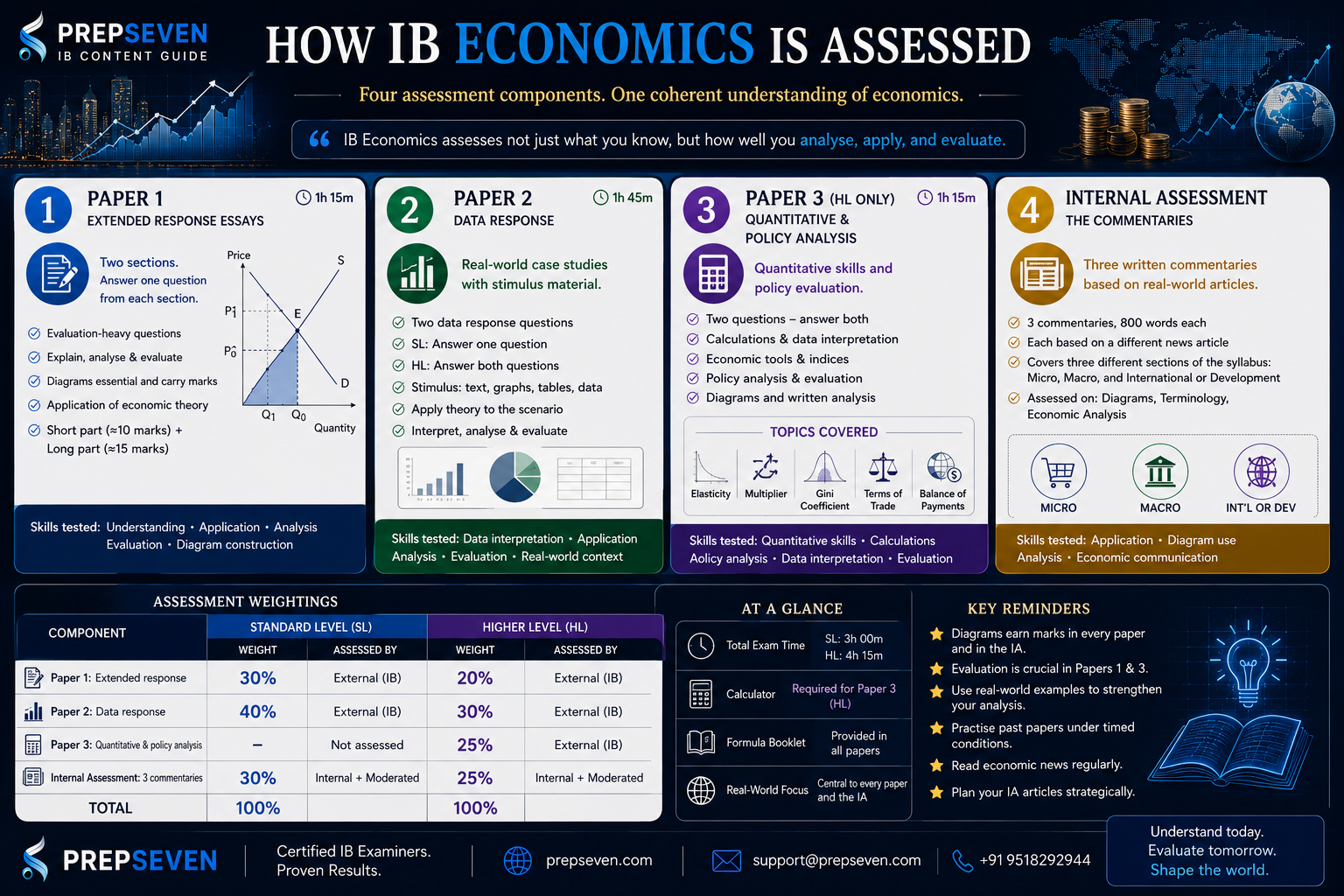
Paper 1 is one hour and fifteen minutes at SL and one hour and fifteen minutes at HL. It contains two sections, each with a choice of questions. You answer one question from each section. Each question has two parts: a shorter part worth around 10 marks that asks you to explain or analyse a concept, and a longer part worth around 15 marks that asks you to evaluate a policy or statement.
The word evaluate is the most important command term in Paper 1. It means you must present arguments on multiple sides, weigh the evidence, and arrive at a supported conclusion. A response that presents only the benefits of a policy, or only the costs, will score in the middle range at best regardless of how technically accurate it is. Evaluation requires intellectual balance, and it requires you to make a final judgement rather than simply summarising both sides without concluding anything.
Diagrams are essential in Paper 1. The IB mark scheme allocates specific marks for correctly drawn and labelled diagrams in most questions. A well-labelled supply and demand diagram showing the effect of a tax, with the deadweight loss triangle shaded and clearly labelled, earns marks that a purely verbal explanation cannot. A poorly drawn diagram, or one that is correct but not explained in the text, earns fewer marks than students expect. The rule is simple: draw the diagram, label it fully, and then explain in words what it shows and why it is relevant to the question.
Paper 2: Data Response
Paper 2 is one hour and forty-five minutes at SL and one hour and forty-five minutes at HL. It presents two data response questions, each built around a real-world case study with stimulus material including text, graphs, tables, and data. You answer one question at SL. At HL you answer both questions.
Paper 2 is where students who have genuinely engaged with current economic events have a meaningful advantage. The case studies are drawn from real situations, and the questions ask you to apply economic theory to what the stimulus material describes. Students who read economic news regularly throughout both years, who have built up a mental library of real-world examples, can connect the theory to the stimulus material more fluently than students whose economic knowledge is confined to the textbook.
A consistent source of lost marks on Paper 2 is answering the question that students wish had been asked rather than the one that was asked. Read the stimulus material carefully. Identify which concepts from the syllabus are directly relevant to what it describes. Answer with reference to the specific scenario, not in general theoretical terms. An answer that could have been written without the stimulus material is not a Paper 2 answer.
Paper 3: HL Quantitative and Policy Analysis
Paper 3 is one hour and fifteen minutes and is taken only by HL students. It contains two questions, each with multiple parts. The questions involve calculations, diagram construction, and policy analysis applied to given data. You answer both questions.
The calculations in Paper 3 cover topics including price elasticity of demand and supply, income elasticity, the multiplier effect, the Gini coefficient, terms of trade, and balance of payments. These calculations are not particularly complex mathematically, but they require precision. A wrong sign, a transposed ratio, or a failure to express an answer in the correct units will cost marks even when the method is correct.
The policy analysis parts of Paper 3 are where HL students who have done thorough Paper 1 preparation have an advantage. They require you to evaluate economic policies using the data provided, drawing on the same skills of multi-sided analysis and justified conclusion that Paper 1 develops. Students who treat Paper 3 as purely a calculation paper and neglect the written analysis sections consistently underperform relative to their content knowledge.
Internal Assessment: The Commentaries
The Internal Assessment for IB Economics consists of three written commentaries, each 800 words maximum, each based on a different real-world news article. The three commentaries must cover three different sections of the syllabus: one microeconomics, one macroeconomics, and one from either international or development economics.
Each commentary is assessed on three criteria: Diagrams, Terminology, and Economic Analysis. The word limit is strict: 800 words, not including diagrams, the source reference, or the word count itself. Students who exceed the word limit are penalised.
The most common IA mistake is choosing an article that is too complex or too broad for 800 words of economic analysis. A news article about the entire global financial system will not produce a focused commentary. A news article about a specific government decision to increase the minimum wage in a named country will. The narrower the economic event described in your article, the more analytical depth you can achieve within the word limit.
Diagrams in the IA are not optional enhancements. They are specifically assessed. Each commentary should contain at least one accurately drawn, fully labelled diagram that is directly relevant to the economic concept being analysed. The diagram must be original work drawn by the student, not copied from the article or a textbook, and it must be explained in the body of the commentary.
Article selection is where most IA marks are won or lost before a word is written. A strong article is recent, covers a specific and identifiable economic event, relates clearly to one section of the IB syllabus, and contains enough economic detail that you can analyse it using theory rather than just describing what happened. Spend real time finding good articles. The quality of your analysis is directly constrained by the quality of your source.
The Diagram Problem: Why So Many Students Drop Marks Here
IB Economics is arguably the most diagram-intensive subject in Group 3. Diagrams are not peripheral illustrations of the theory. They are the primary language through which economists communicate relationships between variables, and the IB mark scheme treats them accordingly.
In Paper 1, most questions will either explicitly ask for a diagram or reward one even when not explicitly requested. In the Internal Assessment, diagrams are a graded criterion. In Paper 2, correctly interpreting and extending diagrams from the stimulus material is often directly tested.
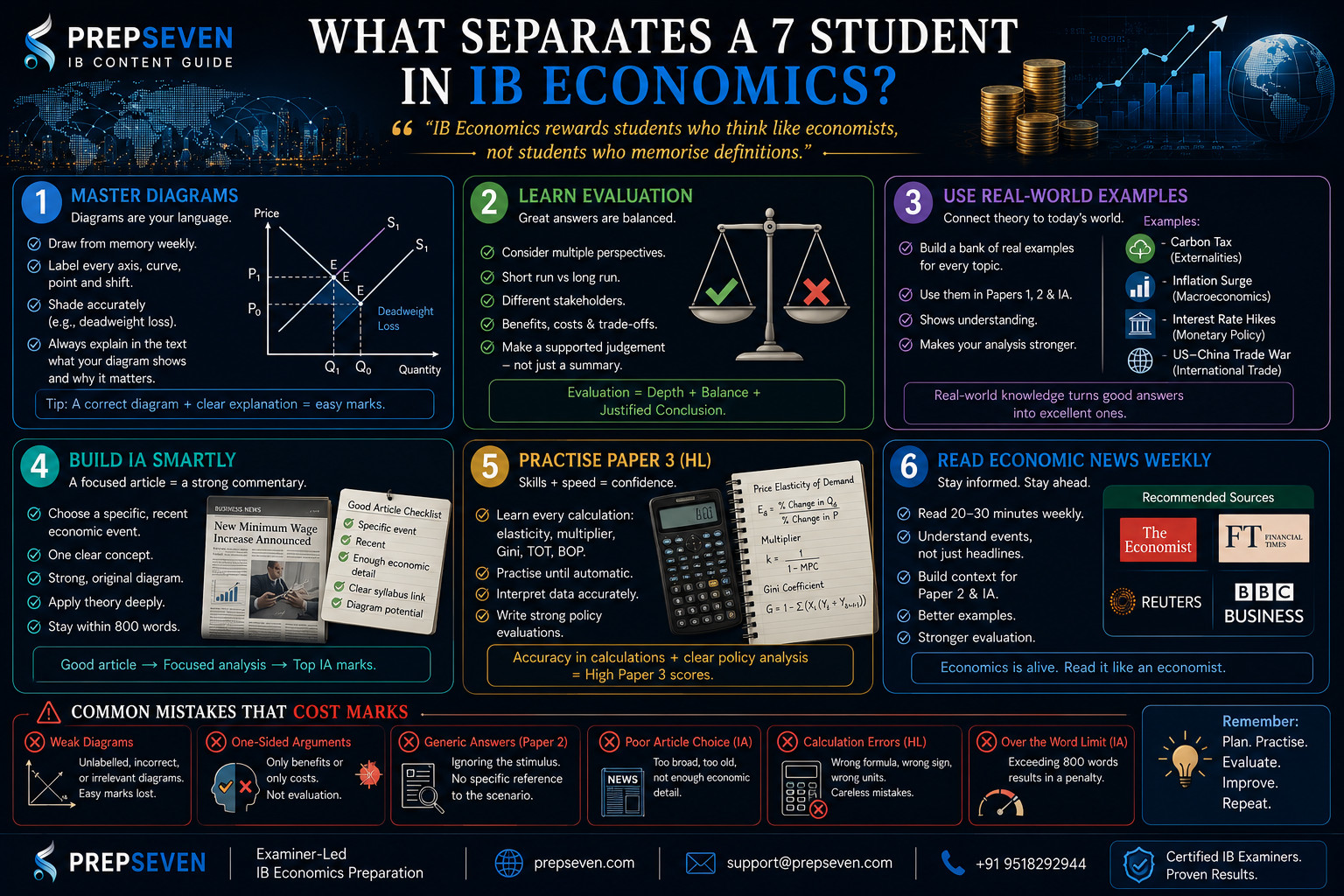
Students lose diagram marks in three consistent ways. The first is drawing an unlabelled or partially labelled diagram: axes without labels, curves without names, equilibrium points without coordinates. Every element of every diagram should be labelled. The second is drawing a correct diagram but not explaining it in the written response: examiners award marks for diagrams that are integrated into the analysis, not diagrams that appear and are never referenced in the text. The third is drawing the wrong diagram for the question: a student who draws a standard supply and demand diagram for a question about a natural monopoly has not earned diagram marks regardless of how well drawn it is.
A practice habit that consistently improves diagram fluency: draw every diagram you encounter in class from memory without looking at notes or the textbook. Then check it. Do this once a week for every topic you have covered. Diagram accuracy under exam pressure requires the kind of automaticity that only comes from repeated practice, not from understanding the theory.
What Actually Gets Students to a 7
They evaluate with genuine intellectual balance
The command term evaluate appears in virtually every high-mark question in IB Economics. Students who have practised only explaining and analysing, but not evaluating, will plateau around the 5 to 6 range. Genuine evaluation requires you to consider the conditions under which a policy works and the conditions under which it does not, the short-run and long-run effects separately, the impact on different stakeholders, and the trade-offs involved. A student who can say not only that a minimum wage increases income for low-paid workers but also that its effect on employment depends critically on the elasticity of demand for labour in that specific market, and who can then weigh those considerations against each other and conclude something specific, is doing evaluation. That is what 7 looks like.
They connect theory to the real world throughout both years
Paper 2 is built around real economic events, and the ability to connect a stimulus article to the relevant theory fluently, without hunting for the connection, is the product of two years of engaged reading rather than a skill you can develop in the final weeks before exams. Students who read a quality economics publication, whether that is The Economist, the Financial Times, or even a good economics blog, for 20 minutes a week throughout both years arrive at Paper 2 with a mental library of examples that makes the data response questions significantly more manageable.
They treat IA article selection as a strategic decision
Most students pick their IA articles based on what they find interesting. Top-scoring students pick articles based on what will allow the strongest economic analysis within 800 words. A good IA article describes a specific, recent economic event that involves one clear economic concept from the syllabus, contains enough detail to analyse rather than just describe, and lends itself to a diagram that adds real analytical value. Finding that article takes time, and students who invest that time before writing a single word of the commentary consistently produce stronger work.
They practise Paper 3 calculations until they are automatic
HL Paper 3 calculations are not conceptually difficult, but they require precision and speed. Students who practise each calculation type, elasticity formulas, multiplier calculations, Gini coefficient interpretation, terms of trade index, until they can execute them quickly and correctly without having to think hard about the method, arrive at Paper 3 with enough time to write strong policy analysis in the later parts of each question. Students who are still working out which formula to use during the exam run out of time.
They develop a standard essay structure and refine it through practice
Paper 1 rewards students who can construct a well-organised evaluative essay quickly. The most efficient approach is a structure that the student has internalised and can deploy across any question: a brief introduction that defines key terms and outlines the argument, paragraphs that each develop one point using theory, a diagram, and a real-world example, and a conclusion that genuinely evaluates and reaches a justified position. Students who have practised this structure across many different question types can produce a strong Paper 1 essay in the allocated time. Students who are still deciding how to organise their essay while the clock is running cannot.
Common Mistakes That Cost Marks
A Realistic Year-by-Year Approach
Year 1 (Grade 11): Build Foundations and Develop Diagram Fluency
- Practise drawing and labelling every new diagram introduced in class from memory within 24 hours of first encountering it. Do not let diagram fluency accumulate as a debt.
- Start reading economic news regularly from the first month of Year 1. The Economist, BBC Business, Financial Times, and Al Jazeera Economics are all accessible sources for IB-relevant events.
- For each IA commentary, give yourself at least two weeks to find an appropriate article before you begin writing. The research phase is where the commentary is won or lost.
- Begin building a real-world examples bank for each syllabus section. When you encounter a real case that illustrates a theory, write a brief note of it. These examples will feed directly into Paper 1 and Paper 2.
Year 2 (Grade 12): Consolidate, Practise, and Develop Evaluation Skills
- Complete at least five full past paper sets under timed conditions before your mock exams, covering Papers 1 and 2 at minimum. For HL students, include Paper 3 practice from the start of Year 2.
- Practise writing complete Paper 1 evaluate responses under timed conditions. The ability to produce a balanced, well-structured evaluative essay in the allocated time is a skill that needs volume of practice to develop.
- Complete all three IA commentaries and submit them for teacher feedback before the end of Term 1. Use the feedback on your first commentary to improve the second and third.
- In the final revision period, focus especially on the HL extension content if you are an HL student: the theory of the firm, the Keynesian multiplier, the Gini coefficient, and the balance of payments analysis are consistently tested and consistently neglected in revision.
How PrepSeven Helps You Score Higher in IB Economics
IB Economics requires two things that are hard to develop alone: the ability to construct a balanced evaluative argument under time pressure, and the diagram fluency that the mark scheme rewards throughout. Our Economics tutors are certified IB examiners who have marked Papers 1, 2, and 3. They know exactly what a 7-band response looks like and exactly what separates it from a 5.
Here is what working with a PrepSeven Economics tutor typically looks like:
- Paper 1 essay sessions where you write a timed response and your tutor marks it against the IB criteria, annotating every paragraph for evaluation quality, diagram accuracy, use of real-world examples, and command term compliance.
- Paper 2 data response sessions where your tutor teaches you to read stimulus material strategically, identify the relevant theory quickly, and apply it specifically to the scenario rather than writing generic explanations.
- Paper 3 sessions for HL students covering each calculation type with worked examples, followed by timed practice until execution is automatic and accurate.
- IA mentorship covering article selection, structure planning, diagram construction, and commentary writing, with feedback on each draft against the three IA criteria.
Book your free demo lesson at prepseven.com and work through an IB Economics evaluation question with one of our examiners. You will see exactly where your argument needs to develop.