
PrepSeven | IB Content Guide authored by Shankar Mutneja (Founder of Prepseven)
IB Business Management
What Is IB Business Management?
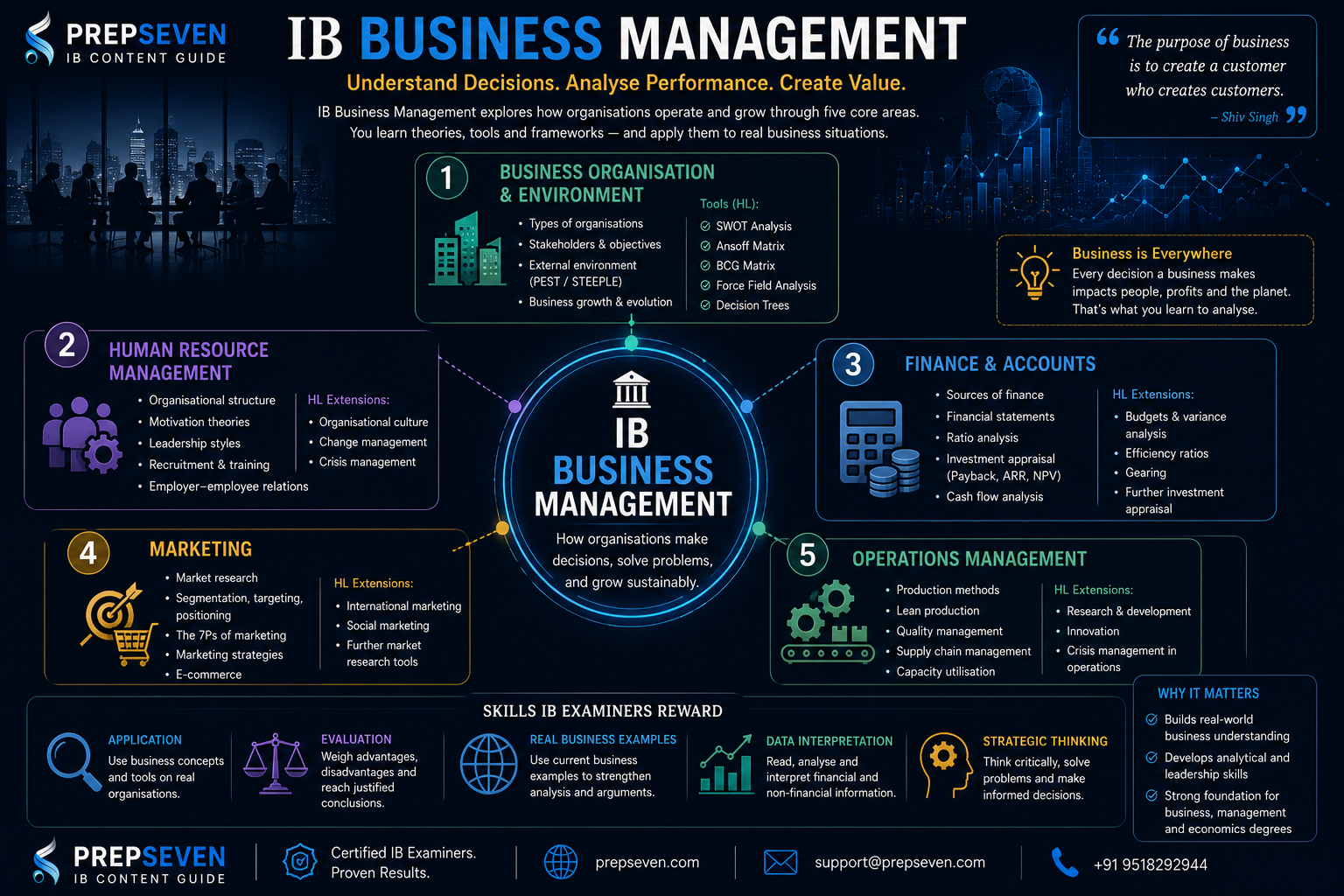
IB Business Management is a course about how organisations make decisions, and why those decisions produce outcomes that are sometimes brilliant and sometimes catastrophic. It asks you to look at real businesses, real strategies, and real failures and understand them using a structured set of analytical tools. The course sits in Group 3 of the Diploma Programme and is available at both Standard Level and Higher Level.
The syllabus covers five broad areas: business organisation and environment, human resource management, finance and accounts, marketing, and operations management. Each area introduces theories, tools, and frameworks that practising managers and consultants actually use, from Maslow’s hierarchy of needs in HR to contribution analysis in finance to the marketing mix in sales strategy. The IB does not teach these as abstract concepts to be memorised. It teaches them as lenses through which to analyse specific business situations.
What makes the course genuinely interesting, and genuinely demanding, is its insistence on application over recall. A student who can define the term market segmentation but cannot apply it to explain why a specific company targets a specific demographic, or why a different company’s segmentation strategy failed, has not met the standard the IB is looking for. Every concept in Business Management exists to be used on real organisations, and the exam rewards students who use them precisely rather than those who define them accurately.
IB Business Management is not a course that rewards passive learning. The students who do best are those who develop a habit of looking at real business news, real company decisions, and real market events through the analytical frameworks the course provides. A news story about a company’s pricing strategy, a supply chain disruption, or a rebranding campaign is not just news. For a Business Management student, it is an exam question waiting to be written.
SL vs HL: What the Difference Really Means
The difference between Business Management SL and HL is more significant than many students realise before they commit to the course. HL students cover additional content in several units and face a more complex assessment structure. But the most important difference is not content volume. It is the depth of analysis expected in the exam.
The HL Internal Assessment is particularly worth understanding before you commit to the level. At SL, the IA is a written commentary based on three to five documents you have collected about a real organisation. At HL, it is a full research project with a stated research question, primary and secondary research, and a structured report. The HL IA requires initiative, independent research, and a level of sustained analytical writing that is closer to undergraduate coursework than most IB assessments. If this sounds appealing rather than daunting, HL Business Management is the right choice.
If you are planning to study business, management, economics, or a related discipline at university, Business Management HL is worth taking seriously. The analytical depth it develops, particularly in finance, operations, and strategic management, gives you a genuine head start in first-year business programmes. Many students who take it at SL and go on to study business at university wish they had done it at HL.
What the Syllabus Covers
The Business Management syllabus is organised into five units. All five are examined at both SL and HL, but HL extends the content within several units and adds topics that SL students do not cover.
Finance and Accounts is the unit that most surprises students who arrive expecting Business Management to be mostly qualitative. The finance unit requires genuine numerical competence: reading and constructing financial statements, calculating and interpreting ratios, performing investment appraisal calculations, and understanding what the numbers tell you about a business’s health. Students who are uncomfortable with numbers need to address this early. The finance unit cannot be avoided, and it appears consistently in both Paper 1 and Paper 2.
The most underestimated unit in the course is Operations Management. Many students treat it as a content-light section and revise it superficially. In practice, operations concepts including lean production, just-in-time inventory management, quality assurance versus quality control, and capacity utilisation appear regularly in both papers and in Paper 1 case studies. A student who has prepared Unit 5 thoroughly often gains marks that other students leave on the table.
Assessment Breakdown: How You Are Graded
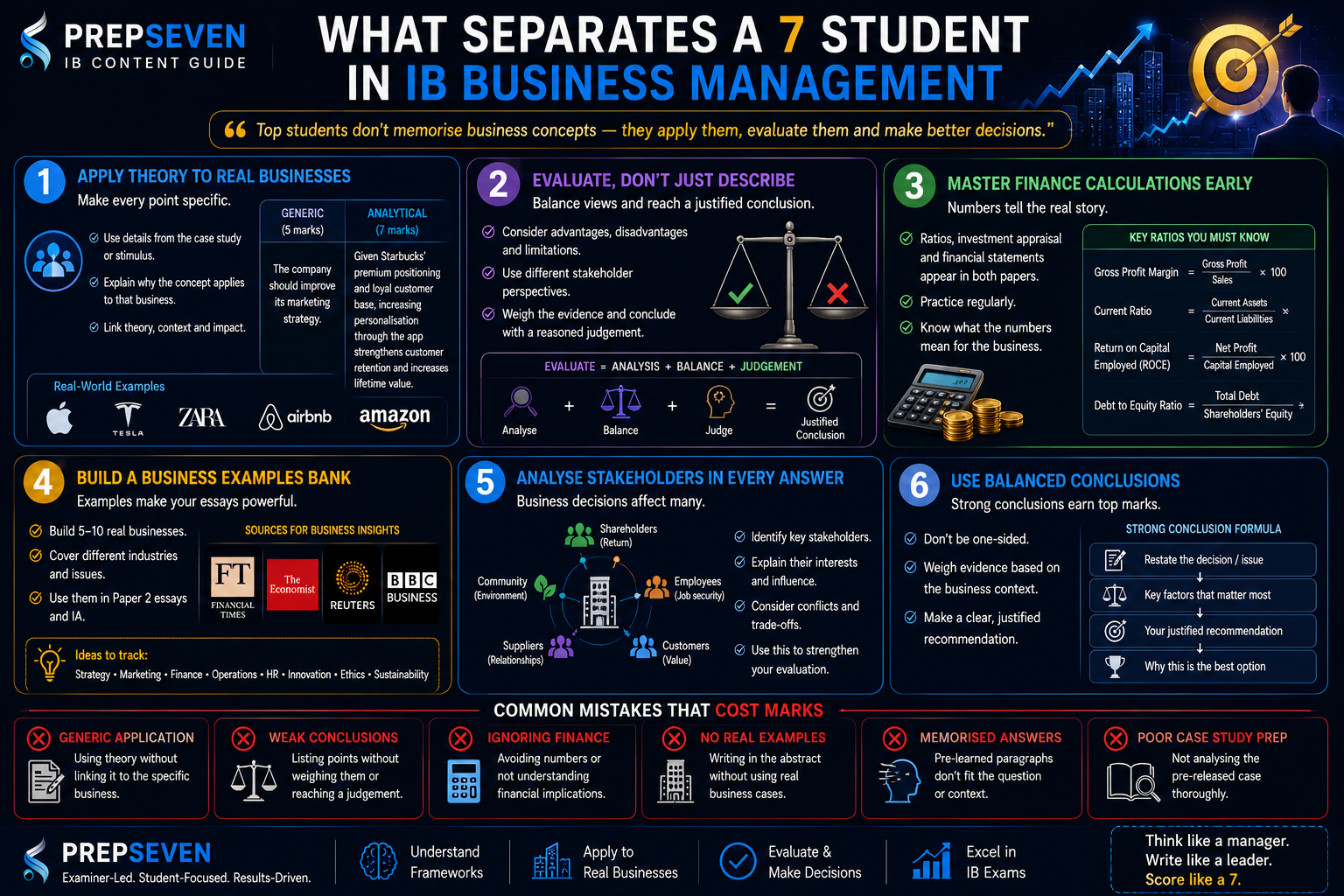
Paper 1: The Pre-Released Case Study
Paper 1 is based on a case study about a real or fictional organisation that is released to students and teachers several weeks before the exam. This is unusual in the IB: you know the organisation, the context, and the key business issues before you sit the paper. What you do not know are the specific questions.
The pre-release case study is typically 500 to 800 words and describes a business facing one or more significant challenges: a strategic decision, a financial difficulty, a human resource issue, a marketing problem, or some combination. Your job in the weeks before the exam is to understand that business thoroughly enough that you can apply any relevant Business Management concept to it quickly and accurately under exam conditions.
Paper 1 has structured questions worth smaller marks and extended response questions worth larger marks. The extended response questions at both SL and HL ask you to evaluate or discuss a business decision in relation to the case study. These questions are where the gap between a 5 and a 7 is made. A response that identifies relevant concepts, applies them specifically to the case study organisation rather than in general terms, considers multiple stakeholder perspectives, and arrives at a justified conclusion will score in the top band. A response that defines concepts and describes the case study without genuinely connecting them will not.
A preparation mistake that costs many students marks on Paper 1: they over-prepare by trying to memorise analysis of every possible topic in relation to the case study. The more effective approach is to understand the case study organisation deeply enough that you can apply any concept to it flexibly. Know the organisation’s stakeholders, its financial position, its market, its key challenges, and its strategic options. The questions will tell you which concepts to apply. Your job is to apply them specifically to that organisation.
Paper 2: Stimulus-Based Questions and Essays
Paper 2 presents two sections. Section A contains shorter structured questions based on stimulus material, typically short texts, data, or scenarios about businesses that students have not seen before. Section B contains essay questions where you choose one from a set of options and write an extended evaluative response.
The Section B essay is where the highest marks in Paper 2 are available and where performance varies most widely. The essay questions ask you to evaluate a business concept, strategy, or decision in a broad context. You are expected to define and apply relevant theory, consider different perspectives and contexts, discuss limitations and counterarguments, and conclude with a justified position.
A critical skill for Paper 2 essays that many students lack: the ability to use real business examples independently, not just the case study from Paper 1. Students who have built a bank of real company examples throughout the two years, businesses whose strategies, failures, marketing decisions, or HR practices they understand well enough to analyse, can deploy those examples in their essays to demonstrate genuine understanding. A student who can write about why Apple’s premium pricing strategy is sustainable given its brand positioning and ecosystem lock-in, or why Volkswagen’s Dieselgate crisis represents a failure of both ethical leadership and crisis management, is demonstrating exactly the kind of real-world engagement the IB rewards.
Internal Assessment: SL Written Commentary and HL Research Project
The Internal Assessment differs substantially between SL and HL, and understanding that difference before the course starts is important.
At SL, the IA is a written commentary of up to 1,500 words based on three to five supporting documents you have gathered about a real organisation. You identify a business issue facing that organisation and apply Business Management concepts to analyse and make a recommendation. The format is structured but the content is your own analysis. The word limit is strict.
At HL, the IA is a research project of up to 2,000 words. You formulate a research question about a real organisation, conduct both primary and secondary research to investigate it, apply relevant Business Management tools and concepts, and make a justified recommendation. The primary research requirement, typically an interview or survey with someone connected to the organisation, is what distinguishes the HL IA most clearly from the SL version.
In both cases, the most common reason for losing marks on the IA is weak application of theory. Students describe their chosen organisation clearly and gather good evidence, but their Business Management analysis is superficial: they name concepts without using them analytically. The IA criterion for analysis and application is specifically designed to reward students who do more than describe. Use the tools the course has given you to genuinely investigate the business issue you have chosen.
Organisation selection for the IA matters more than most students realise. The ideal IA organisation is one you can access directly for primary research, one facing a genuine and identifiable business problem that Business Management tools can illuminate, and one with enough publicly available information to support secondary research. Choosing a vast multinational because it seems impressive often produces weaker IAs than choosing a local business you can actually visit and interview.
The Pre-Released Case Study: How to Prepare Properly
The pre-released case study is the feature of IB Business Management that most distinguishes it from other subjects, and the way students prepare for it determines much of their Paper 1 performance. Knowing the case study organisation is not the same as being prepared for Paper 1. The exam tests your ability to apply Business Management tools to that organisation under time pressure, not your ability to describe it.
An effective case study preparation approach works through the organisation systematically using the five syllabus units. For Unit 1: what type of organisation is this? Who are its stakeholders and what are their interests? What are the key external factors affecting it? What is its strategic position? For Unit 2: what does its organisational structure look like? What motivation and leadership issues does it face? For Unit 3: what is its financial position? Are there liquidity or profitability concerns? What investment decisions is it facing? For Unit 4: how does it market itself? What is its target market? For Unit 5: what production or operational challenges does it face?
Working through all five lenses produces a comprehensive analytical picture of the case study organisation that can be applied to almost any question the exam might ask. Students who have done this work thoroughly feel a moment of recognition when they see the exam questions. Students who have only read the case study without applying frameworks to it feel a moment of panic.
One preparation technique that consistently produces strong Paper 1 results: write your own practice questions about the case study organisation and answer them under timed conditions two to three weeks before the exam. Ask your teacher or tutor to mark them against the IB criteria. The process of generating your own questions deepens your understanding of both the case study and the syllabus far more than passive revision does.
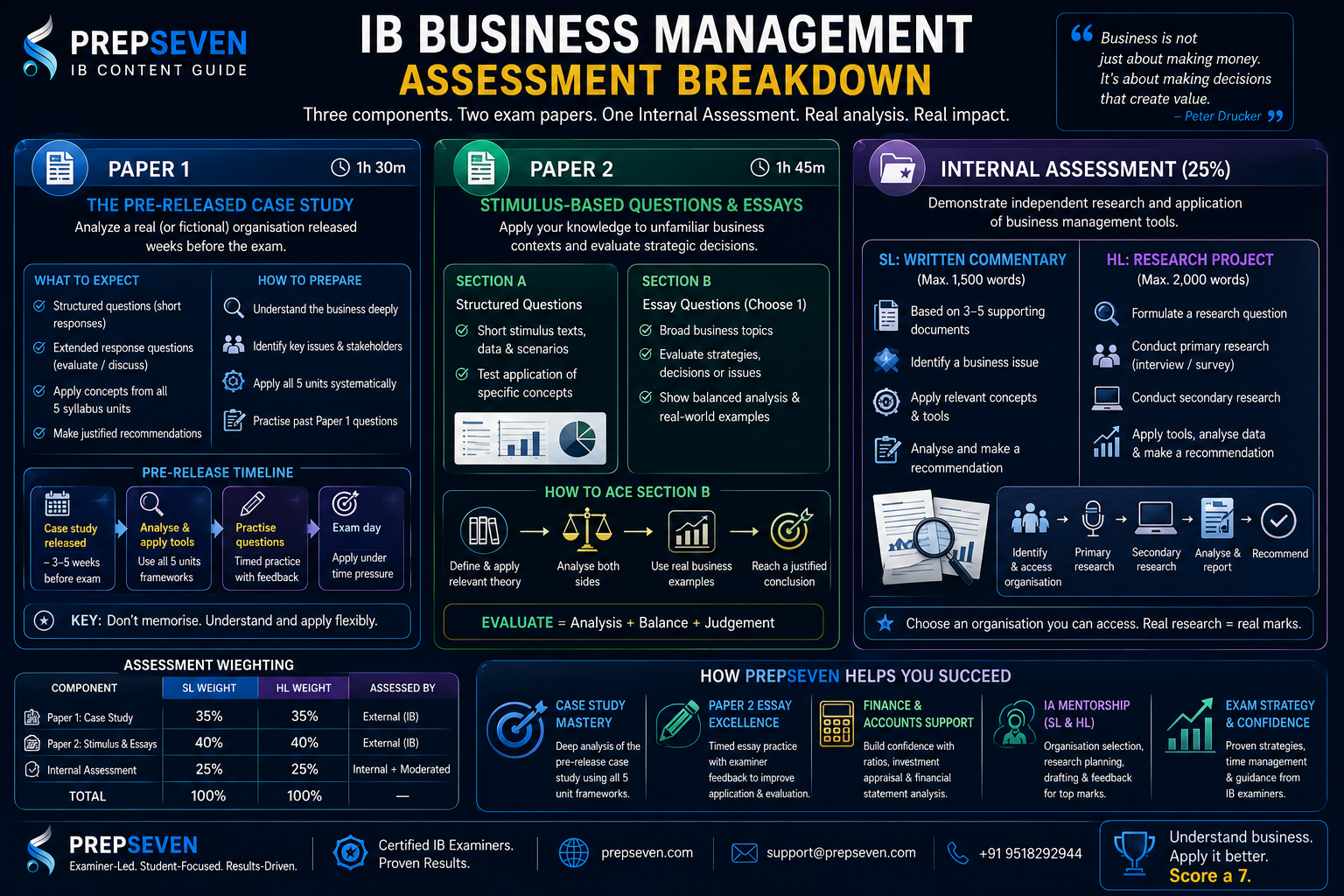
What Actually Gets Students to a 7
They apply theory to specific organisations, not in general
The most consistent mark-losing pattern in Business Management is generic application. A student who writes that the company should use market segmentation to target different customer groups has named a concept. A student who writes that given the case study organisation’s limited marketing budget and its position in a fragmented market, a concentrated segmentation strategy targeting the 25 to 40 urban professional demographic would produce the highest return on marketing investment because that segment shows the highest willingness to pay for the features the company already offers, has applied the concept. The second answer earns the marks. Practise the habit of making every theoretical point specific to the organisation in front of you.
They evaluate with genuine balance and reach a conclusion
IB Business Management essays ask students to evaluate. Many students interpret this as listing the advantages and disadvantages of a strategy and stopping there. Genuine evaluation weighs those advantages and disadvantages against each other given the specific context of the business, considers the conditions under which the strategy works and the conditions under which it fails, and arrives at a justified conclusion. The conclusion is not a summary of what you have said. It is a position that your preceding argument has earned the right to state. Students who produce balanced analysis without concluding anything are leaving marks on the table.
They build a real business example bank throughout both years
Paper 2 Section B essays benefit enormously from the ability to deploy real business examples independently of the case study. Students who have built a personal bank of five to ten well-understood real businesses throughout the two years, companies whose strategies, crises, innovations, or HR decisions they can discuss analytically, arrive at Paper 2 with a resource that passive revision cannot provide. The examples do not need to be famous. A small local business whose marketing strategy you understand deeply is more useful than a vague recollection of something you read once about Amazon.
They take finance seriously from day one
Students who arrive in Business Management expecting it to be mostly essays and case study discussion are often unprepared for the finance unit. Ratio calculations, investment appraisal, financial statement analysis, and variance analysis all require genuine numerical competence and regular practice. The finance content appears in both papers and in the IA, and students who have deferred engaging with it until close to the exam consistently find it the most stressful part of their revision. Start practising finance calculations from the first lesson in which they appear.
They prepare the IA organisation carefully before starting to write
The IA marks are largely determined by choices made before a word is written: the organisation selected, the research question formulated, and the tools identified as relevant. Students who invest time upfront in finding an organisation with a genuine, analysable business problem, formulating a focused and testable research question, and identifying the specific Business Management frameworks that apply, produce IAs that score in the top band. Students who choose an organisation because it is convenient and then try to find a question to fit it often produce work that is descriptive rather than analytical.
Common Mistakes That Cost Marks
A Realistic Year-by-Year Approach
Year 1 (Grade 11): Build Foundations and Start Your Business Awareness
- Engage with every unit as it is taught and start practising application immediately. Business Management rewards students who can use concepts, not those who can define them. Apply each new tool to a real organisation as soon as you learn it.
- Start reading business news regularly from the first month of Year 1. The Financial Times, The Economist, BBC Business, or even a good business podcast will build the real-world awareness that Paper 2 rewards. Twenty minutes a week is enough to make a material difference over two years.
- For the SL IA, begin identifying potential organisations and business issues in Term 2 of Year 1. For the HL IA, begin even earlier: the research project requires more lead time and the primary research element needs planning.
- Build a personal business example bank from the start. Every time you encounter a real company case in class or in the news, write a brief analytical note: what business concept does this illustrate, and why?
Year 2 (Grade 12): Deepen Analysis and Prepare to Perform
- When the Paper 1 pre-release case study is released, work through it systematically using all five unit frameworks. Do not just read it. Analyse it.
- Write at least three full practice Paper 1 and Paper 2 responses under timed conditions before your mock exams. Ask your teacher or tutor to mark them against the IB criteria and use the feedback to understand exactly where your analysis needs to develop.
- Complete your IA and submit the first draft for teacher feedback before the end of Term 1. The revision cycle is where IA marks are made.
- In the final revision period, prioritise the units where your past paper performance is weakest. For most students, that means finance and accounts and operations management. Both are calculation and application heavy and both reward targeted practice more than general revision.
How PrepSeven Helps You Score Higher in IB Business Management
The gap between a 5 and a 7 in Business Management is almost always about application quality rather than content knowledge. Our tutors are certified IB examiners who have marked student work in this subject and understand exactly what the IB is looking for when it says evaluate or discuss in an extended response question.
Here is what working with a PrepSeven Business Management tutor typically looks like:
- Paper 1 preparation sessions where your tutor works through the pre-release case study with you systematically, applying all five unit frameworks and then testing your application through practice questions marked against the IB criteria.
- Paper 2 essay sessions where you write a timed response and your tutor annotates it in detail, identifying where your application is generic and showing you how to make it specific, where your evaluation stops short of a conclusion, and where real business examples would strengthen your argument.
- Finance and accounts sessions for students who need to build confidence with the numerical elements of the course, covering ratio analysis, investment appraisal, and financial statement interpretation with worked examples and timed practice.
- IA mentorship for both SL and HL students, covering organisation selection, research question formulation, tool identification, and draft revision, with feedback against the IB assessment criteria.
Book your free demo lesson at prepseven.com and bring a past Paper 2 essay question. Your tutor will work through it with you and show you exactly what a 7-band response looks like compared to where you are now.
Frequently Asked Questions
PrepSeven | Certified IB Examiners | prepseven.com | support@prepseven.com | +91 9518292944
This guide is produced by PrepSeven for educational purposes. All IB assessment information is based on publicly available IB documentation and is subject to change. Always verify current assessment details with your school’s IB coordinator.