PrepSeven | Online IB Primary Years Programme Tutoring authored by Shankar Mutneja (Founder of Prepseven)
What Is the IB Primary Years Programme?
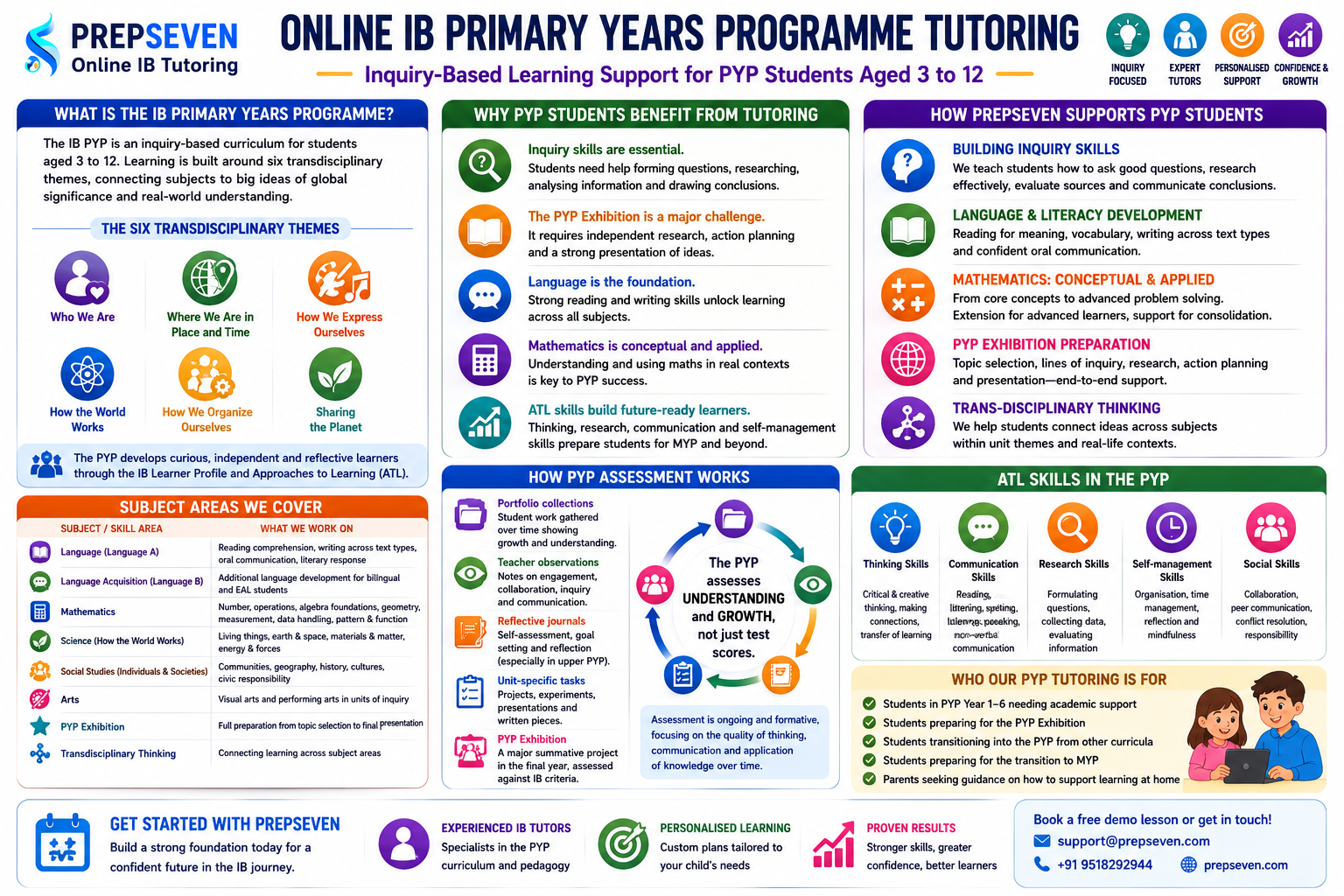
The IB Primary Years Programme (PYP) is an inquiry-based curriculum designed for children aged 3 to 12. Unlike most primary education models, it does not organise learning around separate standalone subjects taught in isolation. Instead, it uses six transdisciplinary themes, big ideas of global significance, as the framework within which language, mathematics, science, social studies, arts, and personal development all connect.
The themes are Who We Are, Where We Are in Place and Time, How We Express Ourselves, How the World Works, How We Organize Ourselves, and Sharing the Planet. Within each theme, teachers design units of inquiry that bring multiple subject areas together around a central concept. A unit on How the World Works might integrate science content about ecosystems with mathematical data collection and language skills for research writing, all in the context of a single overarching inquiry question.
The PYP is explicitly designed to develop curious, independent, reflective learners. The IB Learner Profile, with its ten attributes including inquirer, thinker, communicator, and risk-taker, is central to how learning is designed and assessed throughout the programme.
Why PYP Students Benefit from Tutoring
There is sometimes a misconception that because the PYP does not have external exams, students do not need structured support outside of school. In practice, PYP learning places considerable demands on children that can be easy to miss if you are only looking for traditional marks or test scores.
- The inquiry process requires students to pose questions, research independently, process information critically, and draw conclusions. Children who have not developed these habits early often find the programme frustrating rather than engaging.
- The PYP Exhibition, the culminating project in the final year of PYP, requires students to identify a real-world problem, conduct sustained research, develop an action plan, and present their findings to the school community. For many students, this is the first time they have been asked to lead their own learning project at this scale, and the support structures at school vary considerably.
- Language development is foundational to success across the whole PYP. Students who struggle with reading comprehension or written expression in their Language A will find it harder to access every other subject area, because communication is woven into all PYP assessment.
- Mathematical understanding in the PYP is conceptual and applied, not rote. Students are expected to use mathematics to make sense of real contexts, which is a very different demand from memorising procedures.
- Transition to MYP is smoother for students who have genuinely developed ATL skills during PYP. Research, thinking, and self-management skills developed in the PYP directly support MYP performance.
How PrepSeven Supports PYP Students
PYP tutoring at PrepSeven is not about drilling children for tests that do not exist. It is about building the skills and habits of mind that the programme is designed to develop, so that students can genuinely access and enjoy inquiry-based learning rather than finding it overwhelming or aimless.
Building Inquiry Skills
We work with PYP students on the fundamentals of inquiry: how to form a good question, how to identify reliable sources, how to compare different pieces of evidence, and how to draw and communicate conclusions. These skills are not taught explicitly enough in some school contexts, and children who develop them early are significantly more confident and capable across all subject areas.
Language and Literacy Development
Strong reading comprehension and writing skills are the backbone of PYP success. Our tutors work with students on developing vocabulary, reading for meaning beyond literal content, and constructing written responses that communicate ideas clearly and at an appropriate level. This is especially important for students in bilingual or multilingual PYP environments where language demands are particularly complex.
Mathematics: Conceptual and Applied
PYP mathematics is about understanding, not memorisation. We work through number, operations, geometry, measurement, data handling, and pattern recognition in a way that connects mathematical ideas to real contexts. For students who are ahead of their grade level, we extend into pre-algebra concepts that begin to appear in MYP Year 1. For students who need consolidation, we go back to foundational concepts and build from there.
PYP Exhibition Preparation
The Exhibition is one of the most distinctive features of the PYP and one of the most significant assessments any student will face before the MYP. We support students through every phase of the Exhibition process: choosing a topic that is genuinely interesting and investigable, developing lines of inquiry that connect to the chosen transdisciplinary theme, building a research process that is systematic and well-documented, and preparing a presentation that communicates the work clearly and confidently.
Subject Areas We Cover in the PYP
The PYP Assessment Model: What Parents Should Know
Because the PYP does not use traditional exams or standardised tests, parents can find it difficult to gauge how their child is actually performing. Assessment in the PYP is ongoing, portfolio-based, and primarily formative. Teachers observe students during activities, review their work in process journals and portfolios, use rubrics and checklists against specific skills, and provide reflective feedback.
What this means in practice is that a student’s progress in the PYP is visible through the quality of their thinking and communication over time, not through test scores. Tutoring supports that progress by building the underlying skills that show up consistently across all these assessment forms.
ATL Skills in the PYP
The PYP’s Approaches to Learning framework covers five skill categories: Thinking, Communication, Research, Self-management, and Social skills. These are explicitly developed alongside subject content and are foundational to success not just in the PYP but throughout the MYP and DP.
We deliberately incorporate ATL skill development into every PrepSeven PYP session. When we work through a research task with a student, we are also building research skills. When we review a written piece, we are building communication skills. Students who leave PYP with strong ATL habits are considerably better placed for MYP success.
Get Started with PrepSeven
The PYP sets the foundation for everything that follows in the IB. Students who finish it with strong inquiry habits, solid language and mathematical skills, and a genuine sense of agency in their own learning are much better prepared for MYP and DP challenges. PrepSeven’s PYP tutoring is designed with that longer arc in mind.
Book a free demo lesson or get in touch at support@prepseven.com to talk about what your child needs at their particular year level and how we can help.