
PrepSeven | IB Content Guide authored by Shankar Mutneja (Founder of Prepseven)
IB Sports, Exercise and Health Science
The Complete Guide for IB DP Students and Parents
What Is IB Sports, Exercise and Health Science?
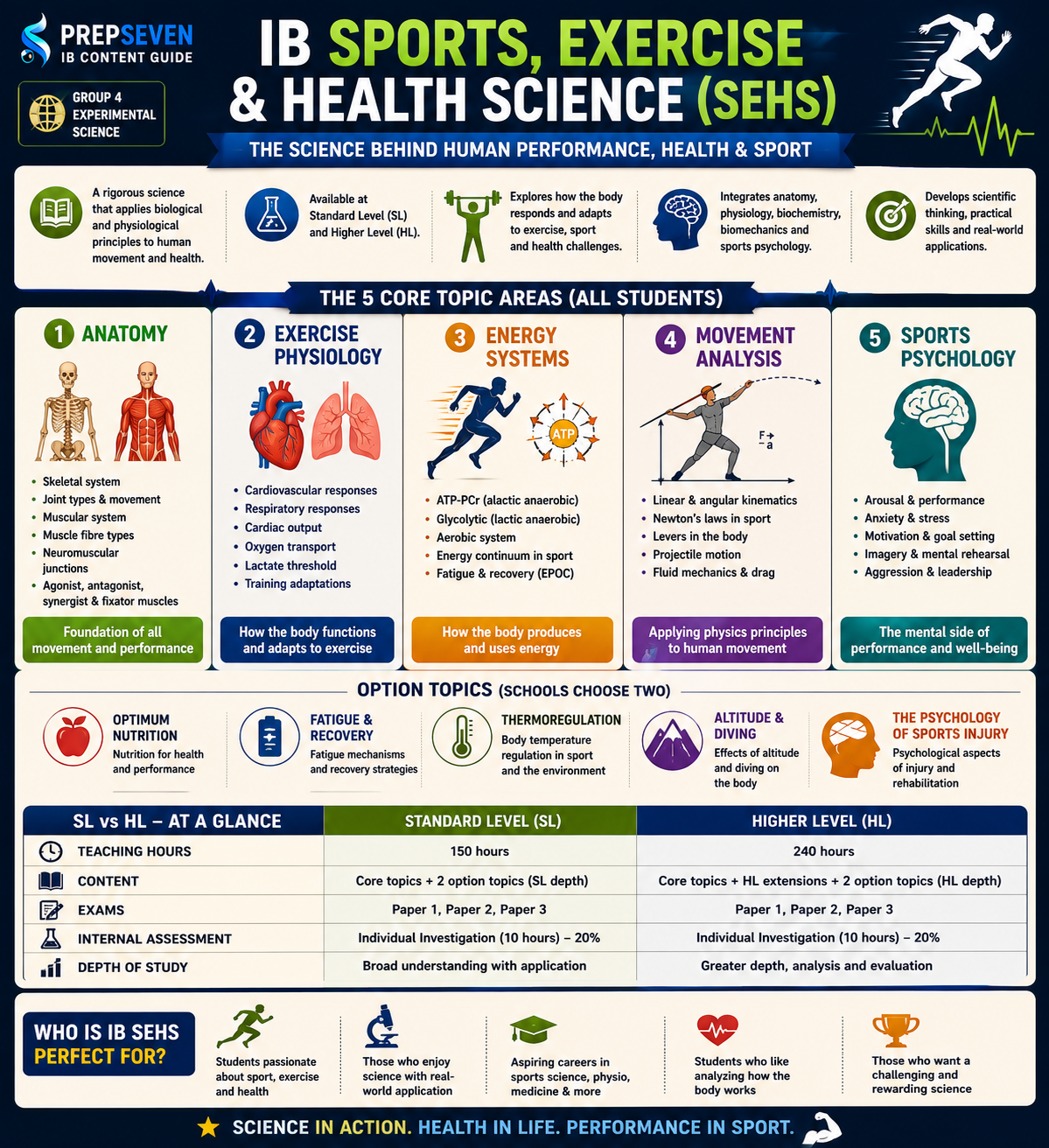
IB Sports, Exercise and Health Science, universally referred to as IB SEHS, is the Diploma Programme’s Group 4 science subject that applies biological and physiological principles to the study of human movement, athletic performance, and health. It is available at Standard Level and Higher Level and sits alongside Biology, Chemistry, Physics, and Environmental Systems and Societies as one of the experimental sciences options. SEHS is a rigorous scientific course, not a physical education elective. It demands the same analytical thinking, data interpretation, and scientific methodology as any other Group 4 subject, applied specifically to the human body in motion and in health contexts.
The course covers five core topic areas: anatomy, exercise physiology, energy systems, movement analysis, and sports psychology, alongside a range of option topics that schools select from. At HL, students cover these topics in greater depth and breadth, with additional content extending the core material in each area. The unifying question running through the course is how does the human body respond and adapt to the demands of exercise, sport, and health challenges, and understanding that question requires integrating knowledge from anatomy, physiology, biochemistry, psychology, and biomechanics simultaneously.
What makes SEHS distinctive among Group 4 choices is its direct applicability to human experience. Every topic connects to something students can observe, measure, or experience in their own bodies: the cardiovascular response to a sprint, the muscle soreness following unfamiliar exercise, the psychological demands of competition, the mechanics of a jump or a throw. This immediacy makes the content more accessible than some other Group 4 options, but it also creates a specific challenge: students sometimes assume that familiarity with sport or fitness translates into scientific understanding of it. The course requires genuine scientific engagement, not just sports knowledge, and the exams consistently test whether students can apply the underlying science rather than recall sporting contexts.
Students sometimes choose IB SEHS because they enjoy sport and assume the course will be easier than Biology or Chemistry. This is a mistake. SEHS has significant biological and physiological content that is as demanding as comparable sections of Biology, and the internal assessment requires genuine experimental design and data analysis skills equivalent to any other Group 4 IA. The students who do best in SEHS are those who bring both genuine interest in sport and health science and the willingness to engage seriously with the scientific content at the depth the course requires.
SL vs HL: What the Difference Really Involves
SEHS is available at SL and HL with the same structural difference as other Group 4 subjects: HL students cover more content, sit a third exam paper, and are expected to engage with the material at greater depth and complexity. Both levels complete the same internal assessment and cover the same core topics, with HL adding the HL-only extension content within each topic and sitting Paper 3, which covers the option topics.
The HL choice is appropriate for students who are considering sport science, physiotherapy, medicine, exercise physiology, or related fields at university, where the additional depth and breadth of HL content provides direct preparation for degree-level study. Students who want a Group 4 science that connects to their sporting or health interests without the full HL commitment often find SL entirely appropriate, and a strong SL SEHS result combined with HL Biology or Chemistry is a competitive profile for health science university applications.
If you are considering medicine, physiotherapy, sports medicine, or exercise physiology at university, check whether your target institutions and programmes have specific Group 4 requirements or preferences before choosing between SEHS and Biology or Chemistry. Some medical school programmes specify Biology as a requirement. SEHS is increasingly recognised as a rigorous and relevant alternative, but it is worth verifying the specific admissions requirements of your target programmes before making your Group 4 choice.
Syllabus Structure: What You Actually Study
The SEHS syllabus is organised into five core topics that all students cover, a set of option topics from which schools select two, and HL-only extension content within each core topic. The five core topics build on each other progressively: understanding anatomy underpins understanding of exercise physiology, which connects to energy systems, which connects to movement analysis, and sports psychology provides the behavioural dimension that sits alongside all of these. Students who see the connections between topics rather than treating them as separate units are better equipped for the extended response questions in Paper 2 that routinely require integration across topic areas.
The option topics are selected by the school and covered in the final part of the course. The available options include optimum nutrition, fatigue and recovery, thermoregulation, altitude and diving, and the psychology of sports injury. Schools typically choose two options that their teacher has expertise in and that connect to the sporting and health contexts their students are most familiar with. Paper 3 is based on these two options, and students who have studied the options in genuine depth rather than surface coverage are in a significantly stronger position on Paper 3 than those who have treated the options as background material.
Assessment Breakdown: Every Component Explained
Paper 1: Multiple Choice
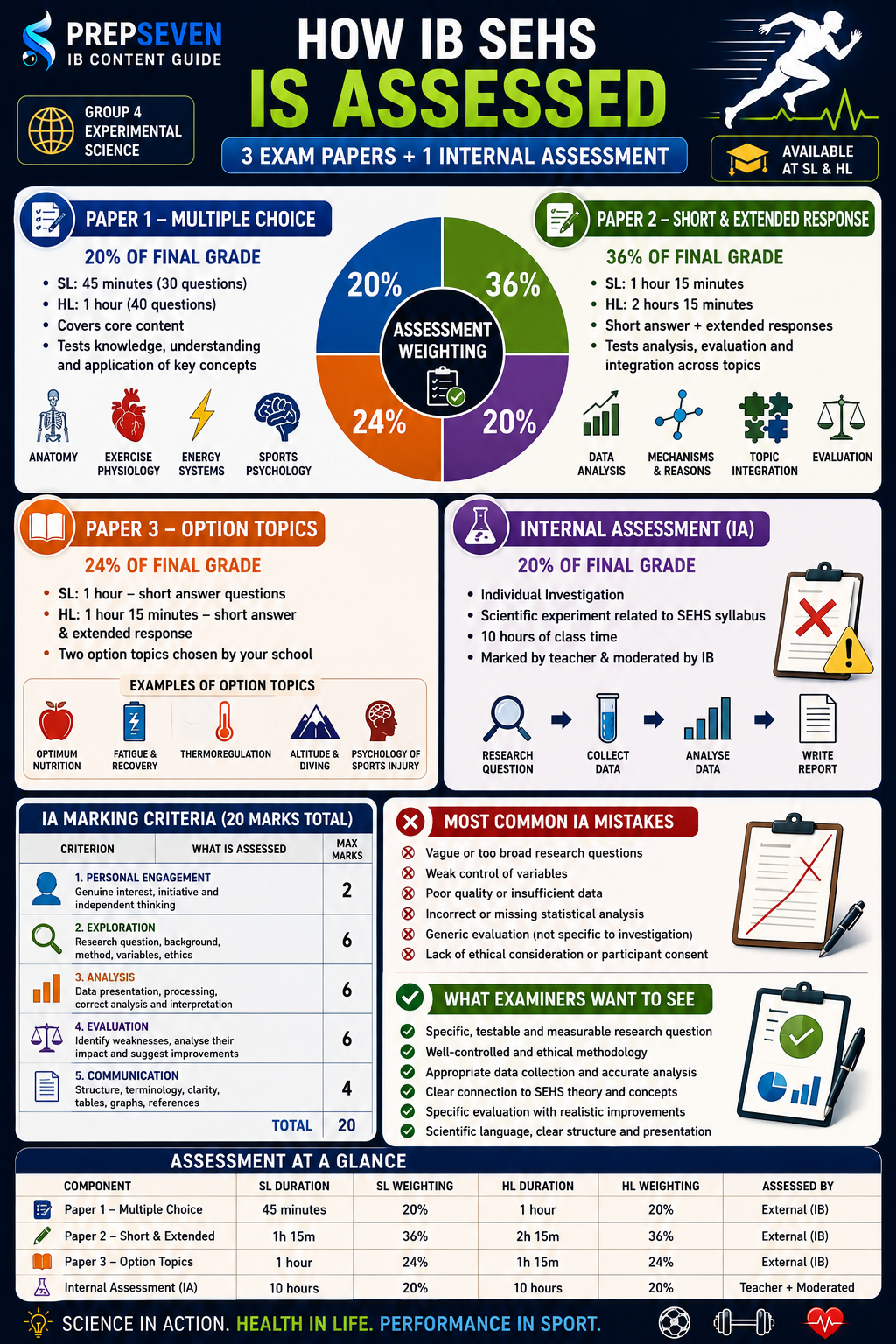
Paper 1 is a multiple choice exam covering the core content. At SL it is 45 minutes with 30 questions; at HL it is one hour with 40 questions covering core and HL content. Like all IB science multiple choice papers, Paper 1 in SEHS tests conceptual understanding rather than simple recall. Questions present physiological scenarios, data, or diagrams and ask students to identify the correct interpretation or application of a concept.
The anatomy and physiology content generates a high proportion of Paper 1 questions, and these are the questions where precise terminology and conceptual accuracy matter most. A question about which muscle acts as the agonist in a specific movement, or which energy system predominates in a 400-metre race, or what happens to stroke volume during progressive aerobic exercise, requires precise knowledge of how the systems work rather than a general understanding of the topics. Students who have learned the content with conceptual depth rather than surface familiarity find Paper 1 significantly more manageable than those who have memorised facts without understanding them.
Build a distinction log for the concepts that are most commonly confused in SEHS Paper 1. The difference between stroke volume and cardiac output, between aerobic and anaerobic threshold, between Type I and Type II muscle fibres and their recruitment patterns, between the ATP-PCr system and the glycolytic system in terms of duration and power output, and between arousal and anxiety in sports psychology, are all distinctions that Paper 1 tests regularly. Understanding each pair of concepts and being able to distinguish them precisely under multiple choice conditions is worth dedicated revision time.
Paper 2: Short Answer and Extended Response
Paper 2 is the main written paper and the one where analytical writing quality most directly determines marks. At SL it is one hour fifteen minutes; at HL it is two hours fifteen minutes. The paper includes short answer questions worth two to four marks each, and extended response questions worth eight or nine marks. The extended response questions require sustained analytical writing that integrates knowledge from multiple topic areas and applies it to specific scenarios or data.
Short answer questions test precise knowledge and the ability to apply specific concepts to given scenarios. Answers need to use accurate scientific terminology and be directly responsive to the command term in the question. A question that uses the command term explain requires more than a description: it requires the mechanism or reason to be articulated. A question using evaluate requires a balanced consideration of both sides of an issue with a justified conclusion. Students who do not attend to command terms consistently lose marks on questions they understand the content of.
Extended response questions in Paper 2 are where students who have genuinely understood the integrated nature of the course demonstrate that understanding. A question asking students to discuss how training adaptations in the cardiovascular and muscular systems together improve endurance performance requires integrating Exercise Physiology and Anatomy content with knowledge of training principles in a single coherent analysis. Students who have studied each topic in isolation and cannot make these connections under exam pressure produce fragmented responses that list rather than integrate and that score in the mid-band as a result.
Paper 3: Option Topics
Paper 3 covers the two option topics that the school has chosen. At SL it is one hour with short answer questions; at HL it is one hour fifteen minutes with short answer and extended response questions. The option topics are examined in the same format as the core in Paper 2, and students need to engage with them at the same depth of conceptual understanding. The option content is not a lighter version of the core material. It is additional specialised content that extends the core topics into specific applied contexts.
The option topics that produce the strongest Paper 3 performance are those that the teacher has taught with genuine depth and that students have engaged with through both class work and independent study. Students who treat the options as supplementary reading rather than core examined content consistently find Paper 3 harder than expected. The option topics are examined just as rigorously as the core, and students who arrive at Paper 3 without solid understanding of the specific physiological principles in their two options are at a significant disadvantage.
Internal Assessment: Individual Investigation
The Internal Assessment in SEHS is an individual investigation worth 20% of the final grade. Students design and conduct an experiment related to the SEHS syllabus, collect and analyse data, and write a scientific report documenting the process and findings. The IA is marked against the same five criteria used across all IB experimental sciences: Personal Engagement, Exploration, Analysis, Evaluation, and Communication.
The SEHS IA offers unusual latitude in terms of experimental design because the subject matter, human performance and health, provides an enormous range of testable questions using relatively accessible equipment. Students can design experiments around cardiovascular responses to exercise, reaction time and its variables, the effect of warm-up protocols on performance measures, flexibility and training adaptations, the psychological effects of music on exercise performance, or any number of other questions that connect to the syllabus.
The Evaluation criterion is where SEHS IA marks are most consistently lost, and it is entirely preventable. A strong evaluation does not say the experiment could be improved by collecting more data or using better equipment. It identifies specific methodological weaknesses, explains the likely direction and magnitude of their effect on the results, and proposes concrete and feasible modifications that would address each weakness specifically. A weak evaluation is generic and could be copied from one investigation to another with no modification. A strong evaluation is specific to this experiment, these results, and these particular sources of error and uncertainty.
The Energy Systems: The Most Examined and Most Misunderstood Topic
Energy systems is the topic area that generates the most questions in both Paper 1 and Paper 2, and it is the area where the gap between surface understanding and genuine conceptual grasp is most consequential. Most students can label the three energy systems and give approximate durations for each. Far fewer can explain the biochemical mechanisms of each system, why the systems overlap rather than switching sequentially, what determines which system predominates at a given exercise intensity, and how training adaptations specifically affect each system’s capacity and efficiency.
The ATP-PCr system, sometimes called the phosphocreatine or alactic anaerobic system, provides energy for maximal intensity efforts lasting up to approximately ten seconds. It does not produce lactate and does not require oxygen, which is why it is available immediately at the onset of maximal exercise. Its limitation is the small and finite store of phosphocreatine in the muscle. Recovery of the PCr store requires oxygen and takes approximately two to three minutes for full restoration, which is why repeated sprint protocols with short recovery intervals deplete this system progressively.
The glycolytic system, sometimes called the lactic anaerobic system, provides energy for high-intensity efforts from approximately ten seconds to approximately two minutes. It breaks down glucose or glycogen through glycolysis, producing ATP and pyruvate. When exercise intensity exceeds the capacity of the aerobic system to process pyruvate, it is converted to lactate. The accumulation of lactate and hydrogen ions is associated with the fatigue experienced in this intensity range. The anaerobic threshold, also called the lactate threshold, is the exercise intensity at which lactate begins to accumulate in the blood because production exceeds clearance, and training raises this threshold, allowing higher intensity exercise before lactate accumulation becomes limiting.
The aerobic system provides energy for lower intensity efforts lasting more than approximately two minutes, generating significantly more ATP per glucose molecule than the anaerobic systems but at a slower rate. The aerobic system involves glycolysis followed by the Krebs cycle and the electron transport chain in the mitochondria. At HL, students need to understand the biochemistry of the Krebs cycle and electron transport chain at a level of detail that goes beyond the SL requirement to know that aerobic metabolism requires oxygen and produces carbon dioxide and water. The HL content is where the energetic yields, the molecular mechanisms, and the regulatory points of aerobic metabolism become examinable.
The energy continuum is one of the most misrepresented concepts in SEHS revision resources. The three energy systems do not switch on and off sequentially during exercise. All three operate simultaneously at all times, with the relative contribution of each shifting depending on exercise intensity and duration. A sprinter uses primarily the ATP-PCr system with growing glycolytic contribution. A 400-metre runner uses primarily glycolytic with some aerobic contribution. A marathon runner uses primarily aerobic with small glycolytic contributions in variable terrain. Understanding the energy systems as a continuum of relative contributions rather than sequential activation is essential for answering both the conceptual questions and the application scenarios that appear in Papers 1 and 2.
Exercise Physiology: Training Adaptations in Depth
Exercise physiology is the topic area that most directly connects the SEHS curriculum to practical sports science applications, and the training adaptations section is one of the most heavily examined areas of the course. Understanding not just what adaptations occur in response to training but why they occur, what mechanisms drive them, and how they translate into measurable improvements in performance, is the level of understanding that Paper 2 extended response questions demand.
The most important concept to understand in the training adaptations section is the principle of specificity: adaptations are specific to the type, intensity, and duration of training performed. An endurance runner who switches to resistance training will develop muscular hypertrophy but will not maintain the cardiovascular adaptations built through endurance work unless they continue endurance training. This specificity principle is tested repeatedly in exam scenarios that ask students to design training programmes or explain why a specific athlete’s physiological profile looks the way it does.
VO2 max, the maximal rate of oxygen consumption during exercise, is one of the most important and most examined concepts in exercise physiology. Understanding VO2 max as a measure of the cardiovascular and muscular system’s combined capacity to deliver and use oxygen, knowing the factors that determine it, understanding why it is higher in endurance athletes than in untrained individuals, and being able to explain why endurance training raises VO2 max through specific mechanisms, is the kind of integrated understanding that high marks on extended response questions require.
Biomechanics and Movement Analysis: Where Physics Meets Sport
Movement analysis is the topic area that most students find initially least familiar, particularly those who do not have a strong physics background. It applies the principles of mechanics, including Newton’s laws, kinematics, and fluid dynamics, to human movement in sporting contexts. The content is not as mathematically demanding as Physics HL, but it requires comfort with quantitative reasoning and the ability to apply physical principles to movement scenarios.
Newton’s three laws of motion appear in the context of sport in ways that require understanding beyond simple definitions. Newton’s first law applied to sport means understanding what forces are needed to change an athlete’s state of motion and why a stationary ball requires a net force to begin moving and a moving ball requires a net force to stop or change direction. Newton’s second law in sport means understanding that a larger force applied to the same mass produces greater acceleration, and that the same force applied to greater mass produces less acceleration, which explains why a heavier shot-putter’s implement requires more force to accelerate to the same velocity. Newton’s third law in sport means understanding why running requires ground contact force and why jumping requires the athlete to push down on the ground to generate the equal and opposite upward force.
The lever system analysis of the human body is another area where conceptual precision matters more than most students initially appreciate. The human body contains all three classes of lever, and each class has different mechanical characteristics in terms of force, load, and fulcrum arrangement that determine the mechanical advantage available. Understanding which class of lever operates in a specific joint movement, what the mechanical advantage implies for the force required, and how this connects to the trade-offs between force production and range of motion in different movements, is the kind of analysis that both Paper 1 and Paper 2 test.
Projectile motion questions in Paper 1 and Paper 2 trip up many students because they confuse the principles governing the initial conditions of a projectile with the principles governing its flight. Once a ball, javelin, or athlete is airborne, only gravity and air resistance act on it. The velocity of the thrower’s arm at the moment of release determines the initial speed of the projectile. The angle at which it is released determines the ratio of vertical to horizontal velocity components. Understanding what can and cannot change a projectile’s path once it is in the air, and why, is what projectile motion questions in SEHS are testing.
Sports Psychology: The Most Underrevised Topic
Sports psychology is consistently the topic area that students underrevise relative to its examination weighting and the depth at which it is tested. Students sometimes treat psychology as softer content that requires less rigorous understanding than the physiological topics, which is a miscalculation. The psychological concepts in SEHS are tested with the same analytical rigour as the physiological ones, and extended response questions in psychology require the same level of evidence-based argument as extended responses in physiology.
The arousal-performance relationship is the most examined psychological concept in the course and the one with the most nuance. The simple inverted U hypothesis, which suggests that performance improves with increasing arousal up to an optimal point before declining, is an approximation that the course expects students to be able to evaluate critically. The catastrophe model, which suggests that the decline in performance above optimal arousal is not gradual but sudden and catastrophic in athletes with high cognitive anxiety, provides a more sophisticated model that better accounts for some observed performance decrements under pressure. Understanding both models, their evidence base, and their limitations is what the extended response questions on this topic require.
Motivation in sport is examined through both intrinsic and extrinsic motivation frameworks and through achievement motivation theory. Students who can explain why intrinsic motivation is more strongly associated with sustained participation and skill development than extrinsic motivation, who understand the concept of the overjustification effect and its implications for coaching and reward structures, and who can apply these principles to real sporting scenarios, are equipped for the motivation questions that appear regularly in both Paper 2 and Paper 3.
Mental rehearsal and imagery is an area where many students know what it is but cannot explain why it works at the level of physiological mechanism. The neuromuscular theory of imagery, which suggests that imagining a movement activates the same neural pathways used in actual movement execution but at sub-threshold levels, provides the mechanism that exam answers on mental rehearsal should reference. An answer that says mental rehearsal helps athletes because they can picture the performance in their mind is a description. An answer that explains the neuromuscular activation hypothesis and connects it to the specificity principle of practice is a scientific explanation. The distinction matters significantly for marks on psychology extended response questions.
The Internal Assessment: Designing a Strong Investigation
The SEHS IA is one of the most open-ended IAs in the IB sciences in terms of the range of viable research questions available. This freedom is an advantage for students who use it well and a pitfall for those who approach the IA without a clear understanding of what makes a strong investigation. The most important principle is that the research question should be specific enough to test with a controlled experiment, connected to the SEHS syllabus, and genuinely interesting to the student who will be conducting and writing about it for months.
The most successful SEHS IAs are those that measure a physiological or psychological variable that responds to a manipulated independent variable in a way that connects clearly to SEHS theory. The effect of recovery duration on repeated sprint performance connects to energy systems. The effect of music tempo on heart rate and perceived exertion during steady-state exercise connects to exercise physiology and sports psychology. The effect of pre-competition mental imagery on free throw accuracy connects to sports psychology. The effect of warm-up type on flexibility connects to anatomy and training principles. Each of these research questions generates measurable data, connects to specific syllabus content, and allows a genuine analysis of the relationship between variables.
The Exploration criterion is where the quality of the experimental design is assessed, and this is where many students leave marks on the table through insufficient attention to variables and controls. A strong Exploration section clearly identifies the independent variable and how it is manipulated, the dependent variable and how it is measured, the controlled variables and how each is held constant, and the ethical considerations involved in using human subjects. Each of these elements needs to be justified: not just what the variable is but why it is being controlled and what effect failure to control it would have on the results.
Ethical considerations in SEHS IAs involving human subjects are not a box-ticking exercise. They are a genuine methodological requirement that should be addressed specifically and substantively. The ethical considerations relevant to a physiological investigation include informed consent, the right to withdraw, confidentiality of participant data, the physical risk of the exercise protocol and how it is managed, and the appropriateness of the exercise intensity for the participants. Students who address each of these specifically, explaining what steps were taken and why, demonstrate scientific rigour that the Exploration criterion rewards. Students who write a single sentence about getting permission demonstrate that they understand ethical requirements superficially.
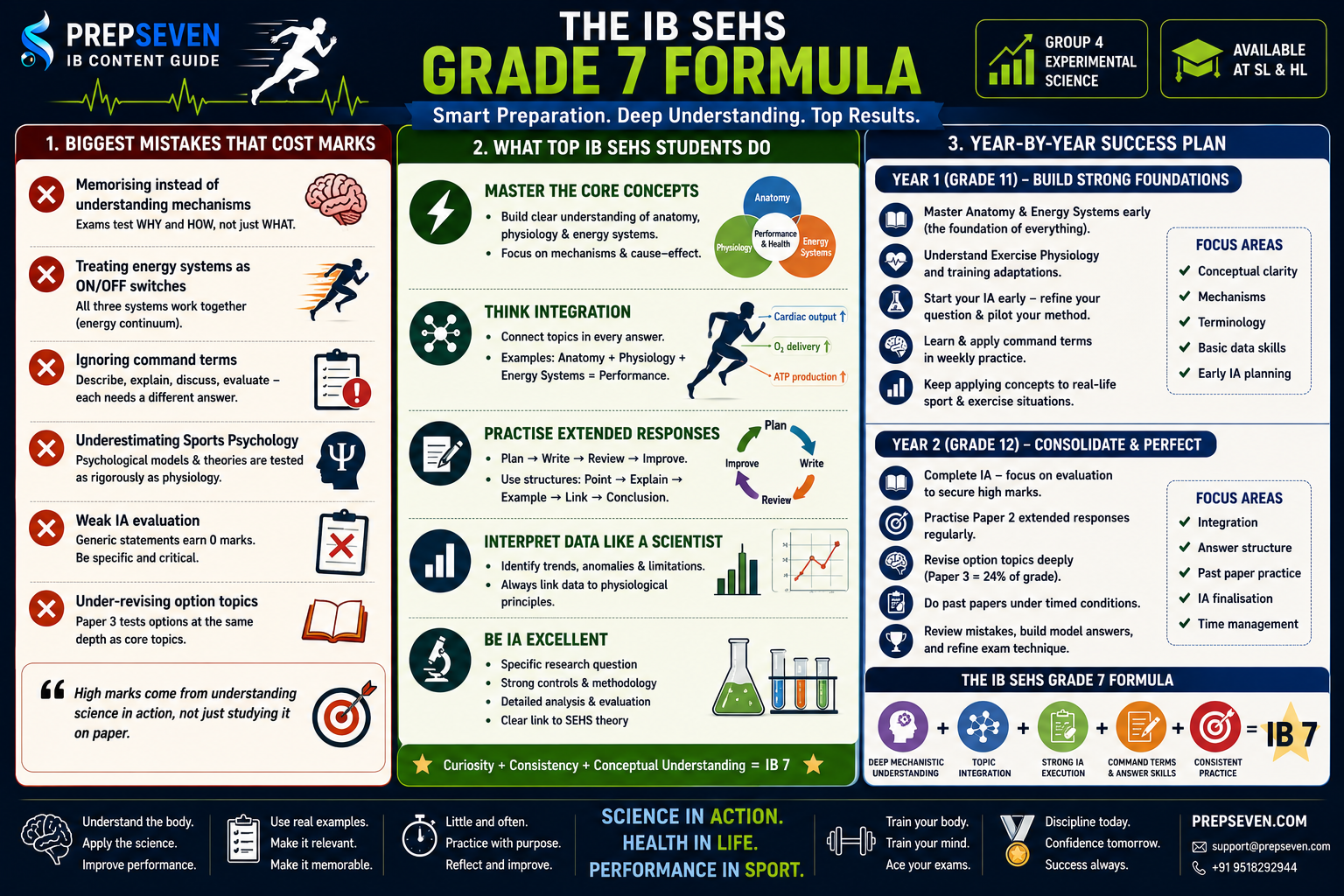
What Actually Gets Students to a 7
They understand mechanisms, not just facts
The extended response questions in Paper 2 consistently reward students who can explain the mechanisms behind physiological phenomena rather than just describing what happens. Cardiac output increases during exercise is a fact. Cardiac output increases during exercise because sympathetic nervous activation increases heart rate while the Frank-Starling mechanism, driven by increased venous return from working muscles, increases stroke volume, and together these effects multiply to produce a cardiac output that can be four to six times the resting value in trained athletes, is a mechanistic explanation that earns marks in the top band. Build the habit of asking why and how for every concept you study.
They connect topics deliberately and practise integration
SEHS Paper 2 extended responses almost always require integration across topic areas. A question about endurance performance requires anatomy, exercise physiology, and energy systems simultaneously. A question about rehabilitation after injury requires anatomy, physiology, and psychology together. Students who have practised making these connections in writing, through essay practice on integration questions that span multiple topics, are significantly better prepared for Paper 2 than those who have revised each topic in isolation. Practise integration questions from the beginning of Year 2.
They treat the option topics with the same rigour as the core
Paper 3 is worth the same proportion of the final grade as it is allocated, and students who treat the option topics as lighter content find Paper 3 unexpectedly difficult. The option questions test physiological understanding at the same depth as the core questions, and students who have engaged with the option content with genuine conceptual rigour across both years are in the strongest position. If your school offers options that connect to your own sporting experience, use that connection to build genuine understanding rather than surface familiarity.
They start the IA with a specific, testable question
The IAs that earn the highest marks begin with a genuinely specific and testable research question. Students who spend time in the early IA stages refining their question until it is precise, measurable, and connected clearly to syllabus content produce investigations that are significantly easier to design, execute, and write up than those built around vague or overly broad questions. The question how does exercise affect fitness is not testable. The question how does six weeks of high-intensity interval training affect VO2 max estimated from the 20-metre multistage fitness test in Year 11 students is testable, specific, and syllabus-connected.
They use command terms correctly under exam pressure
IB SEHS exam questions use specific command terms that define what type of response is required. Describe asks for a factual account without explanation. Explain asks for the mechanism or reason. Discuss asks for a balanced consideration of multiple perspectives or factors. Evaluate asks for a judgement based on evidence with a justified conclusion. Outline asks for a brief account of the main points. Students who misread command terms and produce a description when the question asks for an explanation consistently lose marks that their knowledge would have allowed them to earn. Practise reading command terms carefully and checking the type of response each requires before beginning to write.
Common Mistakes That Cost Marks
A Realistic Year-by-Year Approach
Year 1 (Grade 11): Build Foundations and Begin the IA
- Begin your IA research question development in Term 1 of Year 1. The best IAs are those where the student has had time to refine the question, pilot test the methodology, make adjustments based on what the pilot reveals, and then conduct the full investigation with a methodology that has been genuinely tested. Students who begin the IA in Year 2 compress this process and consistently produce investigations that the pilot testing would have identified weaknesses in.
- Build your understanding of the anatomy and energy systems topics deeply from the beginning, because these are the conceptual foundations that most of the subsequent topics build on. A student who does not understand the structure and function of the cardiovascular and muscular systems will find exercise physiology harder than it needs to be. A student who does not understand the biochemistry of the energy systems will find training adaptations harder to explain at the mechanistic level.
- Develop the habit of applying course concepts to the sporting and exercise contexts you encounter in everyday life. When you watch a 100-metre sprint, think about which energy system is predominantly operating and at what point the PCr store is likely to be depleted. When you experience muscle soreness after unaccustomed exercise, connect it to the physiological mechanisms of delayed onset muscle soreness. This ongoing active application builds the conceptual depth that exam scenarios require.
- Complete at least one Paper 2 practice, including an extended response question, before the end of Year 1. Identify which topic areas produce the weakest responses and which command terms you are least confident with. This early diagnostic shapes the most productive use of Year 2 revision time.
- If you are taking SEHS HL, begin engaging with the HL extension content from the first time it is introduced in class rather than treating it as additional material to be covered later. The HL biochemistry of the aerobic system, in particular the Krebs cycle and electron transport chain, requires more time to understand deeply than students typically allocate to it if they leave it until Year 2.
Year 2 (Grade 12): Deepen, Complete, and Refine
- Complete your IA investigation and write the report with genuine attention to all five criteria, particularly the Evaluation criterion. Do not rush the evaluation. Identify at least three specific methodological weaknesses, explain the direction and likely magnitude of each on your results, and propose specific modifications. Get teacher feedback on the evaluation specifically before finalising the report.
- Work through past Paper 1 and Paper 2 questions systematically from Term 1 of Year 2. For every question you answer incorrectly, identify whether the error was a conceptual misunderstanding, a terminology error, a failure to apply the command term correctly, or a failure to connect across topic areas. Each type of error requires a different response in your revision.
- Build model extended response answers for the most common question types in each topic area, checking them against mark schemes and getting teacher feedback on whether the mechanistic depth is sufficient. The difference between a mid-band and top-band extended response is almost always in whether the mechanism behind the physiological phenomenon has been explained, not just whether the phenomenon has been described.
- Revise the option topics systematically in Term 2 of Year 2 with the same rigour as the core. Build concept maps that connect the option content to the core topics it extends, because Paper 3 questions often require this connection to be made explicitly. A question in the optimum nutrition option about glycogen depletion requires connecting nutrition content to energy systems and exercise physiology.
- In the final four to six weeks before the exam, focus revision on the topic areas where your Paper 2 extended response performance has been weakest in practice. These are the highest-mark questions in the paper and the ones where targeted preparation produces the most significant score improvements. Practise writing timed extended responses without notes, checking against mark schemes, and identifying where the mechanistic depth is still insufficient.
How PrepSeven Helps You Score Higher in IB SEHS
IB Sports, Exercise and Health Science rewards students who can explain physiological mechanisms with precision, integrate knowledge across topic areas in extended response questions, and design and evaluate investigations with genuine scientific rigour. The difference between a 5 and a 7 is almost always in the depth of mechanistic understanding, the quality of integration in extended responses, and the rigour of the IA evaluation. Our SEHS tutors are certified IB examiners and experienced sports science educators who know exactly what each assessment component requires and where students consistently lose marks they could have secured with better preparation.
- Paper 2 extended response sessions where your tutor marks your practice responses against the IB mark scheme, identifies where mechanistic depth is insufficient, where integration across topic areas is missing, and where command terms are not being answered correctly, with specific guidance on what a top-band response to the same question looks like.
- Energy systems conceptual sessions where your tutor works through the biochemistry and physiology of all three systems at the depth that HL requires, building the mechanistic understanding that both Paper 1 and Paper 2 extended response questions on energy systems demand.
- IA design and evaluation sessions where your tutor reviews your research question and experimental design against the Exploration criterion, identifies methodological weaknesses before data collection, and works through the Evaluation criterion with you to ensure your weaknesses analysis is specific, your effect direction analysis is accurate, and your improvement suggestions are concrete and feasible.
- Sports psychology sessions where your tutor covers the arousal-performance models, motivation frameworks, and mental skills concepts at the analytical depth that Paper 2 psychology questions require, building the evidence-based argument skills that psychology extended responses reward.
- Option topic sessions tailored to the two options your school is covering, ensuring the physiological detail of each option is at the same depth as the core content and that you can connect option content back to core topic areas in the integrated questions that Paper 3 sometimes includes.
Book your free demo lesson at prepseven.com. Bring a recent Paper 2 extended response you have written or an IA Evaluation section you have drafted. Your tutor will show you precisely where the mechanistic depth is sufficient and where it falls short, and what the preparation looks like that moves your response from a 5-band answer to a 7-band one.