
PrepSeven | IB Content Guide authored by Shankar Mutneja (Founder of Prepseven)
IB Spanish B
What Is IB Spanish B?
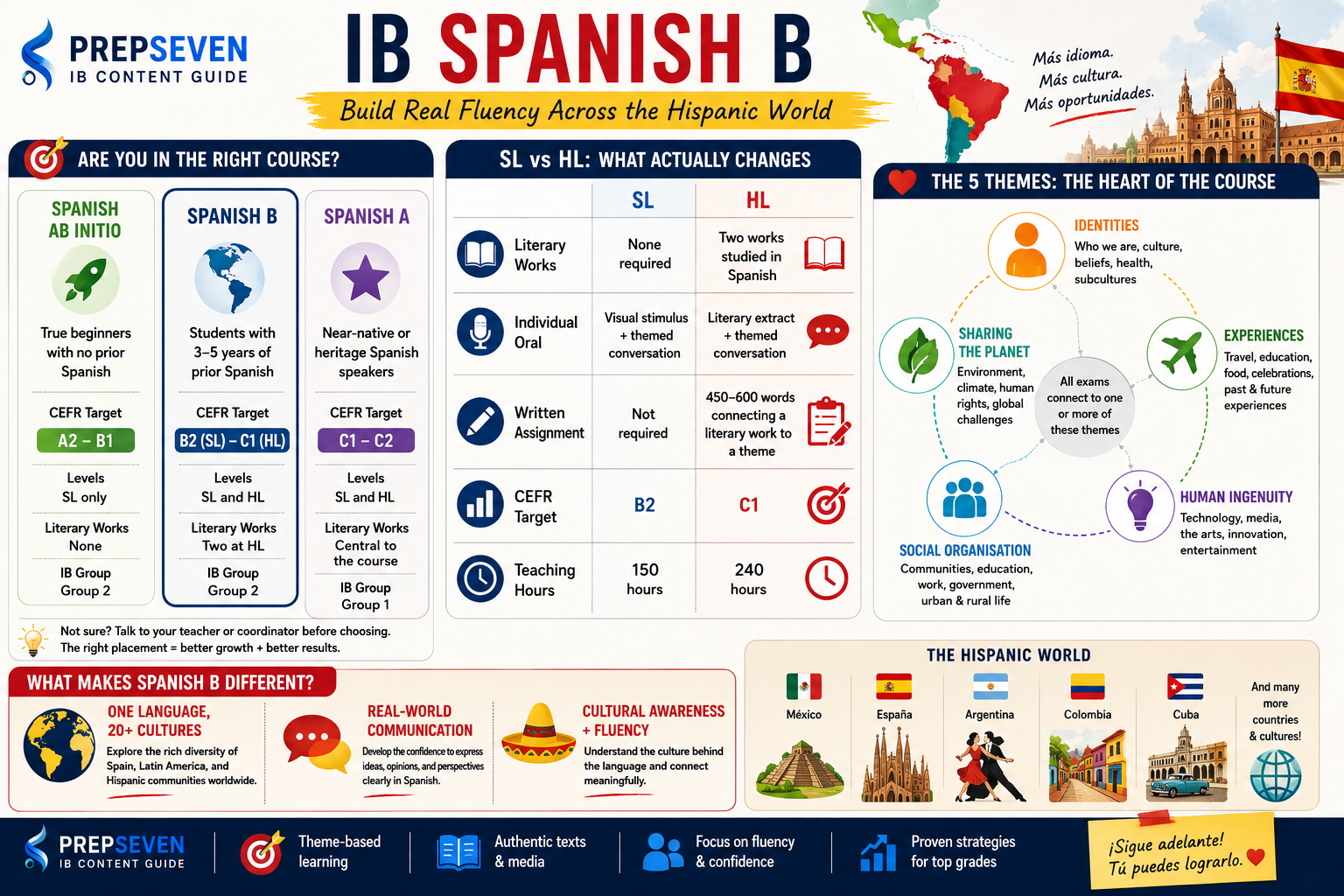
IB Spanish B is the language acquisition course for students who already have a meaningful foundation in Spanish and want to develop that foundation into genuine communicative and cultural fluency through the IB Diploma Programme. It is the most widely taken Group 2 language course in the IB worldwide, reflecting both the global reach of Spanish as a language and the enormous range of students who arrive with Spanish as a school-studied subject rather than a first language.
The course sits in Group 2 of the diploma and is available at both Standard Level and Higher Level. It is built around five themes that run through all four years of language study: identities, experiences, human ingenuity, social organisation, and sharing the planet. Every text you read, every listening task you complete, every oral interaction you practise, and every piece of writing you produce connects to one or more of these themes. They are not content areas to be studied separately. They are the context within which your Spanish develops.
What makes Spanish B genuinely rewarding at the IB level is that it does not treat Spanish as a single monolithic language. The Spanish-speaking world spans more than twenty countries across four continents, each with distinct vocabulary, cultural references, literary traditions, and political histories. The course explicitly values this diversity and rewards students who engage with it rather than those who treat Castilian Spanish as the only valid form of the language.
Spanish B is sometimes assumed to be easier than other Group 2 courses because Spanish is considered relatively accessible for English speakers. That assumption is only partially true. The path from intermediate Spanish to the B2 or C1 level that IB Spanish B targets requires sustained effort over two years, and the HL assessment in particular demands a level of linguistic sophistication, literary engagement, and communicative fluency that most students need genuine dedication to reach.
Are You in the Right Spanish Course?
This is worth addressing directly because misplacement between Spanish Ab Initio, Spanish B, and Spanish A is more common than most students realise and has real consequences for both performance and development.
The critical issue is at both ends. A student who is a native or near-native Spanish speaker taking Spanish B will find the course well below their actual level of proficiency, which wastes two years of language development and can actually create problems if the IB determines the placement is inappropriate. Equally, a student with only a year or two of casual Spanish exposure attempting Spanish B SL will struggle significantly with the vocabulary range and communicative demands the course requires from the start.
If Spanish is spoken at home or you spent significant time living in a Spanish-speaking country, speak honestly with your IB coordinator before committing to Spanish B. Spanish A might be the appropriate course. Similarly, if your Spanish instruction has been limited and informal, discuss whether Ab Initio is a better starting point. Getting this decision right at the start of Year 12 saves considerable difficulty later.
SL vs HL: What Actually Changes
The difference between Spanish B SL and HL matters substantially in practice. HL students study two literary works in Spanish, which shapes both the Individual Oral and Paper 2. This literary dimension changes the intellectual character of the HL course and demands a different kind of preparation from SL.
The HL Individual Oral is where the literary dimension of the course becomes most visible in assessment. At SL, you are shown an unseen visual stimulus and speak about it in relation to one of the five themes before moving into a broader conversation. At HL, you choose an extract from one of your two literary works, speak about how it connects to a course theme, and then enter a conversation that extends into both the work and the broader themes. The ability to discuss a literary text with genuine analytical depth in Spanish, under examination conditions, is a high-level skill that develops only through sustained engagement with the works throughout both years.
Students considering HL Spanish B should ask themselves honestly whether they find reading and analysing literature in Spanish interesting rather than burdensome. The two literary works are not supplementary material. They shape 20% of the HL grade directly and inform the HL Individual Oral significantly. Students who choose HL because they think it will look better on a university application but then disengage from the literary component tend to underperform relative to their spoken language ability.
The Five Themes: Why They Shape Everything You Do
The five IB language acquisition themes are the organisational framework for the entire Spanish B course. Every assessed component, every classroom activity, every piece of extended reading, and every oral interaction is situated within one or more of these themes. Understanding them from the beginning is not just useful for the exam. It helps you see why the course is structured the way it is and how everything connects.
One dimension of these themes that makes Spanish B genuinely different from a standard language course: each theme has a specifically Spanish-speaking cultural dimension. Identities in the context of Spanish B is not just about personal values in the abstract. It is about how identity is understood differently across Mexico, Argentina, Colombia, Cuba, and Spain; how language itself functions as an identity marker in bilingual communities; and how the colonial history of Latin America continues to shape contemporary questions of cultural belonging. Students who engage with these cultural specificities produce work in both papers and the oral that is more interesting and more relevant than those who treat the themes as generic topics.
Assessment Breakdown: How You Are Graded
Paper 1: Productive Writing
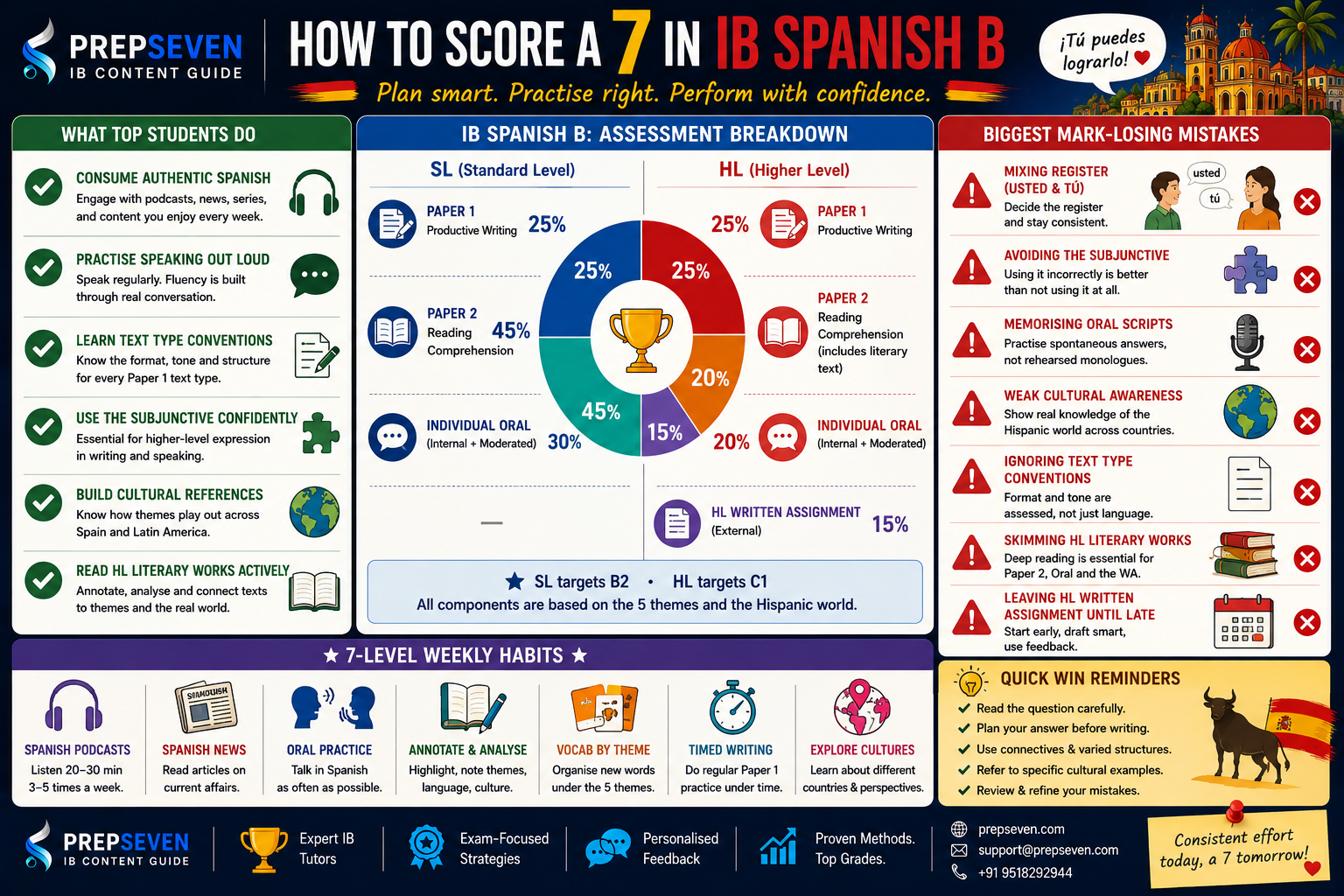
Paper 1 is one hour fifteen minutes at SL and one hour thirty minutes at HL. It presents stimulus material and asks you to produce one or two pieces of writing in specified text types. The text types include blog posts, opinion articles, letters, reports, speeches, social media posts, and interviews among others. Each text type has its own register, conventions, and structural expectations.
The three criteria for Paper 1 are Language, Message, and Conceptual Understanding of the text type. Language covers accuracy, range of vocabulary and grammatical structures, and overall clarity of expression. Message covers whether you have communicated the required content effectively and completely. Conceptual Understanding covers whether your writing demonstrates genuine awareness of the conventions appropriate to the text type you have been asked to produce.
The Conceptual Understanding criterion is where marks are consistently either secured or lost based on preparation that has nothing to do with language ability. A blog post written in the register of a formal report will lose marks on this criterion regardless of how accurate the Spanish is. A speech that lacks direct address to an audience, that does not use the rhetorical features associated with spoken persuasion, will similarly underperform. These are learnable features. A student who has studied and practised each text type at least once during the two years arrives at Paper 1 with a significant advantage over one who encounters an unfamiliar text type format for the first time in the exam room.
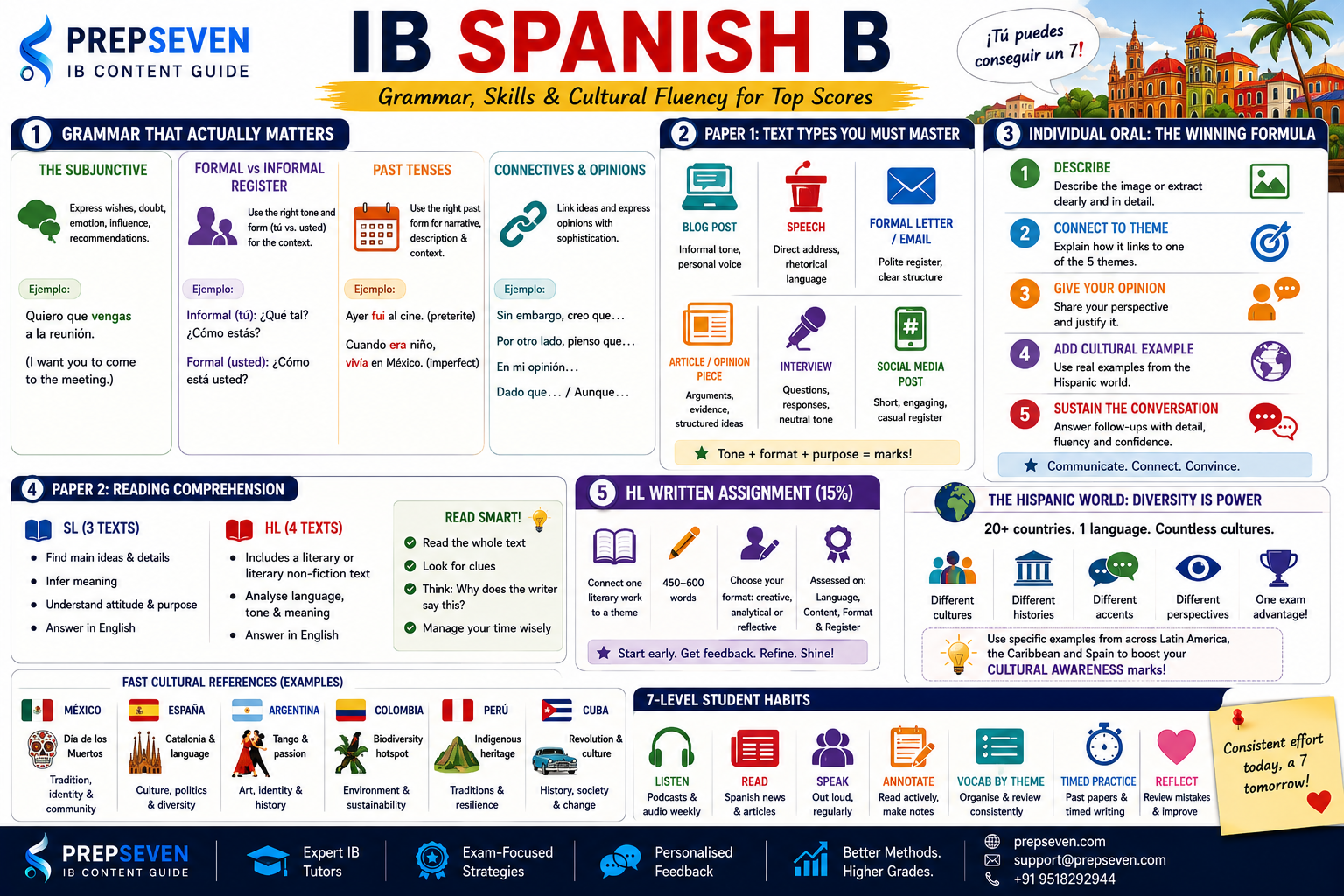
A specific feature of Spanish that affects Paper 1: register is marked more visibly in Spanish than in English. The formal usted versus informal tu distinction, the use of subjunctive in formal writing, the conventions of formal letter openings and closings in Spanish, and the difference between peninsular and Latin American formal register choices, all affect whether your writing sounds appropriately calibrated for the context. Students who default to a single register regardless of the task consistently lose marks on the Language and Conceptual Understanding criteria simultaneously.
Paper 2: Reading Comprehension
Paper 2 is one hour at SL and one hour thirty minutes at HL. At SL it presents three reading texts in Spanish and asks comprehension questions answered in English. At HL it presents four texts, with the fourth being a literary or literary non-fiction text, and the questions include analysis of the literary text’s language and meaning.
The comprehension questions are designed to test genuine understanding at multiple levels: locating specific information, inferring meaning from context, understanding the writer’s attitude or purpose, and at HL, analysing how language is used to create meaning in the literary text. Students who read the texts quickly and rely on recognising familiar vocabulary for the specific information questions often miss the inference and attitude questions, which require a deeper engagement with what the text is implying rather than stating.
The HL literary text question is where students who have genuinely engaged with their two literary works and developed the habit of reading literary Spanish analytically have a clear advantage. The text presented will be from literature or high-quality literary non-fiction, and the questions ask you to identify not just what the writer says but how they say it: the effect of a particular word choice, the tone created by a specific stylistic device, the implied meaning of a passage whose surface reading is straightforward. This requires the kind of close reading that develops through regular practice with literary Spanish, not through general reading comprehension practice alone.
Individual Oral
The Individual Oral contributes 30% of the SL grade and 20% of the HL grade. It is conducted by your teacher, recorded, and externally moderated by the IB. The format differs significantly between SL and HL.
At SL, you are shown an unseen visual stimulus connected to one of the five themes and given a few minutes to prepare. You then speak about it for approximately two minutes before entering a broader conversation with your teacher about the theme, drawing on your knowledge of Spanish-speaking cultures and your own language resources. The conversation lasts around twelve to fifteen minutes in total.
At HL, you choose an extract from one of your two literary works before the exam. You speak for approximately two minutes about how the extract connects to a course theme, then enter a conversation that moves between the literary work and the broader themes of the course. The teacher may ask you to discuss other aspects of the work, other connections to the themes, or to compare the work’s treatment of a theme with something from your own experience or knowledge.
In both cases, the oral is assessed on two criteria: Language and Communication, and Cultural Awareness. Language and Communication covers the accuracy, fluency, and range of your spoken Spanish and your ability to maintain a real conversation in the language. Cultural Awareness covers the degree to which you demonstrate knowledge of and engagement with Spanish-speaking cultures and communities in your responses.
The Cultural Awareness criterion is one that strongly favours students who have genuinely engaged with the Spanish-speaking world rather than those who have only studied the language. Mentioning specific cultural references, knowing something about how a theme plays out differently in Mexico than in Spain, understanding the historical context behind a contemporary social issue in Argentina, being able to reference a real event, figure, or cultural practice in your conversation, these are what the Cultural Awareness criterion is looking for. It cannot be faked by a student who has only studied Spanish grammar and vocabulary.
HL Written Assignment
The HL Written Assignment is 450 to 600 words and connects one of the two literary works to a theme from the course. It is externally marked by the IB and carries 15% of the final HL grade. The format is flexible: it can be a piece of creative writing inspired by the work, an analytical reflection on how the work addresses a specific theme, or a response to the work from the perspective of one of its characters or the author.
The Written Assignment is assessed on Language, Content, and Format and Register. The Content criterion specifically rewards students who demonstrate genuine engagement with both the literary work and the course theme, connecting them in a way that is meaningful and specific rather than superficial and generic. A student who chooses to write a blog post inspired by a theme in a novel they have studied and who uses specific details from the work, draws genuine connections to real-world manifestations of the theme in the Spanish-speaking world, and writes with personal voice and intellectual engagement, will score far higher than a student who produces a technically correct piece of writing that could have been written without reading the book.
The Hispanic World: Why Cultural Depth Gives You an Edge
IB Spanish B is not a course about Spain. It is a course about the Spanish-speaking world, which is one of the most linguistically, culturally, geographically, and historically diverse language communities on earth. This matters for assessment because the Cultural Awareness criterion in the Individual Oral and the thematic engagement rewarded in Paper 1 writing tasks explicitly value knowledge of and reference to specific Spanish-speaking contexts.
A student who knows only Spanish as spoken and written in Spain, and who relates every theme only to peninsular Spanish culture, is drawing on a fraction of the cultural universe the course is designed to engage with. A student who can discuss how the theme of identities plays out differently for indigenous communities in Bolivia than for second-generation immigrants in Madrid, who can reference the environmental activism of Latin American indigenous rights movements in the context of Sharing the Planet, or who understands the specific political history behind press freedom debates in Venezuela or Mexico, is demonstrating exactly the kind of cultural range the IB rewards.
Building cultural knowledge of the Spanish-speaking world does not require visiting these countries. Spanish-language media, podcasts, journalism, and film from across Latin America and Spain is freely accessible online. Thirty minutes per week of consuming authentic Spanish-speaking content from at least two or three different countries builds the cultural awareness that cannot be developed through textbooks alone, and it develops listening comprehension at the same time.
Grammar Spotlight: The Subjunctive and Why It Matters for IB Spanish B
No grammar feature in Spanish divides students more clearly by level than the subjunctive. At the A2 and B1 levels that Ab Initio targets, students rarely need to use it. But at the B2 to C1 levels that Spanish B targets, the subjunctive is not an optional flourish. It is woven into the grammatical fabric of natural Spanish and its absence in a student’s writing and speaking is immediately noticeable.
The subjunctive appears in Spanish in a wide range of contexts: expressing wishes, desires, and emotions about other people’s actions; making recommendations and giving advice; expressing doubt, uncertainty, and denial; describing hypothetical situations; and making formal requests. These are all communicative functions that appear regularly in Paper 1 writing tasks and in oral conversation. A student writing a formal letter in Spanish who can use the subjunctive to express polite requests, a speech who can use it to appeal to collective emotions, or an opinion article who can use it to qualify claims with appropriate uncertainty, is writing at a level that the Language criterion for Paper 1 specifically rewards.
The subjunctive is also a marker of register in Spanish. Formal and literary Spanish uses the subjunctive in contexts where informal spoken Spanish increasingly uses the indicative. For HL students reading literary works in Spanish, recognising and understanding subjunctive constructions in literary prose is a comprehension skill as much as a production skill.
A practical approach to building subjunctive confidence: identify the five most common triggers for the subjunctive in Spanish, querer que, esperar que, recomendar que, es importante que, aunque with uncertainty, and practise using each one deliberately in your writing tasks and oral practice from the start of Year 1. Do not wait until you understand all the rules before you start using it. Use it in specific, controlled contexts and build your range gradually. Students who avoid the subjunctive entirely because they are uncertain of the rules consistently score lower on the Language criterion than those who use it imperfectly but deliberately.
What Actually Gets Students to a 7
They consume authentic Spanish content consistently across two years
The students who score highest in IB Spanish B almost never got there through textbook work alone. They are the students who found authentic Spanish content they genuinely enjoy and consumed it regularly throughout both years. This might be a Spanish-language podcast about current affairs, a Netflix series produced in Latin America, a WhatsApp group or social media account in Spanish, a Spanish-language newspaper for a region that interests them, or a combination of all of these. The cumulative effect of two years of authentic input on vocabulary, idiom, listening comprehension, and natural register cannot be replicated by any amount of formal study.
They know text type conventions and apply them deliberately
Paper 1 assesses text type conventions as a specific criterion and it is one of the most accessible sources of marks in the entire course. A student who knows that a formal letter in Spanish opens with Estimado and closes with Atentamente, that a blog post uses informal address and a personal voice, that a speech uses direct appeals to the audience and rhetorical structuring, and who applies these conventions consistently in every practice task, is earning marks that require almost no additional language development to secure. Students who arrive at the exam uncertain about text type conventions are leaving reliable marks on the table.
They speak Spanish out loud, not just in their head
The Individual Oral is a spoken performance and oral fluency is a physical skill. It requires your mouth to produce Spanish sounds, your memory to retrieve vocabulary and structures, and your mind to process meaning and formulate responses, simultaneously, in real time, under assessment conditions. None of these processes can be developed through silent reading or written practice alone. Students who have spoken Spanish regularly throughout both years, in class, with a tutor, with a language partner, or with anyone willing to converse, arrive at the Individual Oral with a level of oral automaticity that students who have only practised mentally cannot replicate.
They read the HL literary works carefully and annotate as they go
HL students who skim their literary works or rely on summaries and translations are significantly disadvantaged in both Paper 2 and the Individual Oral. The HL literary text question in Paper 2 requires comprehension at the level of specific language choices, tone, and implied meaning, not just plot knowledge. The HL Individual Oral requires you to speak with genuine intellectual depth about the work and how it connects to a course theme. Neither of these is achievable for a student who has not actually read and engaged with the text carefully. Read both works with a pen in hand, noting language features, cultural references, and thematic connections as you encounter them.
They prepare the Individual Oral for the conversation, not just the prepared section
The two-minute prepared section of the Individual Oral is the part students consistently over-prepare. The subsequent conversation, which can last twelve minutes or more at SL and a similar duration at HL, is where spontaneous language ability and cultural knowledge are tested. Students who have rehearsed their prepared section thirty times but never practised responding unpredictably to questions about the themes often find the conversation section significantly harder than the prepared section. Effective oral preparation means practising spontaneous responses to questions across all five themes, in Spanish, with someone who can probe and follow up. This is exactly the kind of preparation where a tutor makes a substantial difference.
Common Mistakes That Cost Marks
A Realistic Year-by-Year Approach
Year 1 (Grade 11): Build Language Habits and Cultural Engagement
- Establish a regular Spanish consumption habit from the first week of Year 1. Choose one source of authentic Spanish content you genuinely enjoy, whether a podcast, a series, a news source, or a social media account, and engage with it for at least twenty to thirty minutes per week throughout both years.
- Build a vocabulary notebook organised by the five themes from the start. Every new word or phrase you encounter in class or in authentic content goes into the relevant theme section. Review each section weekly.
- Practise each Paper 1 text type at least once during Year 1. Write a formal letter, a blog post, a speech, and an opinion article in Spanish and ask your teacher for feedback specifically on register and text type conventions, not only on language accuracy.
- For HL students: begin reading the first literary work as soon as your teacher assigns it. Annotate in Spanish as you read. Note cultural references, thematic connections, and language features. Do not leave literary work engagement to Year 2.
- Start building your cultural knowledge bank for the five themes. As each theme is studied in class, note specific Spanish-speaking country examples: a policy, a cultural practice, a historical event, or a current issue that illustrates the theme in a specifically Hispanic context.
Year 2 (Grade 12): Consolidate and Prepare to Perform
- Complete at least four full timed Paper 2 comprehension exercises under exam conditions before your mock exams. Use past paper texts and practise reading for inference and attitude, not just specific information.
- Practise the Individual Oral at least three times in conditions as close to the real exam as possible: with someone who can show you a stimulus or extract, listen to your prepared section, and then ask unpredictable follow-up questions in Spanish for twelve or more minutes.
- For HL students: submit your HL Written Assignment first draft for teacher feedback before the end of Term 1. Use the feedback cycle seriously. A second draft is almost always significantly stronger than a first draft.
- In the final revision period, identify the themes where your vocabulary is thinnest and spend targeted time on those. Past Paper 2 texts are the best source of thematic vocabulary in context because they are drawn from authentic Spanish-language sources at the right level of complexity.
How PrepSeven Helps You Score Higher in IB Spanish B
Developing genuine Spanish fluency at the IB level requires more than classroom instruction. It requires consistent exposure to authentic language, targeted feedback on production skills, and the kind of cultural knowledge that makes the Individual Oral and the Paper 1 writing tasks feel like genuine communication rather than performed exercises. Our Spanish B tutors are experienced IB language teachers and examiners who understand both the language and the assessment framework from the inside.
Here is what working with a PrepSeven Spanish B tutor typically looks like:
- Paper 1 writing sessions where you produce a timed writing task in a specified text type and your tutor marks it against the three IB criteria, giving detailed feedback on language range and accuracy, message completeness, and text type convention compliance.
- Paper 2 comprehension sessions where your tutor guides you through reading strategy for Spanish texts at your level, building your ability to identify inference and attitude questions, and working through the HL literary text question with attention to language analysis rather than just plot comprehension.
- Individual Oral preparation sessions where your tutor conducts a full mock oral in Spanish, starting with the stimulus or literary extract and moving through an unpredictable themed conversation, giving detailed feedback on spoken fluency, vocabulary range, and cultural awareness.
- For HL students: literary work discussion sessions where your tutor works through the texts with you analytically, building the depth of understanding needed for both the HL Individual Oral and the HL Written Assignment.
Book your free demo lesson at prepseven.com. Bring a Paper 1 writing task you have already completed or a theme you want to practise discussing in Spanish. Your tutor will show you exactly where your language and cultural knowledge stands against the IB criteria and what it takes to push it to the next level.