
PrepSeven | IB Content Guide authored by Shankar Mutneja (Founder of Prepseven)
IB Spanish Ab Initio
What Is IB Spanish Ab Initio?
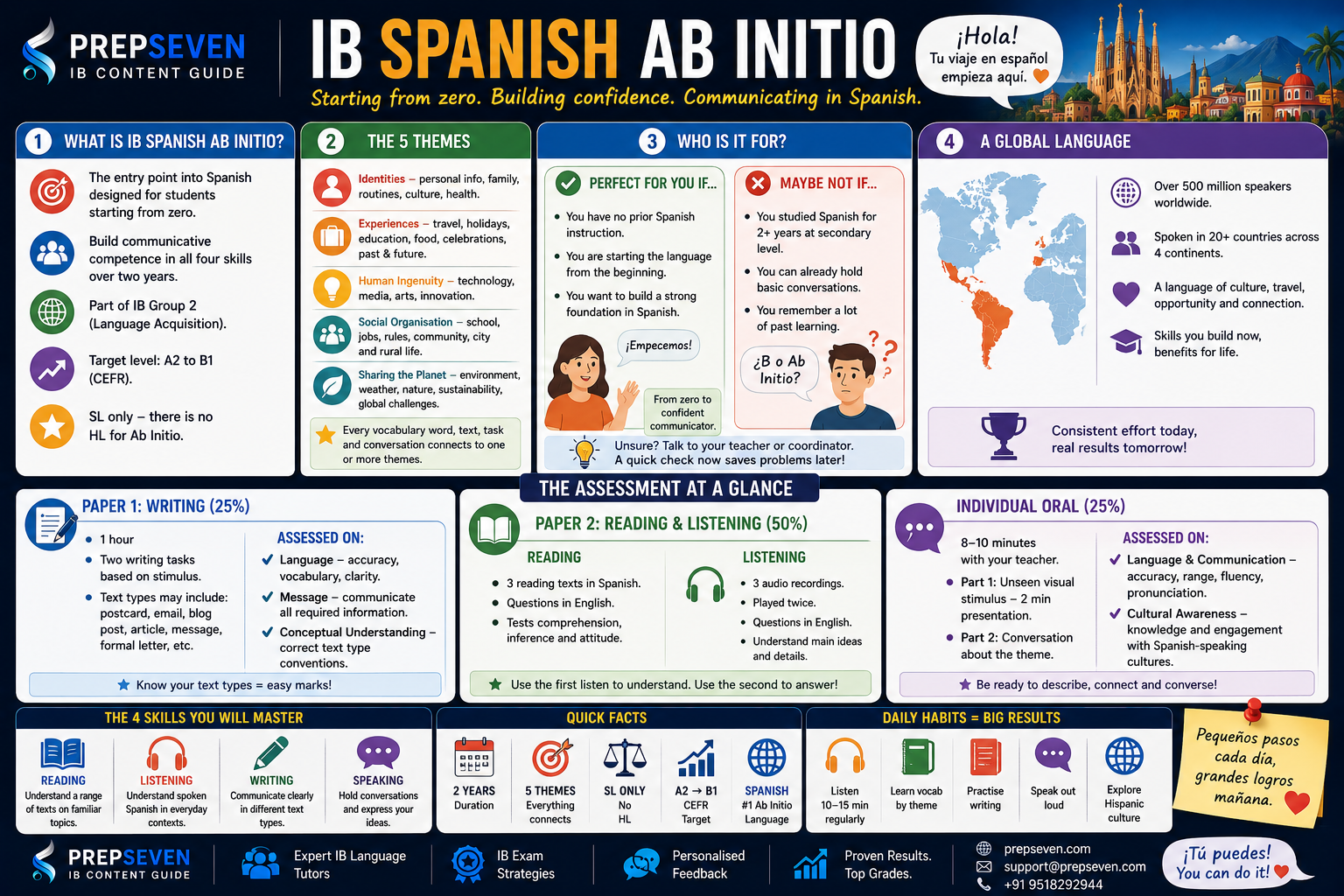
IB Spanish Ab Initio is the entry point into Spanish in the IB Diploma Programme, designed specifically for students who are beginning Spanish from zero. Ab initio is Latin for from the beginning, and that is exactly what the course does. It builds communicative competence in Spanish across all four language skills over two years, starting with the assumption that you have no prior knowledge of the language at all.
The course is offered at Standard Level only. There is no Higher Level version of Ab Initio in any language. It sits in Group 2 of the diploma alongside Spanish B and satisfies the Group 2 language requirement for students who are genuinely starting a new language in the IB. Spanish is the most widely taken Ab Initio language in the IB worldwide, which reflects both the accessibility of Spanish as a starting language and the global demand for Spanish proficiency.
The course is structured around five themes that run through every aspect of learning: identities, experiences, human ingenuity, social organisation, and sharing the planet. Every vocabulary set, grammar structure, reading text, and oral exercise connects to one or more of these themes. By the end of two years, the IB expects students to have reached a level roughly equivalent to A2 to B1 on the Common European Framework of Reference, which means you can handle straightforward communication tasks, understand the main points of clear messages and texts in Spanish, and express yourself on familiar topics with reasonable accuracy.
Spanish is often described as one of the easier languages for English speakers to begin, and there is some truth to this: the phonetic spelling system, the shared Latin vocabulary with English, and the relatively consistent grammar patterns make early progress feel achievable. But going from zero to A2 or B1 in two years while managing a full IB workload still requires genuine consistency. Students who treat Ab Initio as the low-effort language option tend to plateau early and find the exam more demanding than they anticipated.
Who Is IB Spanish Ab Initio Actually For?
The answer matters because choosing the wrong course creates problems that are difficult to fix once the two years have started. Spanish Ab Initio is the right course if you have genuinely had no formal Spanish instruction, or only very brief and non-sustained exposure such as a semester in primary school with no continuation.
Students who have studied Spanish for two years or more at secondary level, even if they feel their Spanish is weak, are usually better placed in Spanish B SL rather than Ab Initio. The reason is both developmental and practical: Spanish B will push your language further and produce more meaningful improvement, and the IB is alert to students who are enrolled in a course that is below their actual proficiency level.
If you are unsure whether Ab Initio or Spanish B is the right level for you, ask your teacher or coordinator for a brief placement conversation or written exercise before committing. Starting in the wrong course and realising mid-year is significantly more disruptive than taking ten minutes to check at the outset.
The Five Themes: The Framework Behind Everything
Every component of IB Spanish Ab Initio is organised around five themes. These themes are not separate content units to be studied one at a time. They are the contexts through which your Spanish develops, and they are the framework the exam is built around. Understanding them from your first week helps you see how class activities, vocabulary work, and assessment all connect.
Organising your vocabulary learning by theme from the very first week of Year 1 is one of the highest-return habits you can build in this course. When you learn words related to travel and holidays, they go under Experiences. When you learn vocabulary about technology, it goes under Human Ingenuity. This organisation mirrors the structure of both exam papers and the oral, which means retrieval under pressure is significantly faster than it would be if vocabulary is stored randomly by textbook chapter or week of class.
Assessment Breakdown: How You Are Graded

Ab Initio has three assessed components that together test all four language skills across the five themes.
Paper 1: Writing Tasks
Paper 1 is one hour long and asks you to complete two writing tasks. Each task provides stimulus material and specifies a text type and context. You might be asked to write a postcard to a friend about a trip, an email to a host family introducing yourself, a short article about an environmental issue for a school magazine, or a message about your weekend plans. The tasks are designed to be accessible at Ab Initio level, which means familiar contexts and manageable vocabulary demands.
Each writing task is assessed on three criteria: Language, Message, and Conceptual Understanding of the text type. Language covers grammatical accuracy, vocabulary range, and clarity of expression. Message covers whether you have communicated the required content fully and clearly. Conceptual Understanding covers whether your writing demonstrates genuine awareness of the conventions appropriate to the specific text type.
The Conceptual Understanding criterion is where marks are won or lost based on preparation that requires almost no additional Spanish ability. A postcard is brief and informal, uses short sentences, ends with a greeting. A formal email uses usted rather than tu, includes appropriate Spanish opening and closing formulas, and maintains a structured tone throughout. These conventions are specific, learnable, and directly assessed. Students who have not studied them before the exam consistently leave marks on the table that a single afternoon of focused preparation would have secured.
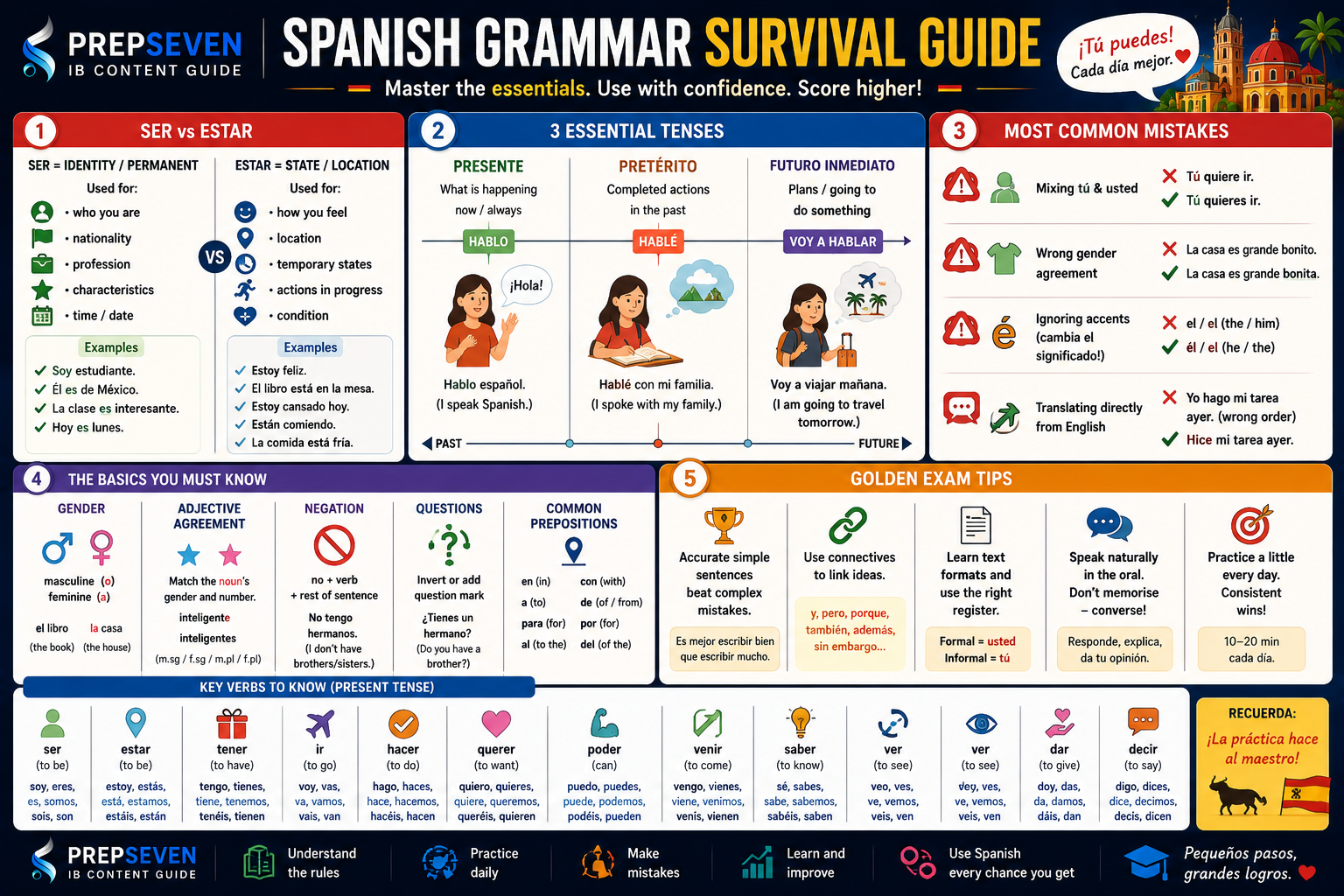
One feature of Spanish that affects Paper 1 immediately: the formal usted versus informal tu distinction maps directly onto your text type choice. Any formal writing task, a letter to a school, an email to an institution, a report for an authority, requires usted. Any informal task, a message to a friend, a postcard to family, a blog post with a personal voice, uses tu. Mixing them within a single writing task is a register error that affects both the Language and the Conceptual Understanding criteria simultaneously. Build the habit of deciding which register applies before you write a single word.
Paper 2: Reading and Listening Comprehension
Paper 2 is one hour thirty minutes long and is divided into two sections. The reading section presents three written texts in Spanish, each connected to one of the five themes, and asks comprehension questions answered in English. The listening section plays three audio recordings in Spanish, also theme-connected, and asks comprehension questions answered in English.
The fact that you answer in English is important and often underappreciated. Paper 2 tests your ability to understand Spanish, not to produce it. A student whose written Spanish is still developing can score very strongly in Paper 2 if their reading comprehension and listening comprehension are solid. These are genuinely separate skills and students who invest preparation time exclusively in writing sometimes discover too late that Paper 2 carries twice the weight of Paper 1.
Reading comprehension at Ab Initio level tests three things: locating specific information stated directly in the text, understanding meaning that is implied rather than stated, and recognising the writer’s attitude or purpose in specific passages. The third type is where students who read carefully and analytically score higher than those who scan for familiar words. A text might use positive vocabulary about a topic while the overall tone is actually ironic or critical. Reading for attitude requires attending to the whole text rather than pulling out familiar phrases.
The listening section is consistently the most challenging component for Ab Initio students to improve quickly. When you read, you can pause, reread, and process at your own pace. When you listen, the audio continues regardless. Building listening comprehension in Spanish requires sustained exposure to authentic spoken Spanish throughout both years, not intensive practice in the weeks before the exam. The ear needs time to adjust to the rhythm, speed, and sound patterns of natural Spanish, and that adjustment cannot be rushed.
Each audio recording in Paper 2 is played twice. Use the first listening to understand the overall topic, the main speakers, and the general situation. Use the second listening to verify your answers and pick up the specific details you need for the questions. Students who try to answer all questions completely during the first listening often lose track of content they would have caught easily on the second pass. Resist the urge to write answers during the first listen. Use it to understand. Write during the second.
Individual Oral
The Individual Oral is conducted by your teacher, recorded, and externally moderated by the IB. It contributes 25% of your final grade and lasts approximately eight to ten minutes. It has two parts.
In the first part, you are shown an unseen visual stimulus, a photograph or image connected to one of the five themes, and given a few minutes to prepare. You then speak about the image for approximately two minutes: describing what you see, connecting it to the relevant theme, and offering your own response to what it represents. In the second part, your teacher leads a conversation based on the stimulus and the broader themes, asking you questions and following up on what you have said.
The oral is assessed on two criteria: Language and Communication, and Cultural Awareness. Language and Communication covers the accuracy and range of your Spanish, your pronunciation, and your ability to maintain a genuine conversation. Cultural Awareness covers whether you demonstrate knowledge of and engagement with Spanish-speaking cultures in your responses. The Cultural Awareness criterion does not require encyclopedic knowledge of every Spanish-speaking country. It rewards students who can make relevant, specific references to Hispanic cultures, communities, or practices when they arise naturally in the conversation.
The conversation portion of the oral is where marks are most consistently made or lost. Students who have prepared only a two-minute description of the visual stimulus often run out of meaningful Spanish to say when the teacher begins asking follow-up questions about the theme. The teacher can ask you about your own life, your opinion on topics related to the image, how the theme plays out in Spanish-speaking countries you have encountered in your course, or anything else connected to the five themes. Preparing for this conversation means practising spontaneous responses to unpredictable questions in Spanish, not memorising a prepared speech.
The Grammar You Actually Need: What to Prioritise
Spanish grammar is extensive, but Ab Initio does not require you to master all of it. It requires confident, accurate command of the structures that are genuinely necessary for communication at A2 to B1 level. These are specific, learnable, and worth prioritising over trying to understand the entire grammatical system before you are ready.
The distinction between ser and estar is the grammar point that causes more confusion for English-speaking Spanish learners than almost any other. Ser is used for permanent or defining characteristics: nationality, profession, inherent qualities. Estar is used for states, conditions, and locations: how someone feels, where something is, temporary situations. The rule is learnable but requires consistent practice to become automatic. Build sentences using both from the very first month of Year 1 and correct yourself deliberately every time you mix them up.
What Actually Gets Students to a 7
They organise vocabulary by theme from week one
Students who store vocabulary by the five themes from the beginning of Year 1 arrive at the exam with a mental filing system that matches how both papers are structured. When Paper 2 presents a reading text about environmental issues, relevant vocabulary is retrieved quickly from the Sharing the Planet section of their notes. When Paper 1 asks them to write about a holiday experience, the Experiences theme vocabulary is accessible without the effort of searching through unorganised word lists. This is a simple habit change with a significant cumulative benefit over two years.
They listen to Spanish outside class every week
The listening section of Paper 2 carries substantial weight and it is the hardest skill to improve quickly. The ear adjusts to natural spoken Spanish only through sustained exposure over time. Students who have listened to Spanish regularly throughout both years, through podcasts for learners, Spanish-language YouTube content, short news broadcasts, or even simple telenovelas or children’s programming, develop listening comprehension that cannot be built by cramming in the final weeks before the exam. Ten to fifteen minutes three or four times a week builds far more than an hour once a week.
They practise text type conventions before the exam, not during it
Paper 1’s Conceptual Understanding criterion is one of the most accessible sources of marks in the entire Ab Initio course and one of the most consistently underused. Students who have written at least one example of every likely text type, a postcard, a formal email, a blog post, a short article, a message to a friend, and who have received feedback on whether the format conventions are correct, arrive at Paper 1 knowing exactly what each text type requires. Students who encounter an unfamiliar text type for the first time in the exam room produce something formally incorrect regardless of how much Spanish they know.
They practise speaking Spanish out loud, regularly
The Individual Oral is a spoken performance. The ability to speak Spanish with reasonable fluency under assessment conditions is a physical skill: your mouth needs to produce Spanish sounds, your memory needs to retrieve words and structures, and your mind needs to process meaning and formulate responses, all simultaneously in real time. None of these processes develop through silent revision. Students who speak Spanish regularly throughout both years, in class, with a tutor, with a language partner, or even talking to themselves in Spanish during daily routines, develop the oral automaticity that makes the Individual Oral manageable. Students who have only studied Spanish silently often find the oral much harder than the papers.
They prepare for the oral conversation, not just the stimulus description
The two-minute stimulus description at the start of the oral is the part students consistently over-prepare. The subsequent conversation, which lasts six to eight minutes more, is where spontaneous language ability is tested. Students who have rehearsed their stimulus description thirty times but never practised responding to unpredictable questions in Spanish often freeze or revert to English when the conversation goes somewhere they have not anticipated. Effective oral preparation means practising spontaneous responses to a wide range of questions across all five themes, out loud, in Spanish, with someone who can probe and follow up.
Common Mistakes That Cost Marks
A Realistic Year-by-Year Approach
Year 1 (Grade 11): Build Foundations Systematically
- Set up a vocabulary notebook organised by theme from week one. Every new word goes into its theme category. Review each section weekly rather than cramming before tests.
- Establish a Spanish listening habit within the first month. Coffee Break Spanish, Dreaming Spanish, or News in Slow Spanish are all excellent resources pitched at beginner to intermediate level. Ten to fifteen minutes three times a week is more effective than an hour once a week.
- Master the present tense of the twelve most common Spanish verbs until they are completely automatic: ser, estar, tener, ir, hacer, querer, poder, venir, saber, ver, dar, and decir. These verbs appear in almost every sentence you will ever produce in Spanish.
- Write one Paper 1 style practice task per month from the end of Term 1 onwards. Ask for feedback specifically on the three criteria: Language accuracy, Message completeness, and text type conventions.
- Practise the ser versus estar distinction deliberately in every class exercise. Do not move past a sentence that uses one of them without checking whether you have chosen correctly.
Year 2 (Grade 12): Consolidate and Prepare to Perform
- Complete at least four full timed Paper 1 practice sessions before your mock exams, covering different text types. Practise the ones you find hardest and ask for written feedback on each.
- Do at least three full Paper 2 reading and listening practice sets under exam conditions. Use past paper audio from your teacher and practise the two-listen strategy on every recording.
- Practise the Individual Oral at least three times in realistic conditions: with a teacher or tutor who shows you a stimulus image, listens to your description, and then conducts an unpredictable follow-up conversation in Spanish.
- In the final revision period, target your weakest theme vocabulary. Past Paper 2 texts are the most useful revision material because they expose you to authentic Spanish at the right level in the exact thematic contexts that will appear in your exam.
How PrepSeven Helps You Score Higher in IB Spanish Ab Initio
Learning a language from zero while managing a full IB Diploma workload is one of the more demanding things a student can take on. Our Spanish Ab Initio tutors are experienced IB language teachers who understand both what the course requires and what the specific challenges of adult language learning from zero actually feel like.
- Paper 1 writing sessions where you complete a timed practice task, your tutor marks it against the three IB criteria, and you work through specifically how to improve language accuracy, message completeness, and text type awareness in your next attempt.
- Paper 2 comprehension sessions where your tutor builds your reading strategy for Spanish texts at your level, works through listening comprehension exercises using past paper audio, and helps you develop the inference and attitude skills that go beyond simple information location.
- Individual Oral preparation sessions where your tutor presents a stimulus image, conducts a full mock oral in Spanish, and gives detailed feedback on both your language use and your ability to sustain a conversation across all five themes.
- Grammar and vocabulary sessions targeted at the specific areas where your accuracy is weakest, built around the structures that carry the most weight across all three assessment components.
Book your free demo lesson at prepseven.com. Whether you are just starting Spanish from zero or approaching the exam and looking for targeted preparation, your tutor will show you exactly where you stand against the IB criteria and what it takes to reach a 7.