
PrepSeven | IB Content Guide authored by Shankar Mutneja (Founder of Prepseven)
IB Psychology
What Is IB Psychology?
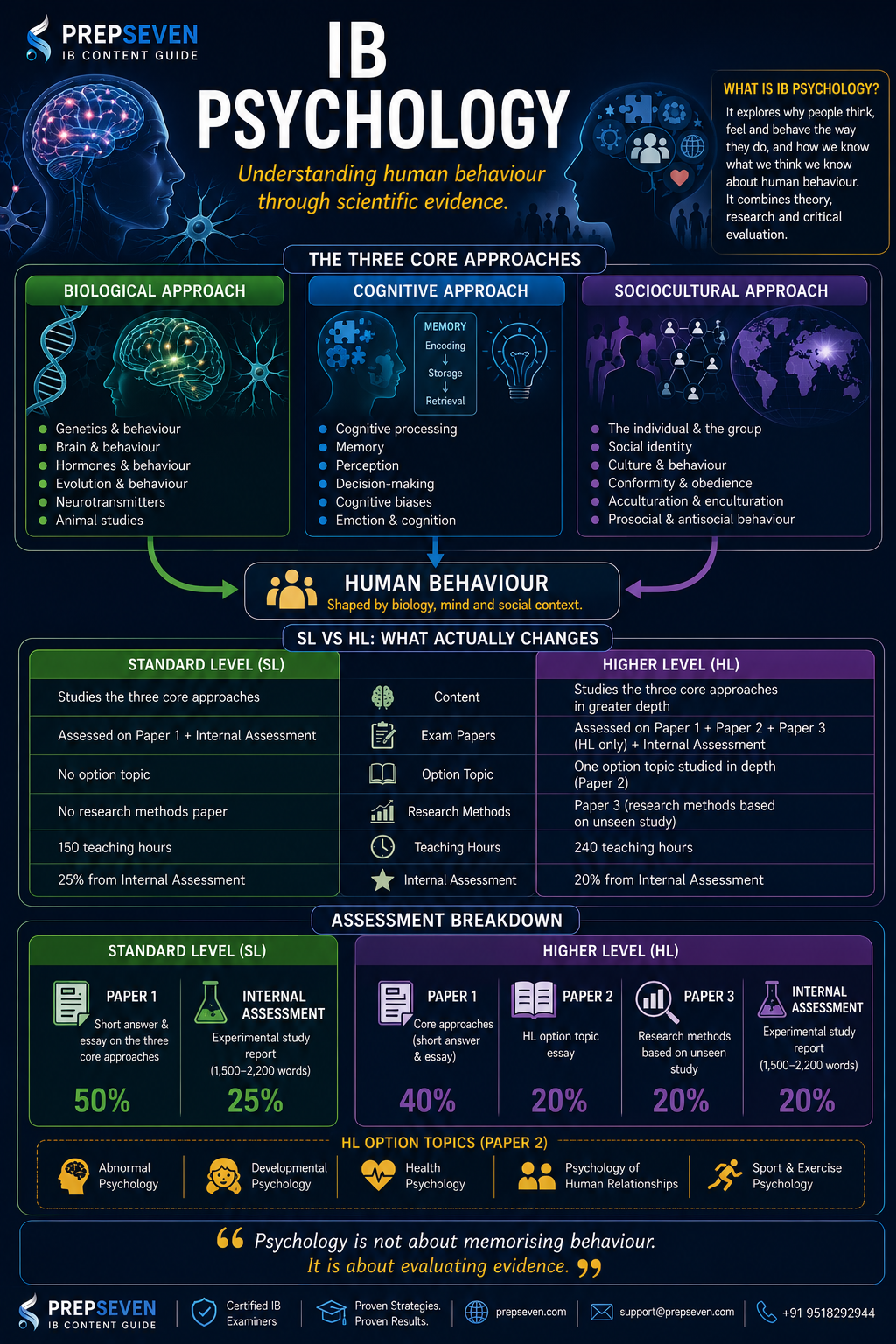
IB Psychology is a course about why people think, feel, and behave the way they do, and more importantly, how we know what we think we know about human behaviour. It sits in Group 3 of the Diploma Programme and is available at both Standard Level and Higher Level. It is one of the most popular Group 3 subjects in the world, and it is also one of the most misunderstood in terms of what it actually requires.
The course is built around three levels of analysis: the biological approach, which examines how genetics, neuroscience, and physiology shape behaviour; the cognitive approach, which examines how mental processes like memory, perception, and decision-making influence what we do; and the sociocultural approach, which examines how social context, culture, and group membership affect human behaviour. At HL, students also study an additional option topic in depth, chosen from abnormal psychology, developmental psychology, health psychology, psychology of human relationships, and sport and exercise psychology.
What makes IB Psychology genuinely demanding is that it is not primarily a content course. Students sometimes arrive expecting to learn theories about human behaviour and repeat them in essays. What the IB actually requires is something more sophisticated: the ability to evaluate the research evidence for and against those theories, to understand the methodological strengths and limitations of the studies that produced that evidence, and to construct arguments about what psychology can and cannot tell us about human behaviour. The content is the vehicle. Critical thinking is the destination.
IB Psychology is not biology, and it is not philosophy, though it draws on both. It is the scientific study of behaviour and mental processes, and the IB version of the course places the emphasis on science: how psychological knowledge is produced, what counts as good evidence, and what the limitations of that evidence are. Students who approach it as a subject about interesting human behaviour stories will find the evaluation and methodology requirements much harder than they expected.
SL vs HL: What Actually Changes
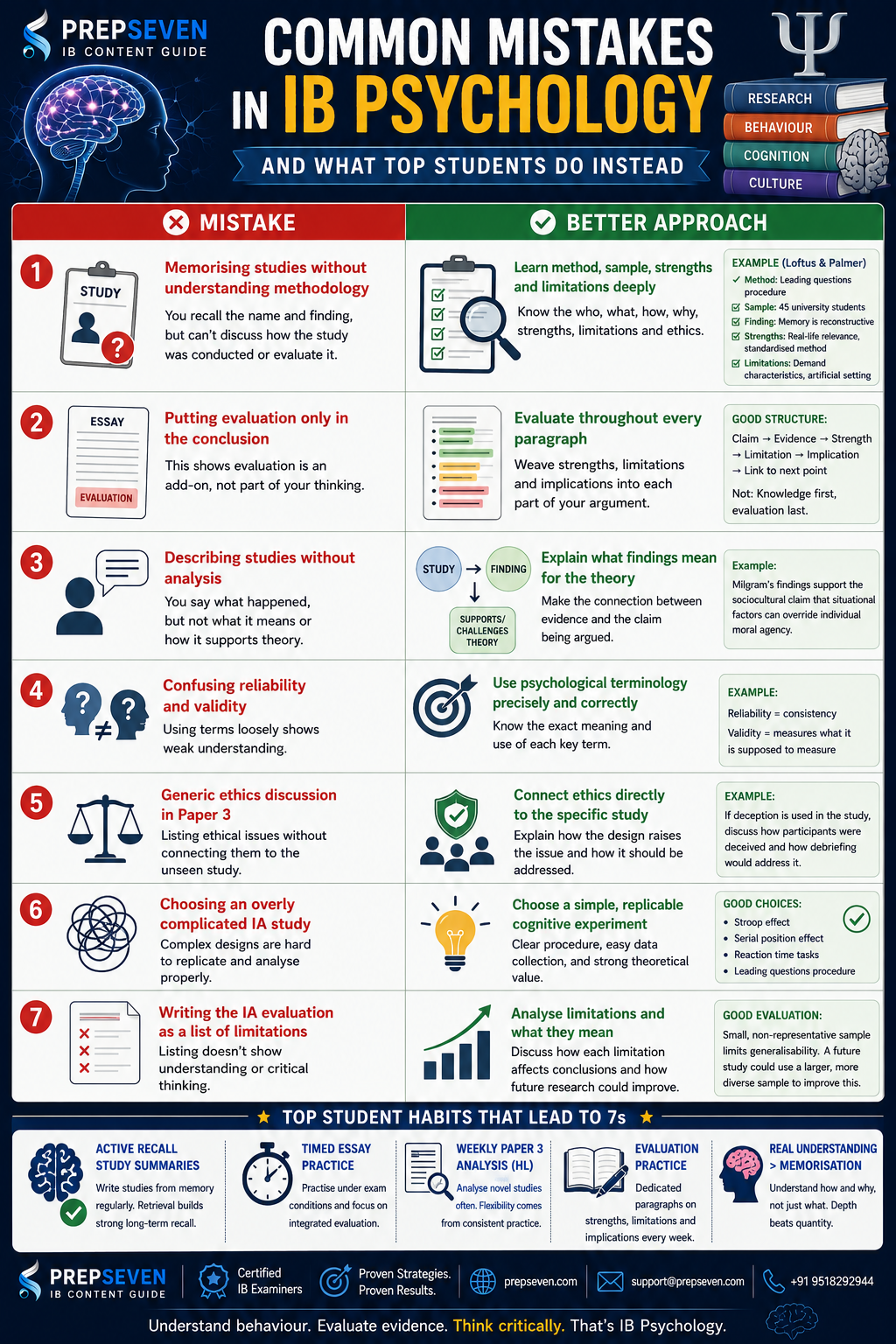
The difference between Psychology SL and HL is more substantial than many students realise before they commit to the level. HL students cover an additional option topic in depth, sit a third exam paper, and are held to a higher standard of critical evaluation across all components.
HL Paper 3 deserves particular attention because it is unlike anything else in the IB. It presents a description of a previously unseen psychological study and asks you to analyse it from a research methods perspective: identify the research method used, evaluate its strengths and limitations, discuss ethical considerations, and suggest modifications or extensions. There is no content to revise for Paper 3. What it tests is whether you genuinely understand how psychological research works, which is something that needs to be developed throughout the course rather than crammed before the exam.
If you are considering studying psychology, neuroscience, medicine, education, social work, or any health-related discipline at university, HL Psychology is a meaningful preparation. The research methods content at HL in particular gives you a head start in the quantitative and qualitative methods modules that appear in almost every psychology and social science degree in the first year.
What the Syllabus Covers
The Three Core Approaches
All students, SL and HL, study the three core approaches. Each approach is taught through a specific set of content areas, and each is examined in Paper 1.
The HL Option Topics
HL students study one of the following five option topics in depth. The choice is made by the school, not the individual student. Each option is examined in Paper 2 through extended essay questions.
The option topic your school chooses affects your Paper 2 preparation significantly. If you know your school offers Abnormal Psychology, for example, your revision for Paper 2 will look very different from a student whose school offers Sport and Exercise Psychology. Confirm your school’s option choice early in Year 1 so you can engage with the content from the start rather than discovering it late in Year 2.
Assessment Breakdown: How You Are Graded
Paper 1: The Core Approaches
Paper 1 is two hours long for both SL and HL. It is divided into two sections. Section A contains three short-answer questions, one on each of the three approaches, and you answer all three. Section B contains essay questions and you choose one essay to write.
The short-answer questions in Section A are typically worth eight marks each and ask you to describe and evaluate a particular psychological concept or study within a specific approach. The command terms are important here: a question using the term explain requires something different from one using the term evaluate, and students who conflate these terms consistently lose marks on questions they actually know the content for.
The Section B essay is worth twenty-two marks and is the single highest-value question on the paper. Essay questions in Psychology require you to do three things simultaneously: demonstrate knowledge of relevant psychological theory and research, evaluate the evidence for and against the claims you are making, and construct a coherent argument that reaches a justified conclusion. Students who produce knowledge-heavy essays without genuine evaluation rarely score above the middle bands. Students who evaluate throughout, not just in a final paragraph, consistently score higher.
The most important single habit for Paper 1 essay writing: evaluation should be woven through the essay, not added at the end. A common structure that loses marks is: three paragraphs of theory and research, followed by one paragraph of evaluation, followed by a conclusion. The IB rewards students who are critically evaluating throughout each paragraph. A strong structure might be: claim, supporting research, strength of that research, limitation of that research, how that limitation affects the strength of the original claim. Repeat across multiple claims. Conclude by weighing the overall evidence.
Paper 2: HL Option Topic Essay (HL Only)
Paper 2 is one hour long and contains essay questions on the HL option topic. You answer one essay from a choice of questions. The essay is worth twenty-two marks and is assessed on the same criteria as the Paper 1 essay: knowledge, understanding, application, and critical evaluation.
Paper 2 is where HL students who have engaged deeply with their option topic and built a strong bank of relevant research studies have a significant advantage. The option essays reward students who can draw on a range of studies from different perspectives within the option, who can discuss the methodological quality of those studies, and who can apply psychological concepts to real-world contexts within the option area. Knowing three or four studies extremely well, including their methodology, findings, limitations, and ethical considerations, is more valuable than knowing ten studies superficially.
Paper 3: Research Methods (HL Only)
Paper 3 is one hour long and presents a description of a previously unseen psychological study. It asks a series of structured questions about that study from a research methods perspective. The questions typically cover: identifying the research method used, explaining the sampling technique, evaluating the credibility or reliability of the study, discussing ethical considerations, and suggesting how the study could be modified or followed up.
Paper 3 is the component that most clearly rewards students who have genuinely understood research methodology throughout the course rather than those who have memorised lists of strengths and limitations. The study you are given is new. You have never seen it before. The questions require you to apply your understanding of methodology flexibly to an unfamiliar research scenario. Students who have practised this kind of transfer, analysing novel studies using their knowledge of research methods, are consistently better placed than those who have only revised methodology as a content topic.
A key insight for Paper 3: the ethical considerations question is often underperformed. Students tend to list generic ethical issues such as informed consent, debriefing, and protection from harm without connecting them specifically to the study described. Paper 3 marks for ethics are awarded for discussion of how specific ethical issues arise in the specific study and how a researcher would address them, not for a rehearsed list of principles.
Internal Assessment: The Experimental Study
The Internal Assessment for IB Psychology is an experimental study report of 1,500 to 2,200 words. You replicate a simple cognitive psychology experiment, collect data, analyse it using descriptive statistics, and write up your findings in a structured scientific report format. It carries 25% of your final grade.
The IA is assessed on five components: introduction, exploration, analysis, evaluation, and presentation. The introduction requires you to describe the original study you are replicating, explain the theoretical background, and state your hypothesis. The exploration section describes your methodology. The analysis presents your results using descriptive statistics and a visual representation of the data. The evaluation discusses what your results mean and what the limitations of your study are.
The evaluation section is consistently where students either demonstrate genuine scientific thinking or reveal that they have gone through the motions. A strong evaluation discusses not just what the limitations are but what those limitations mean for the conclusions that can be drawn. If your sample was small and unrepresentative, the question is not just that this is a limitation but what it means for the generalisability of your results and how a future study could address it. That level of analytical engagement is what distinguishes a high-scoring IA from an average one.
The IA replication must be based on a cognitive psychology study from the published literature, not on a biological or sociocultural study. Most students replicate classic studies in memory, attention, or perception, such as variations on Stroop’s colour-word interference task, Loftus and Palmer’s work on leading questions, or studies of the serial position effect. Choose a study that is methodologically simple enough to replicate feasibly in a school setting but rich enough in theoretical implications to write a substantial evaluation section about.
Building Your Research Study Bank: The Foundation of Everything
In IB Psychology, studies are the currency of every exam answer. You cannot evaluate a theory without evidence, and in psychology, evidence means research studies. The question is not whether to know studies. The question is how many, how deeply, and how flexibly.
Students who try to memorise a large number of studies superficially, knowing the name, the basic finding, and one limitation, consistently perform worse than students who know a smaller number of studies deeply. Knowing a study deeply means knowing its methodology well enough to discuss its strengths and limitations in relation to specific claims, knowing its findings precisely enough to use them as evidence for more than one argument, and understanding its ethical dimensions well enough to discuss them in the context of Paper 3 style questions.
A practical target: for each of the three core approaches, know four to six studies extremely well. Know the researcher names, the method, the sample, the key findings, at least two methodological strengths, at least two methodological limitations, and any ethical considerations raised by the study. For your HL option topic, know an additional four to six studies at the same depth. This is not a large number of studies. It is a manageable number of studies known with genuine depth rather than surface familiarity.
The single most useful revision activity in IB Psychology is writing study summaries from memory, then checking them against your notes and identifying what you missed or misremembered. Do this for every key study in your bank regularly throughout Year 2. Students who can retrieve accurate study details under exam pressure without prompting consistently outperform those who can only recall details when they can see their notes.
What Actually Gets Students to a 7
They evaluate throughout, not just at the end
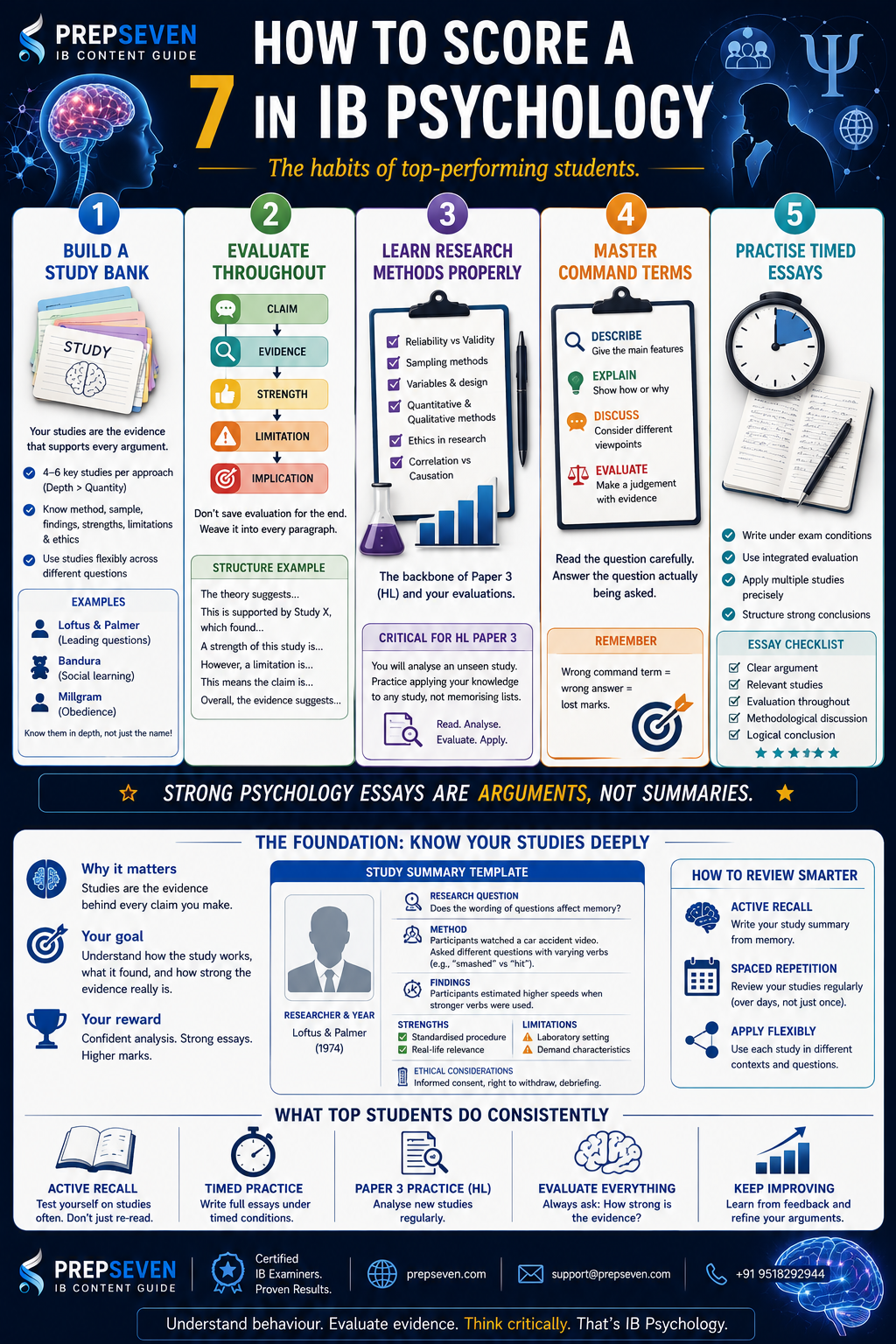
The most consistent mark-limiting pattern in IB Psychology essays is the back-loaded evaluation: several paragraphs of knowledge and description, followed by a brief critical section and a conclusion. IB examiners award marks for evaluation that is integrated throughout the response. In practice, this means that after you present a theory or finding, you immediately ask: what is the evidence for this, how reliable is that evidence, what are its limitations, and what does that mean for the strength of the original claim? This rhythm of claim, evidence, critical evaluation should run through every paragraph of every essay.
They discuss methodology, not just findings
Students who describe what a study found without discussing how it found it are performing at a lower analytical level than the top band requires. The methodology of a study determines how much confidence we can place in its findings. A brain imaging study on emotion and memory is more convincing if the sample size is large, the imaging technique is valid, and the conditions are well-controlled. A self-report questionnaire on cultural values is less convincing if participants are from a single university in a single country. These methodological considerations are the substance of genuine psychological evaluation, and the examiners are specifically looking for them.
They use the language of psychology precisely
IB Psychology has a specific vocabulary, and using it precisely matters. There is a difference between reliability and validity, between a correlation and a cause, between a theory and a model, between generalisation and determinism, between ethical guidelines and ethical principles. Students who use these terms loosely or interchangeably signal to examiners that they have a surface-level understanding. Students who use them precisely and consistently signal genuine conceptual understanding. Build the habit of defining psychological terms carefully and using them deliberately rather than reaching for them as general-purpose academic language.
They connect studies to specific claims, not to approaches in general
A weak way to use a study: ‘Milgram’s obedience study supports the sociocultural approach.’ A strong way to use the same study: ‘Milgram’s findings that 65% of participants delivered what they believed were lethal electric shocks when instructed by an authority figure demonstrate that situational factors can override individual moral agency, supporting the sociocultural claim that behaviour is significantly shaped by social context and authority structures.’ The second version earns marks. The first version describes. The difference is in the specificity of the connection between the evidence and the claim being argued.
They prepare Paper 3 by analysing novel studies, not by memorising methodology lists
HL students who revise for Paper 3 by memorising lists of research methods and their generic strengths and limitations are preparing for a different exam than the one they will sit. Paper 3 gives you a study you have never seen and asks you to analyse it. The preparation that works is practising this skill on novel studies throughout the course: reading short study descriptions and asking, what method is this, what are the specific strengths of this method in this context, what are its specific limitations given this sample and these conditions, and what ethical issues does this particular design raise? Regular practice with unfamiliar material is what builds the flexible application Paper 3 demands.
Common Mistakes That Cost Marks
A Realistic Year-by-Year Approach
Year 1 (Grade 11): Build Your Knowledge Base and Research Fluency
- As each approach is taught, build a study bank for it immediately. For every key study covered in class, write a structured summary: researcher, year, method, sample, findings, two strengths, two limitations, ethical considerations. Do this as you go, not in retrospect.
- Practise writing short evaluation paragraphs from the start of Year 1. After each new study is introduced in class, write one paragraph that describes the study and evaluates its methodology. This builds the habit of integrated evaluation early, before the exam pressure of Year 2 arrives.
- For HL students: engage with Paper 3 preparation from the beginning. Every time a study is discussed in class, practise identifying its research method, its sampling technique, and at least one ethical consideration. This takes two minutes per study and builds the analytical reflex Paper 3 requires.
- Begin your IA preparation in Term 2 of Year 1. Identify potential studies for replication, discuss feasibility with your teacher, and start thinking about your hypothesis and methodology well before the formal IA period begins.
Year 2 (Grade 12): Deepen Evaluation and Practise Under Exam Conditions
- Write at least four full timed essay responses under exam conditions before your mock exams. Ask your teacher or tutor to mark them using the IB criteria and focus the feedback specifically on evaluation quality and study application.
- For HL students: practise Paper 3 using novel study descriptions at least once a month. Your teacher can source these from psychology journals or past-paper style resources. The goal is comfort with unfamiliar material, which only comes from repeated exposure.
- Complete your IA and submit the first draft for teacher feedback before the end of Term 1. Pay particular attention to the evaluation section and the quality of your descriptive statistics and data presentation.
- In the final revision period, do active recall revision on your study bank: cover your notes and write out every study from memory, then check what you missed. Do this for your weakest approach first. The studies you struggle to recall accurately are exactly the studies most likely to cost you marks if they come up in the exam.
How PrepSeven Helps You Score Higher in IB Psychology
The gap between a 5 and a 7 in IB Psychology is almost entirely about evaluation quality and the depth of study knowledge. Our Psychology tutors are experienced IB examiners and teachers who understand precisely what integrated evaluation looks like at the 7 level and how to develop it in students who are currently producing knowledge-heavy but critically thin responses.
Here is what working with a PrepSeven Psychology tutor typically looks like:
- Essay writing sessions where you write a timed response and your tutor marks it against the IB criteria, annotating every paragraph to show where evaluation is missing, where study methodology should have been discussed, and where the argument structure needs strengthening.
- Study bank sessions where your tutor tests your knowledge of key studies through active recall, identifies gaps in your depth of understanding, and teaches you how to use each study flexibly across different essay questions.
- Paper 3 practice sessions for HL students where your tutor presents novel study descriptions and works through the questions with you, building the methodological analysis skills that Paper 3 demands and showing you how to connect ethical issues specifically to the study at hand.
- IA mentorship from study selection and hypothesis formation through to final draft, with close attention to the evaluation section and the quality of statistical analysis and data presentation.
Book your free demo lesson at prepseven.com and bring a Psychology essay you have already written. Your tutor will show you exactly where the evaluation is thin and what a 7-band version of the same argument looks like.