
PrepSeven | IB Content Guide authored by Shankar Mutneja (Founder of Prepseven)
IB Physics
What Is IB Physics?
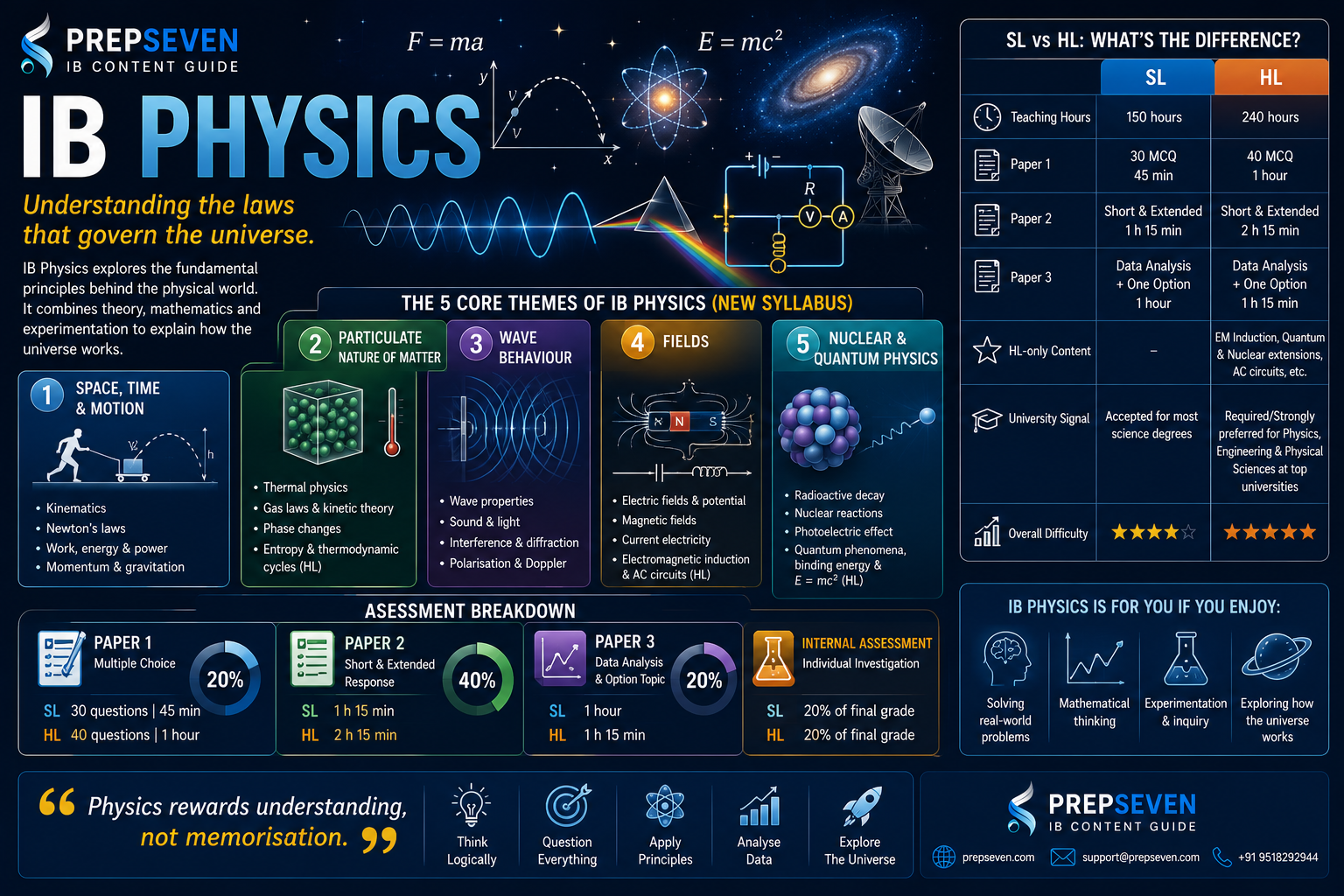
IB Physics is one of the most demanding subjects in the Diploma Programme and, for the right student, one of the most rewarding. It sits in Group 4 alongside Biology, Chemistry, and Environmental Systems and Societies, and it is available at both Standard Level and Higher Level. Physics HL in particular is widely regarded as among the most challenging two-year science courses available at pre-university level anywhere in the world.
The course covers the fundamental principles that govern the physical world: mechanics, thermodynamics, waves and optics, electricity and magnetism, nuclear and particle physics, and at HL, additional topics in astrophysics, quantum mechanics, and electromagnetic induction. What connects all of these areas is a common way of thinking: identifying the underlying physical principle, expressing it mathematically, applying it to a specific situation, and checking whether the result makes sense in terms of units, magnitude, and physical intuition.
That last part, physical intuition, is something many students undervalue. IB Physics rewards students who do not just know the equations but understand what they mean. A student who has memorised F = ma without understanding that it describes how the net force on an object produces acceleration proportional to its mass, and that this has specific implications for how objects of different masses respond to the same force, will struggle the moment a question presents a slightly unfamiliar application of Newton’s second law. The physics matters as much as the mathematics.
IB Physics is not a course you can perform well in through memorisation alone. The questions are designed to test understanding in unfamiliar contexts, not recall of familiar examples. A student who has genuinely understood the principles behind each topic will handle an unfamiliar application of those principles. A student who has only memorised worked examples will not. This distinction determines more exam outcomes in Physics than in almost any other IB subject.
SL vs HL: Understanding the Real Difference
The decision between Physics SL and HL is one of the most consequential course choices in the IB, both in terms of workload and in terms of what it signals to universities. It is worth understanding precisely what the difference involves before committing.
The HL-only content in IB Physics is not just more content. It includes some of the most conceptually challenging material in the entire diploma: electromagnetic induction and Faraday’s law, the wave nature of matter, quantum phenomena including photoelectric effect and matter waves, and nuclear binding energy and mass-energy equivalence. These are not topics that respond well to surface-level revision. They require deep conceptual understanding developed over time, which is one reason Physics HL rewards students who engage seriously from the very first month of Year 1.
If you are planning to study physics, engineering, aerospace, or any physical science at university, particularly at selective institutions in the UK, Europe, or North America, research the specific entry requirements for your target programmes before finalising your course choice. Many will state Physics HL explicitly and set a minimum grade requirement of 6 or above. Discovering this requirement after you have chosen SL is a problem that is very difficult to solve.
The New IB Physics Syllabus: What Has Changed
IB Physics underwent a significant syllabus revision, with the new curriculum first assessed in May 2025. If you are currently in the Diploma Programme, you are almost certainly studying the new syllabus. The structure is different from the previous version and it is worth understanding the changes, particularly if you are using older revision resources.
The new syllabus is organised into five core themes rather than the previous topic-numbered structure. The five themes are: Space, Time, and Motion; The Particulate Nature of Matter; Wave Behaviour; Fields; and Nuclear and Quantum Physics. Each theme integrates content that was previously spread across separate topics, and the assessment approach has been updated to reflect a stronger emphasis on experimental skills and data analysis.
The option topics remain: Relativity, Engineering Physics, Imaging, and Astrophysics. However, the way they are integrated into Paper 3 has been updated. If you are using past papers from before May 2025, be aware that the question formats and some of the content coverage may differ from what you will encounter in your exam. Always verify that any revision resource you are using corresponds to the syllabus you are actually studying.
Past papers from the previous syllabus are still useful for practising physics problem-solving skills and data analysis, even if the specific topic structure differs. The underlying physics principles are the same. What changes is the way questions are framed and which topics are included or extended. Ask your teacher to clarify which past papers are most relevant to your specific syllabus year.
What the Syllabus Covers
Fields is the theme that most consistently challenges students, particularly at HL. The move from understanding electric and magnetic fields conceptually to applying them quantitatively, including Faraday’s law of electromagnetic induction, Lenz’s law, and the behaviour of alternating current circuits, requires a level of mathematical fluency and physical intuition that many students underestimate. Students who have not fully mastered Newton’s laws and energy conservation in Theme 1 find that those gaps compound when they reach the more demanding content in Fields.
The most important thing to understand about the IB Physics syllabus is that the topics are cumulative. Mechanics is the foundation for energy, which connects to thermodynamics, which connects to wave behaviour, which feeds into electromagnetic theory. Gaps in early topics do not stay contained. They propagate forward and make later topics significantly harder. This is why students who fall behind in Year 1 and plan to catch up in Year 2 often struggle: they are trying to learn new physics while simultaneously repairing foundations that should have been solid months earlier.
Assessment Breakdown: How You Are Graded
Paper 1: Multiple Choice
Paper 1 is entirely multiple choice: 30 questions at SL in 45 minutes, and 40 questions at HL in one hour. Each question has four options. There is no negative marking for wrong answers, so you should always attempt every question even when uncertain.
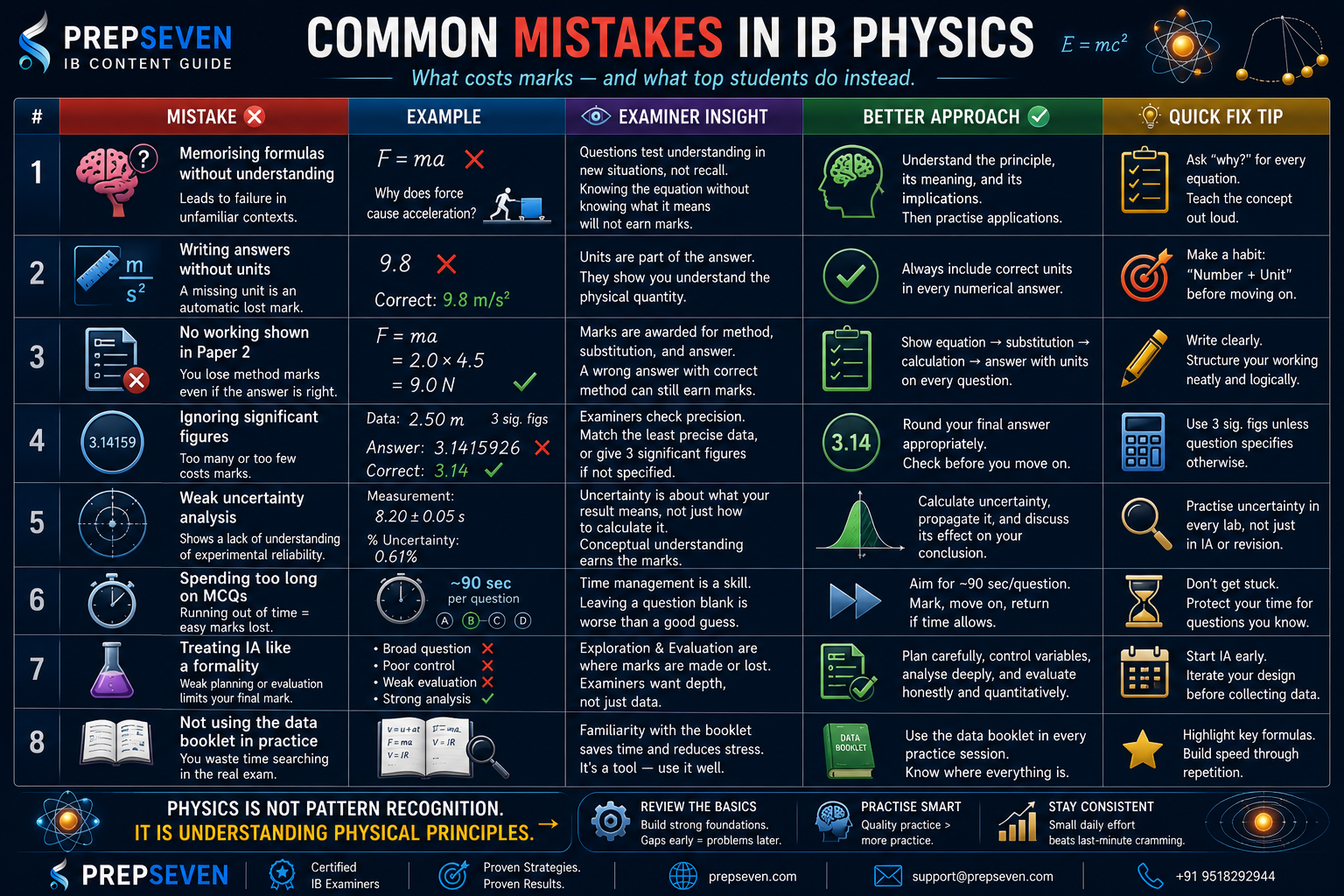
The multiple choice questions in IB Physics are not trivial. Many of them require you to work through a calculation or apply a principle in a context that is slightly different from anything you have seen before. Students who attempt Paper 1 without having practised calculation under time pressure find themselves running out of time. A pace of roughly 90 seconds per question is what Paper 1 demands. Students who are uncertain on a question should mark their best answer, note it for review if time allows, and move on rather than spending five minutes on a single question and running out of time for the ones they know well.
Data booklet familiarity is essential for Paper 1. The IB provides a data booklet with every exam containing all the equations and constants you need. Students who know where to find each formula instantly, and who understand what each symbol in each formula represents, can navigate Paper 1 significantly faster than students who search the booklet under time pressure. The data booklet is available from your teacher or the IB website. Spend time with it throughout both years, not just before the exam.
Paper 2: Short Answer and Extended Response
Paper 2 is the longest paper: one hour fifteen minutes at SL and two hours fifteen minutes at HL. It contains structured short-answer questions and extended response questions. The structured questions typically build through multiple parts, starting with accessible recall or application and progressing to more demanding analysis or evaluation. The extended response questions require sustained problem-solving over multiple steps.
Working is essential in Paper 2. Every calculation question requires you to show the equation you are using, the values you are substituting, and the result with units. A correct final answer with no working earns only the answer mark, typically one mark. A question worth four marks will usually allocate one mark for the correct equation, one for correct substitution, one for correct calculation, and one for the correct final answer with units. A student who makes an arithmetic error but shows correct method and correct units can earn three of those four marks. A student who writes only the wrong final answer earns nothing.
Units are a consistent source of lost marks in Paper 2 that requires almost no additional physics knowledge to address. Every numerical answer should include units unless the question asks for a dimensionless quantity. An answer of 9.8 where the correct answer is 9.8 m/s squared loses the unit mark. An answer of 9.8 m/s squared where the correct answer is 9.8 m/s squared earns it. Over an entire paper, these marks accumulate significantly.
Significant figures are specifically assessed in IB Physics Paper 2. The general rule is that your answer should be given to the same number of significant figures as the least precise data in the question, or to three significant figures if the question does not specify. Giving an answer to seven significant figures when the question data has three is penalised. Giving an answer to one significant figure when precision is expected is also penalised. Build the habit of checking significant figures on every numerical answer before moving on.
Paper 3: Data Analysis and Option Topic
Paper 3 has two sections. Section A presents a set of experimental data and asks you to analyse it: plotting graphs, calculating gradients, identifying relationships between variables, and evaluating experimental uncertainty. Section B presents questions on the option topic your school has chosen from Relativity, Engineering Physics, Imaging, and Astrophysics.
The data analysis section of Paper 3 is where students who have genuinely engaged with the Internal Assessment process have an advantage. The skills it tests, graphing data accurately, calculating gradients from best-fit lines, determining percentage uncertainty, and evaluating sources of systematic and random error, are exactly the skills the IA develops. Students who have understood and engaged with the IA process find Section A of Paper 3 substantially more manageable than those who treated the IA as a box-ticking exercise.
The option topic section rewards depth of preparation on a relatively contained body of content. Because the option is known in advance, it is one of the most directly reviable parts of the IB Physics course. Students who have worked through the option content methodically, built a set of solved problems covering every sub-topic, and practised past option questions perform well here even if other parts of the course are less secure.
Internal Assessment: The Individual Investigation
The Physics IA is an individual scientific investigation worth 20% of the final grade. You design your own experiment, collect data, analyse it, and write it up in a report of no specified page limit but typically around ten to fifteen pages including graphs, tables, and calculations. It is assessed on five criteria: Personal Engagement, Exploration, Analysis, Evaluation, and Communication.
The Exploration criterion is where many IA marks are made or lost in the planning phase. It assesses whether your research question is appropriately focused, whether your experimental design is suitable for investigating it, and whether you have considered the relevant variables clearly. A student who chooses a research question that is too broad, that involves too many uncontrolled variables, or that cannot produce enough data for meaningful analysis, will find the Exploration criterion difficult to score well on regardless of how carefully they execute the experiment.
The Evaluation criterion rewards students who engage honestly with the limitations of their own investigation. What are the sources of systematic error in your method? How significant are they and how do they affect your conclusions? What random errors are present and how are they reflected in your uncertainty analysis? What would you do differently to improve the investigation? These are not rhetorical questions. The IB expects specific, quantified discussion of uncertainty and error, not general statements that all experiments have limitations.
Topic selection for the Physics IA is genuinely important. The best investigations are those where the student has a clear, testable hypothesis, can collect enough data points to establish a trend or relationship, and can control the relevant variables well enough in a school setting. Investigations that are too ambitious, that require equipment or conditions beyond what your school can provide, or that depend on measuring very small quantities with imprecise instruments, tend to produce data that is impossible to analyse meaningfully. Discuss feasibility with your teacher before committing to a topic.
Experimental Uncertainty: The Topic Most Students Underestimate
Experimental uncertainty is woven through both Paper 3 and the Internal Assessment, and it is one of the topics that most reliably separates students who understand physics as a science from those who understand it only as a collection of equations and facts.
Every measurement in physics carries uncertainty. When you measure the length of a spring, your ruler has a precision limit. When you measure a time interval with a stopwatch, your reaction time introduces a random error. When you use a voltmeter, its calibration affects the accuracy of your readings. IB Physics expects you to quantify these uncertainties, propagate them through calculations, and reflect on what they mean for the reliability of your conclusions.
The key skills are: expressing absolute and percentage uncertainty for a single measurement, combining uncertainties when measurements are added or subtracted, multiplied or divided, or raised to a power, drawing best-fit lines and worst-case lines on graphs to determine the range of possible gradients, and discussing the implications of your uncertainty range for the validity of your hypothesis.
Students who have only encountered uncertainty as a box to tick in their IA often find Paper 3 Section A unexpectedly difficult. The questions are designed to test whether you actually understand what uncertainty means for experimental conclusions, not just whether you can calculate it mechanically. A question might ask you to determine whether two experimental results are consistent with each other within their uncertainty ranges, or to identify whether a particular source of error is systematic or random and what effect it would have on the final result. These require conceptual understanding, not just procedural skill.
A habit that builds uncertainty fluency efficiently: every time you collect data in a physics lab, practise calculating the absolute and percentage uncertainty in your measurements before you leave the lab. Do not wait until you are writing up the IA. If you calculate uncertainty consistently throughout two years of practical work, it becomes instinctive rather than effortful by the time the exam arrives.
What Actually Gets Students to a 7
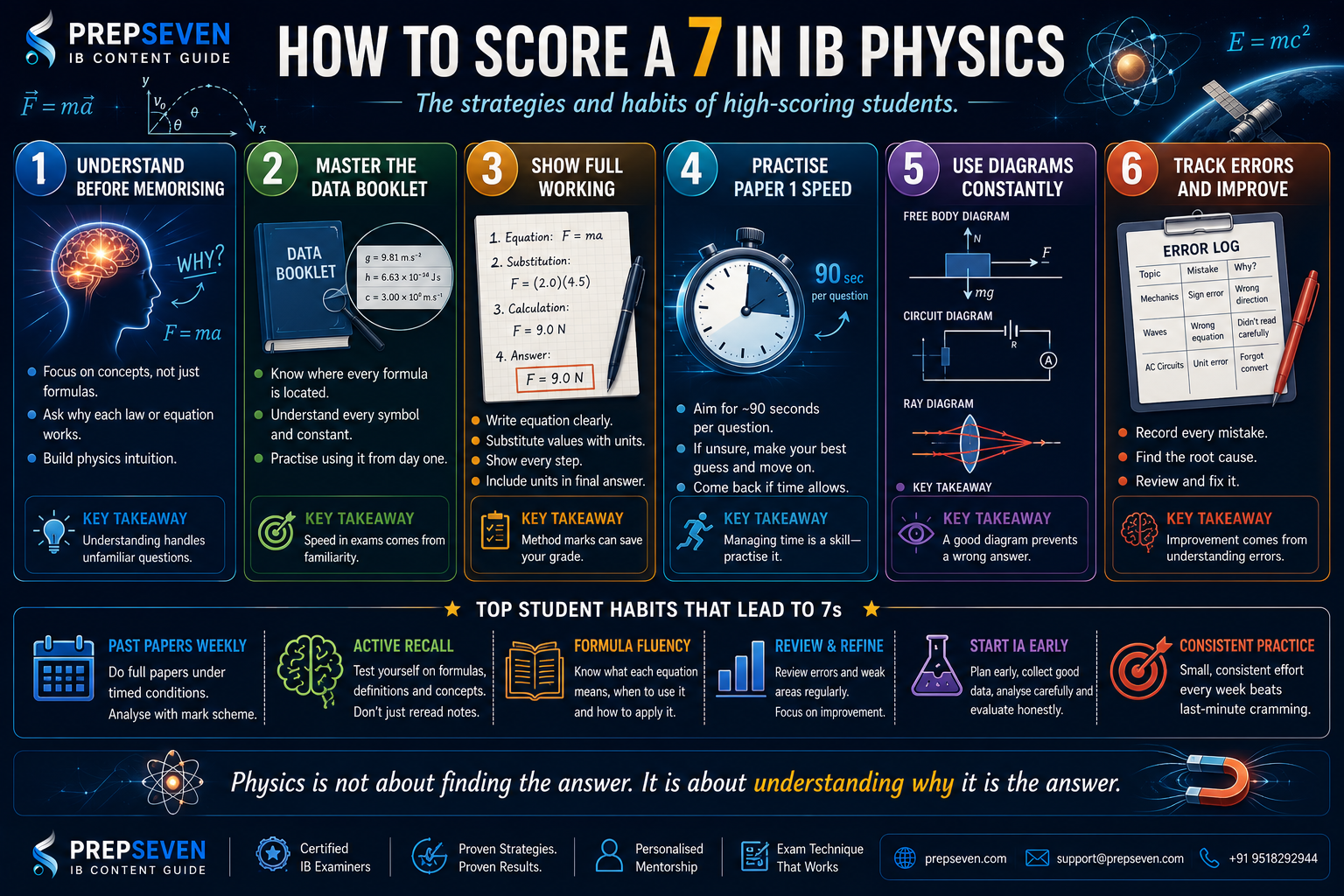
They understand principles before practising problems
Students who move straight to past paper practice without first building genuine conceptual understanding tend to develop a pattern-matching approach to physics: they recognise question types that look like ones they have seen before, apply the method they memorised, and struggle when the question presents the same principle in a slightly different context. Students who understand why Newton’s second law takes the form it does, what it actually means physically, and what its implications are for different physical situations, can handle any question that applies it, regardless of how unfamiliar the context looks. Build understanding first. Practice problems are where you test that understanding, not where you build it.
They show complete working on every question
In Paper 2, marks are awarded for method as well as for correct answers. A student who writes down the relevant equation, substitutes the correct values with units, and performs the calculation will earn the method marks even if their arithmetic is wrong. A student who writes only the final answer earns only the answer mark if it is correct, and nothing if it is wrong. Showing complete working is not just good practice. In IB Physics, it is directly worth marks. The habit needs to be built in every practice session, not just saved for the real exam.
They use the data booklet actively, not just as a reference
The IB Physics data booklet contains every equation you need for the exam. Students who know the booklet well, who can find any equation instantly and who understand every symbol in every equation they use, have a significant advantage in both Paper 1 and Paper 2. The way to develop this familiarity is to work with the booklet throughout both years: every time you use an equation in class or in homework, find it in the booklet rather than writing it from memory. This builds the navigation habit automatically and also reinforces what each symbol represents.
They draw diagrams and free body diagrams before calculating
Many physics problems become significantly clearer, and errors become significantly less likely, when you draw a diagram before you start calculating. A free body diagram showing all the forces on an object before applying Newton’s laws, a circuit diagram before applying Kirchhoff’s laws, a ray diagram before solving an optics problem: these are not decorative steps. They are analytical tools that help you identify which equations apply, what the directions of forces and fields are, and whether your final answer is physically reasonable. Students who skip the diagram step to save time often make direction errors that cost them more marks than the diagram would have taken seconds to draw.
They review errors immediately and understand why, not just what
When a student gets a physics problem wrong, the useful question is not what is the right answer but why did my reasoning fail? Was it an incorrect equation? A sign error? A failure to convert units? A misidentification of which law applies? A conceptual misunderstanding about the physical situation? Each of these failure modes requires a different kind of correction. Students who simply look at the model answer, copy it, and move on do not learn from their errors. Students who diagnose exactly where their reasoning broke down and why, and then practise similar problems until that type of error no longer occurs, improve steadily and measurably.
Common Mistakes That Cost Marks
A Realistic Year-by-Year Approach
Year 1 (Grade 11): Build Foundations and Practise Consistently
- Engage with each new topic by understanding the underlying principle before practising problems. Ask why each equation takes the form it does, not just how to use it.
- Start using the data booklet from the first lesson. Every time you use an equation in class or at home, locate it in the booklet and make sure you understand every symbol.
- Practise unit conversions and significant figure discipline from the beginning. These are skills that need to become automatic, and the only way to make them automatic is consistent practice from early in the course.
- Begin your IA preparation in Term 2 of Year 1. Identify a research question, discuss feasibility with your teacher, and start planning your methodology before the formal IA period begins in Year 2.
- For HL students: do not let the HL-only content sit unengaged until Year 2. The Fields theme and the Nuclear and Quantum Physics theme at HL level require time to develop conceptual understanding. Engage seriously as each topic is introduced.
Year 2 (Grade 12): Consolidate, Practise Past Papers, and Address Gaps
- Complete at least six full past paper sets under timed conditions before your mock exams, covering all three papers. Mark them using the official mark scheme and diagnose your errors specifically.
- Build an error log: every time you get a question wrong in practice, write down what the error was, why you made it, and what you need to remember to avoid it next time. Review this log weekly.
- Complete your IA and submit the first draft for teacher feedback before the end of Term 1. Focus the revision on the Evaluation section and the uncertainty analysis, which are the criteria most students underperform on.
- In the final revision period, prioritise the topics where your past paper error rate is highest. Do not spend time on topics you already understand well at the expense of topics where you are consistently losing marks.
How PrepSeven Helps You Score Higher in IB Physics
IB Physics requires two things that are genuinely difficult to develop alone: deep conceptual understanding of physical principles, and the problem-solving fluency to apply that understanding quickly and accurately under exam conditions. Our Physics tutors are certified IB examiners and experienced teachers who know where students lose marks, why they lose them, and what it takes to stop losing them.
Here is what working with a PrepSeven Physics tutor typically looks like:
- Concept sessions where your tutor works through the underlying physics of a topic with you, not just the equations, until you have the kind of understanding that handles unfamiliar applications rather than only familiar ones.
- Past paper marking sessions where your tutor marks your Paper 2 responses exactly as an IB examiner would, annotating every step for working completeness, unit accuracy, significant figure discipline, and physical reasoning quality.
- Paper 3 data analysis sessions where your tutor works through experimental uncertainty, graphing, and error analysis with you using past paper style material, building the practical skills that Section A demands.
- IA mentorship from research question design through to final draft, with particular attention to the Exploration criterion in the planning phase and the Evaluation criterion in the write-up.
Book your free demo lesson at prepseven.com and bring a recent practice paper or a topic you are finding difficult. Your tutor will work through it with you and show you the difference between recognising a method and genuinely understanding the physics behind it.