
PrepSeven | IB Content Guide authored by Shankar Mutneja (Founder of Prepseven)
IB Mathematics: Applications and Interpretation (AI)
What Is IB Mathematics: Applications and Interpretation?
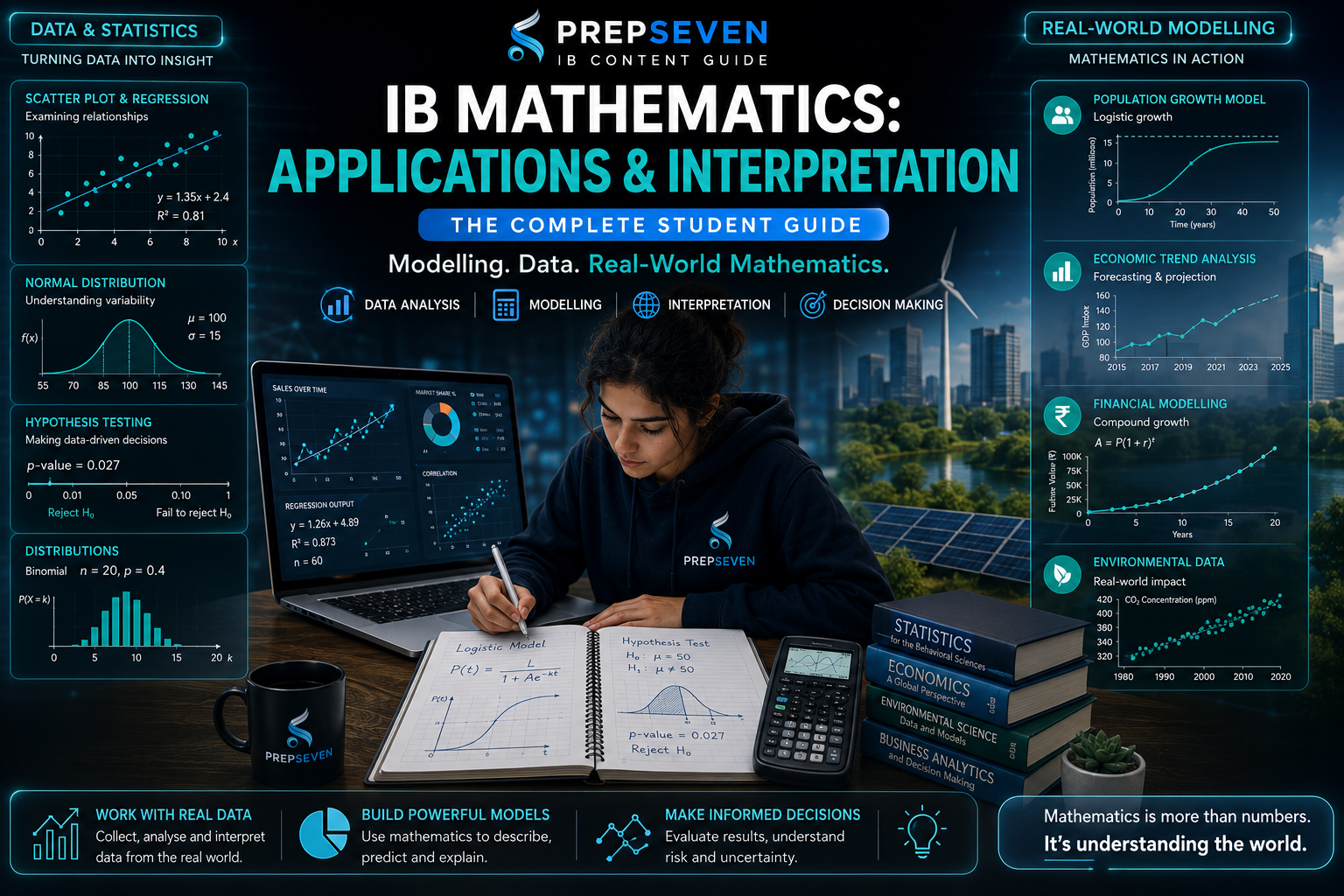
IB Mathematics: Applications and Interpretation, known to most students as IB Math AI, is one of two mathematics courses offered in the IB Diploma Programme. It is not the easier cousin of Math AA. It is a genuinely different course with a genuinely different purpose, and students who understand that distinction from the start tend to do significantly better than those who treat it as a fallback option.
Math AI is built around the idea that mathematics is most powerful when it is used to make sense of the real world. The course teaches you how to build mathematical models, how to work with data, how to use technology as a tool for exploration, and how to reason quantitatively about problems in contexts ranging from economics and biology to social science and design. Throughout both years, your graphical display calculator is present and central. The course assumes you will use it.
This is the mathematics course that prepares students for fields where data literacy and quantitative reasoning matter: business, social science, environmental science, psychology, medicine, economics, and design. If your future involves working with numbers in the real world rather than proving theorems from first principles, Math AI is designed for you.
A common misconception worth addressing head on: Math AI HL is a demanding course. The Higher Level contains content in areas like graph theory, probability distributions, and statistical testing that most SL students never encounter. Choosing Math AI HL is not taking the easier path. It is choosing a different kind of mathematical challenge.
Math AI vs Math AA: The Honest Comparison
This comparison matters because many students make their course choice without fully understanding what it means. The decision has genuine consequences for university applications, so it deserves careful thought.
Math AA is built around pure mathematical reasoning: proof, abstraction, and working from first principles without a calculator in hand. Math AI is built around mathematical application: modelling real situations, interpreting data, and using technology intelligently to extend what you can do analytically.
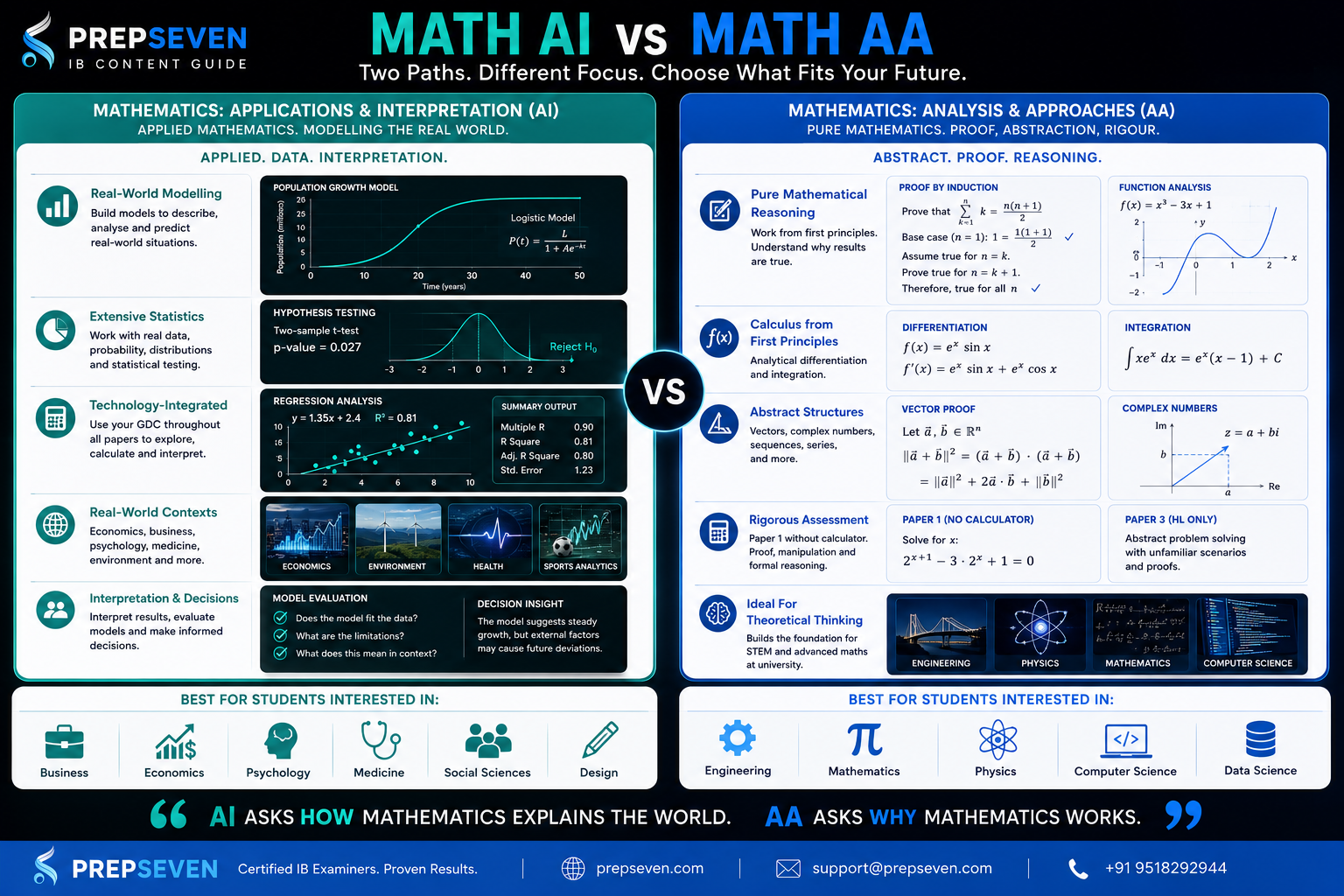
Many universities in the UK, Europe, and North America explicitly list which of the two courses they accept for specific degree programmes. If you are targeting a STEM programme, check the entry requirements before choosing AI over AA. For business, economics, social science, medicine, and design, Math AI HL is typically fully accepted and sometimes preferred.
SL vs HL: What You Are Actually Signing Up For
The gap between SL and HL in Math AI is substantial, and it is more than just additional topics. HL requires a significantly deeper engagement with statistics, probability, and modelling than SL demands. The HL-only content includes areas that many SL students would find genuinely challenging.
Paper 3 at HL is worth particular attention. Unlike Math AA’s Paper 3, which tests abstract problem-solving, Math AI’s Paper 3 is a guided modelling investigation. You are given a real-world scenario, typically involving data, and you work through a structured set of tasks that build toward a mathematical model. The later tasks require independent modelling decisions and justification. Students who have practised the modelling cycle throughout Year 1 and Year 2 are significantly better placed than those who have only practised standard procedures.
What the Syllabus Covers
The Math AI syllabus is organised into five topic areas. At HL, each topic is extended and additional content is added.
Statistics and Probability is the topic area where Math AI goes significantly deeper than Math AA, particularly at HL. Students who are headed toward fields involving data, whether that is medicine, psychology, economics, or business, will find this depth genuinely useful. It is also the area that catches students most off guard. Many arrive in the course expecting it to be straightforward and discover that hypothesis testing, chi-squared tests, and probability distributions require real conceptual understanding, not just formula application.
Financial mathematics is an area of the SL syllabus that often gets covered quickly in class but appears consistently in exam papers. Compound interest, depreciation, amortisation, and loan repayment questions are accessible marks if you have practised them. Students who dismiss this topic because it seems simple often drop marks they could easily have kept.
Assessment Breakdown: How You Are Graded
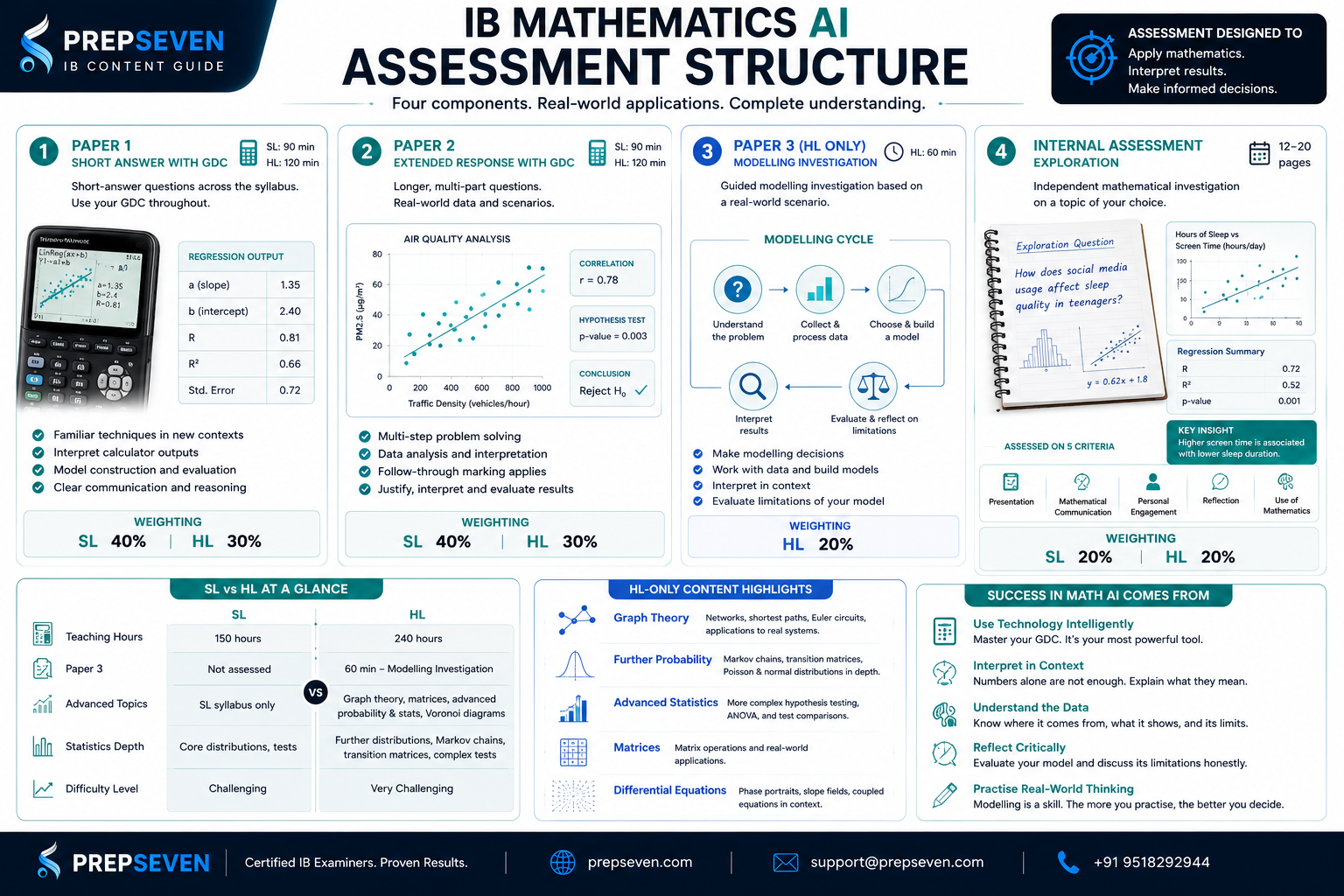
Paper 1: Short-Answer Questions With GDC
Paper 1 contains shorter, more structured questions and is taken with your graphical display calculator. Questions are typically based on familiar procedures applied to new contexts. You will be asked to interpret outputs, construct models, and justify your reasoning. The paper tests breadth across the syllabus.
A consistent source of lost marks on Paper 1 is poor communication. Students arrive at the correct answer but write nothing between the question and the final number. In IB mathematics, working is marked. If your answer is wrong and you have shown no working, you earn nothing. If your answer is wrong but your method was correct, you can still earn the majority of the marks. This applies to Math AI just as much as to Math AA.
Paper 2: Extended Response Questions With GDC
Paper 2 contains longer, multi-part questions that require extended working and often involve real-world data or scenarios. Questions frequently build on each other, so an error early in the question can affect subsequent parts. IB examiners use follow-through marking in these situations: if you made an error in part (a) but applied correct method in parts (b) and (c) using your wrong answer from (a), you will still earn the method marks for (b) and (c).
Understanding follow-through marking changes how you should approach Paper 2. Never give up on a question because you think you got an earlier part wrong. Keep working with whatever answer you have, and make sure your method is clearly visible throughout.
Paper 3: HL Modelling Investigation
Paper 3 at HL is 60 minutes and presents one or two extended real-world scenarios. Unlike most IB exam questions, which test whether you can apply a known method to a structured problem, Paper 3 tests whether you can make modelling decisions yourself: choosing appropriate functions, fitting models to data, interpreting results in context, and recognising the limitations of your own model.
The word ‘limitations’ is important. HL Paper 3 almost always asks students to reflect on what their model cannot do, where it breaks down, and what assumptions it relies on. Students who answer the modelling questions well but skip the reflection parts lose marks that are specifically allocated for that kind of critical thinking. This is not a soft criterion. The marks are real.
Internal Assessment: The Exploration
The Exploration is a 12 to 20 page mathematical investigation on a topic of your choice. It is internally assessed by your teacher and externally moderated by the IB. It carries 20% of your final grade at both SL and HL.
The five assessment criteria are Presentation, Mathematical Communication, Personal Engagement, Reflection, and Use of Mathematics. For Math AI students, the Use of Mathematics criterion means something specific: the mathematics you use should be relevant to the topic, correctly applied, and sufficiently sophisticated for your level. SL students should be working with SL-standard mathematics. HL students should extend into HL territory.
One thing that distinguishes strong Math AI Explorations from weak ones is the quality of the data. Students who gather their own data, whether by conducting a survey, collecting measurements, or pulling from a credible public dataset, and who engage critically with what the data shows, tend to produce far more interesting work than students who pick a topic and model it with textbook examples. Real data is messy. Engaging honestly with that messiness, explaining why the model fits imperfectly and what that tells you, is exactly what the Personal Engagement and Reflection criteria reward.
Topic ideas that work well in Math AI Explorations are almost always grounded in something the student genuinely finds interesting outside of mathematics. Sports statistics, social trends, environmental data, financial modelling, patterns in music or architecture. The mathematics follows naturally from genuine curiosity about a real phenomenon.
What Actually Gets Students to a 7: The Habits That Separate Top Scorers
They treat context as part of the mathematics
In Math AI, every answer exists in a context. A student who writes ‘3.7’ as their answer to a question about population growth has not finished the answer. A student who writes ‘3.7 million people, which represents an increase of approximately 12% from the base year, consistent with the model’s projected trend’ has demonstrated the kind of contextual reasoning that examiners are specifically looking for. Getting into the habit of answering in context, every time, makes a substantial difference across both papers.
They know their GDC better than they know their formulas
Math AI is a calculator-on course throughout. Students who have mastered their GDC, who can run a regression, solve equations numerically, compute statistical tests, and sketch functions quickly and accurately, have a significant time advantage in the exam. This is a skill that requires consistent practice from Year 1, not cramming before exams. Treat GDC fluency as a core subject skill rather than a technical convenience.
They practise statistical interpretation, not just statistical calculation
Statistics questions on both Paper 1 and Paper 2 often ask students to interpret results: what does a p-value of 0.03 actually mean in the context of this study? Should you reject the null hypothesis? What are the limitations of this test given the sample size? Students who can only calculate the test statistic but cannot interpret it in plain English consistently lose the interpretation marks. And those marks are allocated specifically because the IB considers interpretation to be as important as calculation.
They engage honestly with limitations in the Exploration
Strong Explorations do not pretend their model is perfect. They say: here is what the model shows, here is where it fits well, and here is where it breaks down and why. This is the Reflection criterion in practice. Students who write a glowing conclusion that ignores the weaknesses in their own analysis score poorly on Reflection regardless of how good their mathematics is. Intellectual honesty about uncertainty is itself a mathematical virtue.
They read Paper 3 questions all the way through before starting
HL Paper 3 modelling questions are designed to build. The final parts depend on work from earlier parts, but they also sometimes reframe the whole scenario in a way that requires you to revisit your earlier assumptions. Students who read the entire question before writing their first line arrive at that final part with a much better sense of where they are going. Students who answer part by part and only see the final reframing when they reach it often run out of time adjusting their earlier work.
Common Mistakes That Cost Marks
A Realistic Year-by-Year Approach
Year 1 (Grade 11): Lay the Groundwork
- Master your GDC from the very first month. Regression, solving equations, statistical tests, and graphing functions should feel completely natural before you enter Year 2.
- Engage seriously with the statistics topics as they arrive. Many students underestimate them early and struggle to recover later. Chi-squared tests, hypothesis testing, and probability distributions all require conceptual understanding, not just procedure.
- Start exploring Exploration topic ideas by the end of Term 2. Think about what real-world phenomena genuinely interest you. The best Explorations come from authentic curiosity.
- For HL students: engage with graph theory, matrices, and the HL probability content as they appear. These topics are new for most students and need time to settle.
Year 2 (Grade 12): Consolidate and Perform
- Do at least 6 timed past papers across Papers 1 and 2 before your mock exams. Pay close attention to contextual interpretation questions and practise answering them in full sentences.
- For HL students: practise at least 4 Paper 3 style modelling investigations. There is no better preparation than exposure to the format and the type of reasoning it demands.
- Submit your Exploration first draft before the end of Term 1. Use the feedback cycle. The difference between a first draft and a fifth draft is typically 3 to 4 marks.
- In the final revision period, focus on the topics where your marks in practice papers are consistently lowest. For most Math AI students, that means statistical testing and Exploration-adjacent modelling skills.
How PrepSeven Helps You Score Higher in IB Math AI
Our Math AI tutors understand the course from the inside. They know where the marks are, which questions students consistently drop them on, and how to build the kind of applied mathematical thinking that the IB is actually testing.
Working with a PrepSeven Math AI tutor typically looks like this:
- Paper 1 and 2 sessions where your tutor marks your practice paper exactly as an IB examiner would, with particular attention to contextual interpretation and follow-through marking.
- Statistical reasoning sessions focused specifically on the interpretation skills that separate students in the 5 to 6 range from those scoring 7, covering hypothesis testing, p-values, and confidence intervals in plain English.
- Exploration mentorship from topic selection through to final submission, with close attention to all five criteria and especially the Personal Engagement and Reflection sections that most students underserve.
- Paper 3 modelling practice for HL students, with your tutor walking through the full modelling cycle on unfamiliar scenarios so you can develop the decision-making skills the paper demands.
Book your free demo lesson at prepseven.com and see what exam-focused, examiner-led tutoring actually looks like in practice.