
PrepSeven | IB Content Guide authored by Shankar Mutneja (Founder of Prepseven)
IB History
What Is IB History?
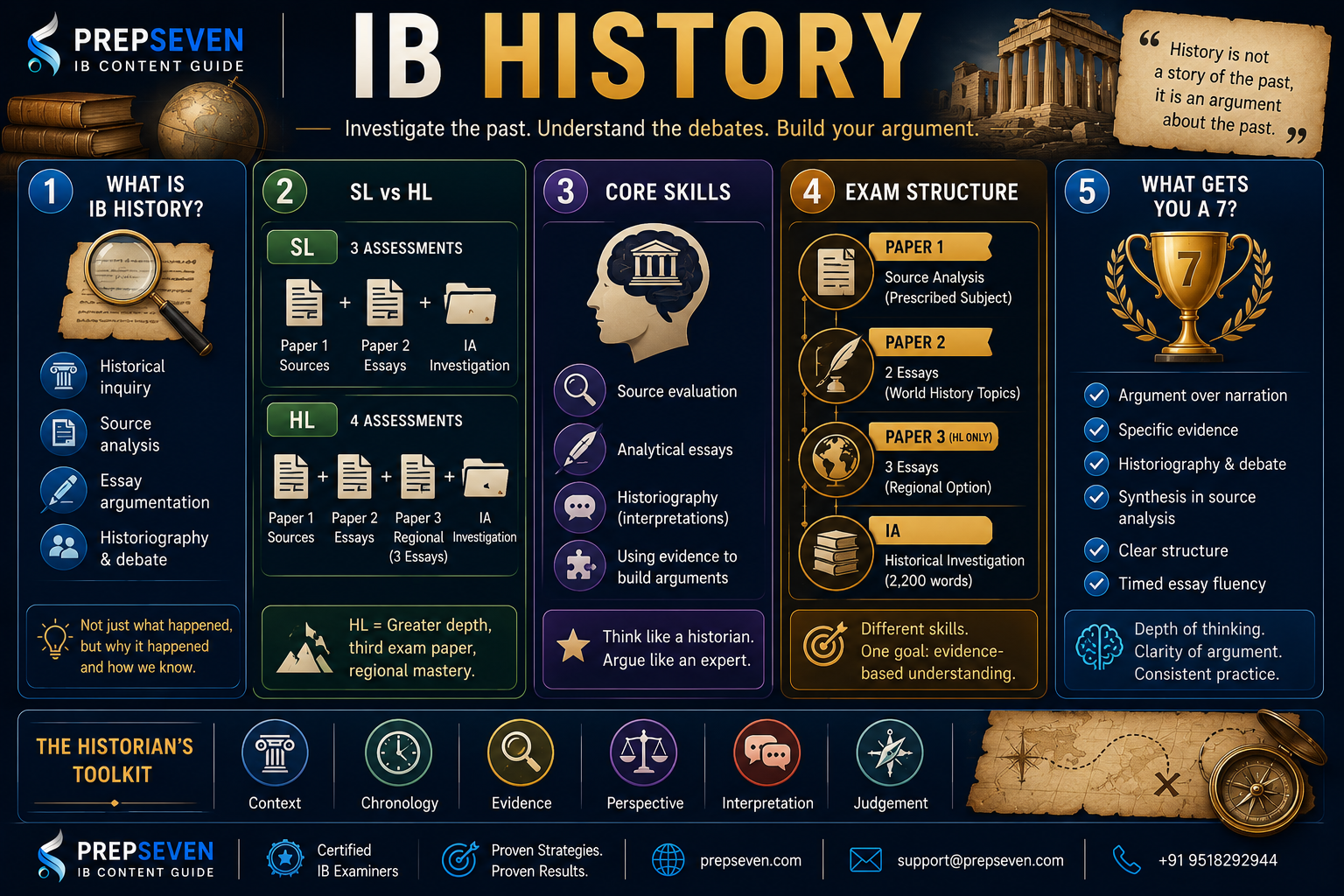
IB History is a course about understanding the past with rigour, honesty, and a genuine awareness of how contested historical knowledge actually is. It sits in Group 3 of the Diploma Programme and is one of the most widely taken humanities subjects in the IB worldwide. It is available at both Standard Level and Higher Level, and the gap between the two is significant enough that understanding it before you commit to a level matters considerably.
The course is built around historical inquiry rather than the passive reception of a fixed narrative. Students do not simply learn what happened. They learn how historians have argued about what happened, why those arguments differ, what evidence underlies competing interpretations, and how the historian’s own context shapes the questions they ask. This means that IB History is simultaneously a content course and a skills course, and the skills dimension, source analysis, essay argumentation, and historical evaluation, often surprises students who arrived expecting to study events rather than methods.
The syllabus is genuinely global in scope. The Prescribed Subjects for Paper 1 cover topics ranging from the move to global war in the twentieth century to rights and protest movements to the Cold War. Paper 2 covers twentieth-century topics including authoritarian states, causes and effects of wars, the Cold War, and independence movements. HL students add a regional depth study in Paper 3, which allows genuine immersion in a specific geographic and chronological area of history. The Internal Assessment, a historical investigation, gives every student the chance to pursue a focused question of genuine personal interest.
IB History is not a course where knowing a lot of facts earns you a 7. Facts are necessary but they are not sufficient. The students who score highest are those who can use historical evidence to construct and sustain a coherent analytical argument, who understand that historical interpretations are contested and can engage with that contestation critically, and who can evaluate the value and limitations of sources with genuine sophistication. These are skills that take two years to develop properly, not two weeks.
SL vs HL: What the Difference Actually Involves
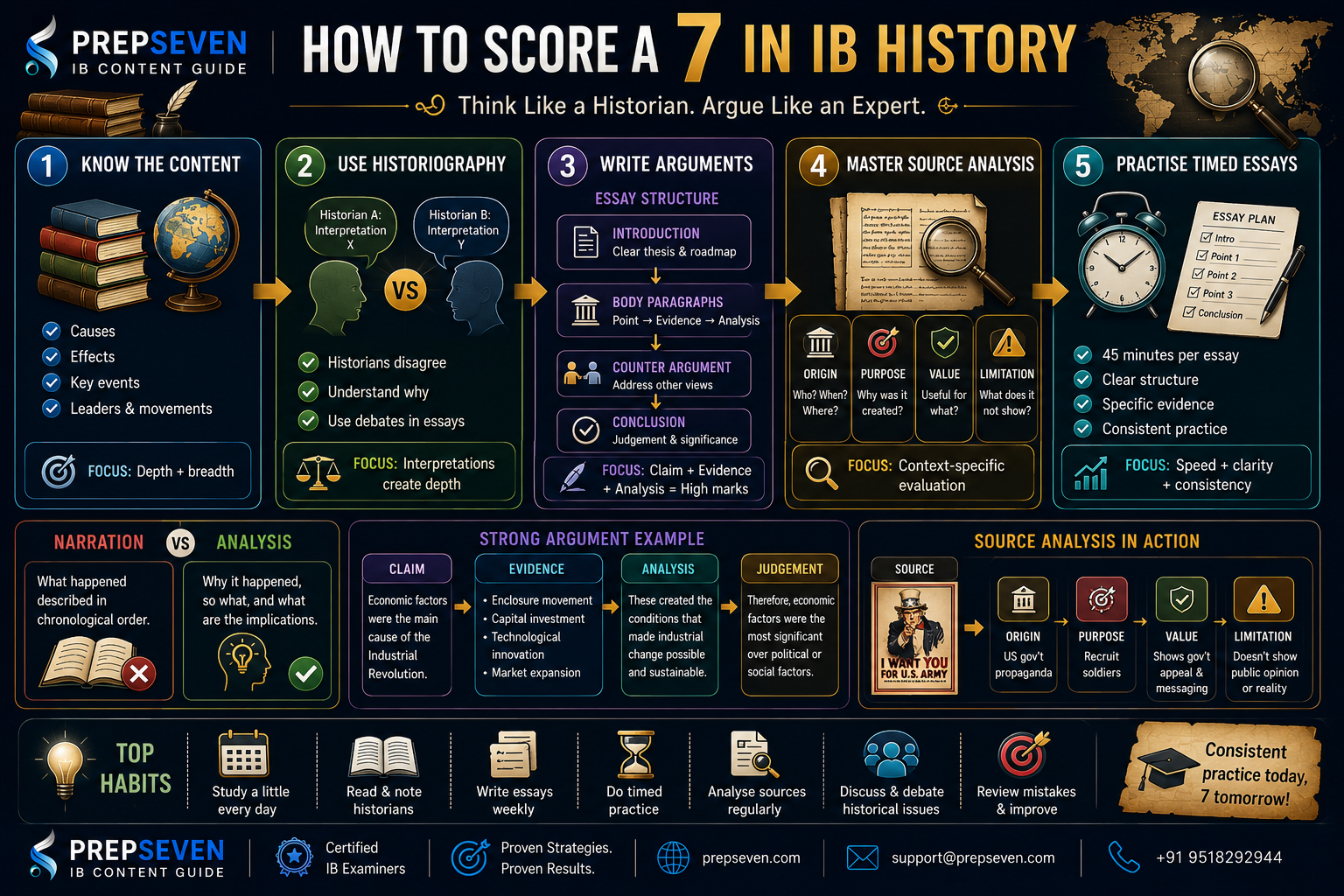
The difference between History SL and HL is the most substantial of any IB Group 3 subject. HL students sit three exam papers rather than two, and the third paper requires depth of knowledge across an entire regional history that demands sustained engagement throughout both years.
Paper 3 at HL is a three-essay paper on a Regional Option, a specific geographic and chronological area of history studied in depth. The four Regional Options are History of Africa and the Middle East, History of the Americas, History of Asia and Oceania, and History of Europe. Each option covers a substantial body of historical content across multiple periods and themes. HL students are expected to know this content with genuine depth and to be able to construct sophisticated analytical essays on it under exam conditions.
If you are planning to study history, politics, law, international relations, or any humanities discipline at university, History HL is a meaningful choice. The analytical skills it develops, constructing evidence-based arguments, engaging with historiographical debate, evaluating the reliability and utility of primary sources, are exactly what undergraduate humanities programmes assume their students have. Many students who take History SL and then study history at university find the jump to undergraduate-level analytical writing harder than their HL peers.
What the Syllabus Covers
Paper 1: Prescribed Subjects
Paper 1 is a source-based paper. Your school chooses one of the IB’s Prescribed Subjects, and the exam presents you with five primary and secondary sources related to that subject. You analyse those sources and answer structured questions about them. The Prescribed Subjects are:
Paper 2: World History Topics
Paper 2 is a two-essay paper. You write one essay from each of two different World History Topics. Your school teaches two of the twelve available topics, and you need to be able to write essays on both. The World History Topics covered most commonly include:
Your school will teach two specific World History Topics, and your Paper 2 essays must come from different topics. Students sometimes assume they can write both essays on the same topic, which is not permitted. Confirm which two topics your school teaches as early as possible in Year 1 and begin building your knowledge base for both from the start.
Paper 3: HL Regional Options
Paper 3 is only assessed at HL. It presents essays questions on one of the four Regional Options and you write three essays, each from a different section within your regional option. The regional options are History of Africa and the Middle East, History of the Americas, History of Asia and Oceania, and History of Europe. Each option covers multiple periods and themes across centuries of regional history.
The depth of knowledge required for Paper 3 is significantly greater than for Paper 2. Paper 2 questions are broad and conceptual, allowing students to select the most relevant evidence from across a topic. Paper 3 questions often require specific, detailed knowledge of particular events, figures, policies, or developments within the regional option. A student who knows the broad narrative of European history in the nineteenth century but cannot analyse specific movements, treaties, or political developments in detail will find Paper 3 significantly harder than students who have engaged with the regional content deeply throughout both years.
Assessment Breakdown: How You Are Graded
Paper 1: Source Analysis
Paper 1 is one hour long and is worth 30 marks. It presents five sources on the Prescribed Subject, a mixture of primary and secondary sources including written documents, images, statistics, or cartoons. You answer four questions.
The first question asks you to identify the message or main point of one or two sources. It tests close reading and carries fewer marks. The second question asks you to explain why a source might be considered limited in its value for a historian studying the prescribed subject. The third question asks you to compare and contrast two sources. The fourth question, worth the most marks, asks you to evaluate the sources and your own knowledge to assess how useful the sources are for understanding a specific historical issue.
Question 4 is where Paper 1 performance varies most. It requires you to do three things simultaneously: use the sources as evidence, apply your own contextual knowledge to supplement them, and make a judgement about how fully the sources answer the question. Students who only paraphrase the sources without applying their own knowledge, or who only write from their own knowledge without engaging with the sources, consistently score in the lower bands. The synthesis of source analysis and contextual knowledge is what the top band requires.
The most underused skill in Paper 1 is applying Own Knowledge to extend and challenge what the sources show. The mark scheme specifically rewards students who go beyond the sources to mention evidence that the sources do not contain but that is relevant to the question. This means your Paper 1 performance depends partly on how well you know the content of the Prescribed Subject, not just on how well you can read sources. Revise the factual content of your Prescribed Subject as thoroughly as you revise source analysis technique.
Paper 2: Historical Essays
Paper 2 is one hour thirty minutes and requires two essays, one from each of your two World History Topics. Each essay is worth twenty-five marks. You choose which question to answer within each topic.
The essay questions in Paper 2 use command terms that define the type of response expected. Examine, Analyse, Discuss, Compare and Contrast, and To what extent are the most common. Each requires a slightly different approach: Examine means investigate thoroughly from different angles; Analyse means break into components and assess their significance; Discuss means present multiple perspectives and consider their relative weight; Compare and Contrast means identify both similarities and differences with equal attention to both; To what extent means argue a position on a scale and justify it with evidence.
The structure of a strong Paper 2 essay follows a consistent logic regardless of which command term is used: a focused introduction that presents a clear argument and outlines the main lines of analysis, body paragraphs that each develop one analytical point with specific historical evidence, and a conclusion that synthesises the argument and directly addresses the question. The biggest mark-losing pattern in Paper 2 is descriptive writing where students recount events without analysing their significance or connecting them to the question being asked.
Historians matter in Paper 2. The IB rewards students who demonstrate awareness of historical debates, who can name historians and their interpretations, and who can use historiographical disagreement as evidence that historical questions are genuinely contested. A student who can note that Taylor’s revisionist account of Hitler’s foreign policy challenged the orthodox view that the war was the result of a deliberate programme of expansion, and that subsequent historians like Kershaw have sought to synthesise these positions, is demonstrating exactly the kind of historiographical awareness that separates the top band from the band below it.
Paper 3: HL Extended Essays
Paper 3 is two hours thirty minutes and requires three essays on the HL Regional Option. You choose three questions from different sections of your regional option. Each essay is worth thirty marks.
The standard expected in Paper 3 essays is the highest of any assessed component in IB History. The questions are often more specific than Paper 2 questions and require detailed factual knowledge alongside sophisticated analysis. A Paper 3 essay on European history might ask you to analyse the significance of the Congress of Vienna for the European state system, or to evaluate the impact of imperialism on African societies in the late nineteenth century. These questions require you to know specific treaties, specific dates, specific policies, and specific historical debates, not just broad trends.
Students who approach Paper 3 by writing three solid Paper 2 style essays often find they are scoring at the lower end of what HL demands. Paper 3 requires more specificity, more historiographical awareness, and more nuanced argument than Paper 2. The extra teaching hours at HL are there precisely to build this depth of knowledge, and students who have not engaged seriously with the regional option content throughout both years cannot compensate with essay-writing technique alone.
Internal Assessment: The Historical Investigation
The Internal Assessment is a historical investigation of 2,200 words maximum. You choose your own historical question, conduct independent research, and write a structured investigation that includes an identification and evaluation of sources, an investigation of the question, and a reflection on the methods used by historians. It carries 25% of the final grade.
The investigation is assessed on three sections. Section 1 is the Identification and Evaluation of Sources, where you introduce your question, identify two key sources and evaluate their value and limitations for your specific investigation. Section 2 is the Investigation itself, where you argue your case using evidence from multiple sources. Section 3 is the Reflection, where you discuss what your investigation has revealed about the methods and challenges of historical inquiry.
The Reflection section is the part of the IA that most students write least effectively. It is not a summary of your findings. It is a methodological reflection on what conducting your investigation has revealed about how historians work: what the limitations of your sources meant for the conclusions you could draw, what challenges arise when evidence is fragmentary or biased, and what your investigation has shown you about the constructed nature of historical knowledge. This requires genuine intellectual engagement with historiographical method, not a formulaic paragraph about bias and reliability.
Question choice for the IA is one of the most consequential decisions of the two years. A question that is too broad will not produce a focused investigation within 2,200 words. A question that is too narrow may not have enough accessible evidence for a school student to research. The ideal IA question is specific enough to investigate in depth but broad enough that multiple credible sources exist for it, and it genuinely interests you enough to sustain the research process over several months. A question that asks why something happened, or to what extent a factor caused an outcome, tends to produce more analytical investigations than a question that asks what happened.
Historiography: What It Is and Why It Changes Everything
Historiography is the study of how historical interpretations have changed over time and why. It is one of the most important concepts in IB History and one of the most consistently underused by students who have heard the word but have not genuinely understood what it means for their essay writing.
The central insight of historiography is that history is not a fixed record of the past. It is an ongoing argument among historians about what the evidence means, which factors were most significant, and how we should understand the human choices that shaped events. Two historians looking at the same evidence can reach genuinely different conclusions, and understanding why they disagree is itself historically significant.
In practical terms, using historiography in your essays means naming specific historians, stating their interpretations, explaining why they interpret the evidence the way they do, and engaging with the debate between competing interpretations rather than treating any single account as definitive. It means being aware, for example, that the debate about the origins of the First World War has moved through several distinct phases: the initial Allied assignment of guilt to Germany, the revisionism of the 1960s that distributed responsibility more broadly, and the more recent return to a focus on German militarism but with greater nuance about the specific mechanisms of escalation. A student who understands that debate is not just parroting a list of historians. They are demonstrating genuine historical thinking.
A practical goal for historiography in essays: in each essay you write for Paper 2 or Paper 3, aim to name at least two historians with opposing or contrasting interpretations and explain why their interpretations differ. Do not just name them. Use the disagreement between them as evidence that the historical question is genuinely complex and that simple causal claims need to be qualified. The presence of genuine historiographical engagement is one of the clearest signals to examiners that a student is working at the top of the grade range.
Source Analysis in Paper 1: What the Examiners Actually Want
Source analysis is a skill that many students think they understand and few students execute at the level the IB actually requires. The reason is that most students have been taught a formula: identify the origin, purpose, value, and limitation of a source. The formula is not wrong, but following it mechanically without genuine historical thinking produces responses that earn middle-range marks rather than top-band marks.
What the examiners are actually looking for is a demonstration that you understand how a source’s origin and purpose affect what it can and cannot tell a historian about the specific question being asked. The key words are for a historian studying this particular question. A government propaganda poster from Nazi Germany has obvious limitations as evidence of popular attitudes, but it has genuine value as evidence of the regime’s intended messaging strategy, the visual language it used to communicate ideology, and the cultural values it sought to mobilise. The same source can be highly valuable for one question and significantly limited for another.
The most common failure in Paper 1 source analysis is stating generic limitations without connecting them to the specific investigation. Writing that a source is limited because it is biased, or because it only represents one perspective, earns partial credit at best. Writing that a source is limited for a historian investigating German public opinion toward the Nazi regime because it was produced by the regime itself and therefore reflects the image the government wished to project rather than the views of ordinary citizens, and that it cannot tell us how widely those projected values were actually internalised, is working at the level the top band requires.
For Paper 1 Question 4, which asks you to evaluate how useful the sources are as a whole for understanding a specific historical issue, the strongest responses make a direct argument: these sources are useful to a significant degree for understanding X because they collectively show Y and Z, but their usefulness is limited by the fact that they do not include A and B, which a historian would also need to assess. This kind of argument, which uses the sources as evidence while being clear about their limitations and supplementing them with own knowledge, is what earns marks in the upper bands.
What Actually Gets Students to a 7
They argue, they do not narrate
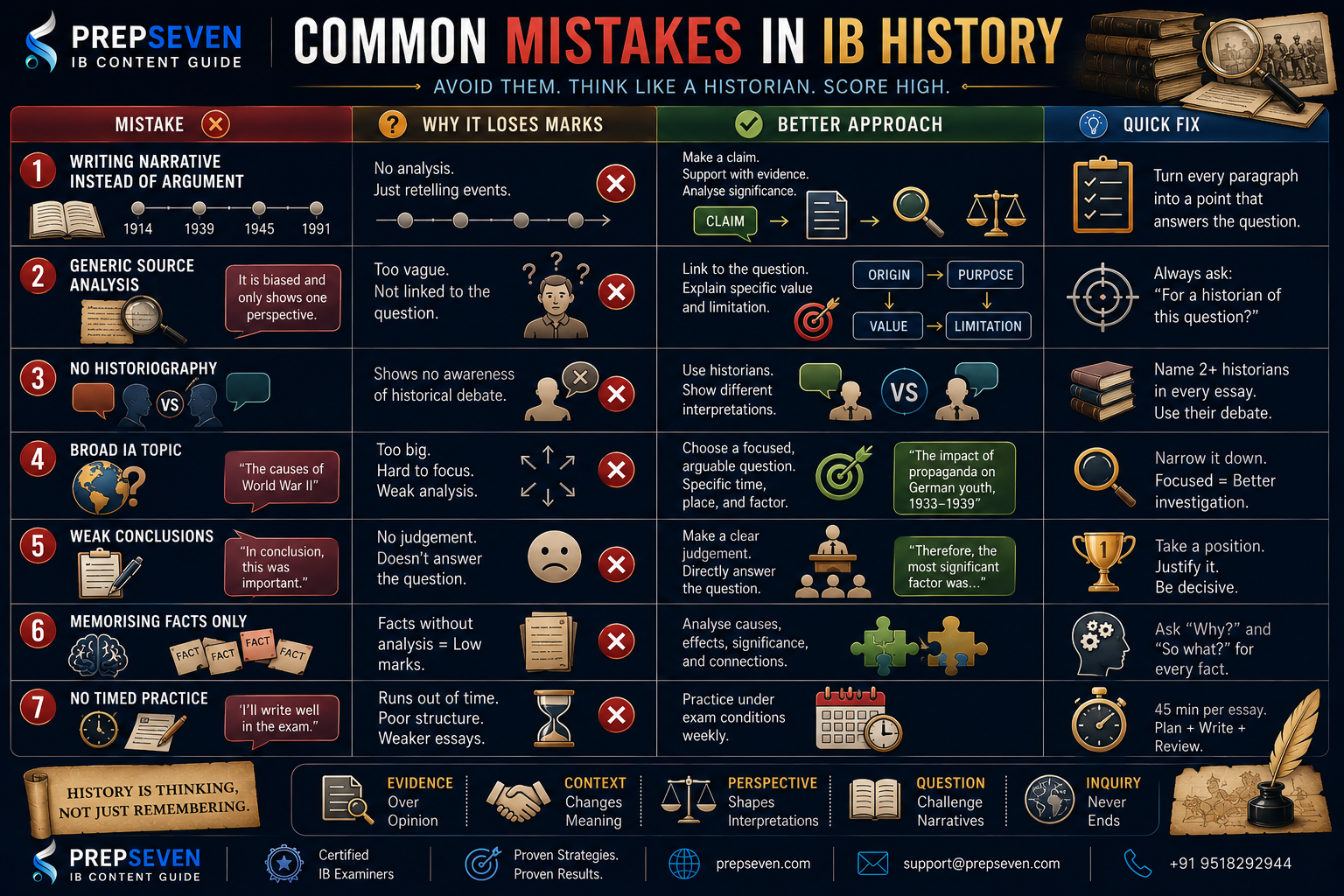
The single most consistent difference between students scoring in the 5 to 6 range and those scoring 7 in IB History is the presence of a sustained argument. A sustained argument means that every paragraph in the essay is developing a specific claim that contributes to answering the question, that claim is supported by specific historical evidence, and the evidence is analysed for its significance rather than simply described. The opposite of sustained argument is narrative: retelling what happened in chronological order without connecting the events to an analytical claim. No amount of historical knowledge expressed as narrative will earn a 7 in IB History. The same knowledge expressed as argument will.
They use evidence specifically, not generally
Writing that the Versailles Treaty caused resentment in Germany is a general claim. Writing that the war guilt clause of the Versailles Treaty, Article 231, which assigned sole responsibility for the war to Germany, was experienced as a profound humiliation by the German public and was exploited by nationalist politicians including Hitler as evidence that Germany’s democratic government had betrayed the nation, contributing directly to the political instability of the Weimar Republic, is specific evidence deployed analytically. The difference is not about knowing more. It is about using what you know more precisely. Develop the habit of asking yourself, after every general claim: what is the specific evidence for this, and what does that evidence tell me about the claim?
They prepare historiography actively throughout both years
Students who encounter historiography for the first time when revising for exams find it extremely difficult to use with genuine fluency. Historiography needs to be built throughout both years: noting which historians your teacher mentions, reading brief summaries of key debates in the topics you are studying, and developing the habit of asking not just what happened but how historians have interpreted what happened and why they disagree. By Year 2, a student with this habit has a mental library of historiographical positions that can be deployed flexibly across essay questions. A student encountering these names for the first time in Year 2 cannot develop that fluency in time.
They practise writing essays under timed conditions from Year 1
History essays written at home with unlimited time and access to notes are a different activity from History essays written in exam conditions. The ability to construct a focused, well-evidenced, analytical essay in the 45 minutes that Paper 2 and Paper 3 allocate per essay is a skill that requires practice under realistic conditions. Students who only write essays at home with notes and then face timed exams for the first time in mock season consistently find that their essay quality drops significantly under time pressure. Practise timed essays from Year 1, even if they are shorter and less polished than your home essays. The habit of organising your argument quickly is what exam performance requires.
They read their IA question with the historian’s lens
The best IAs are written by students who have genuinely thought about their question as a historian would. This means not just researching what happened but engaging with the evidence available, acknowledging what the evidence cannot tell you, considering why different historians have reached different conclusions about the same events, and reflecting on what the process of historical inquiry has revealed about the limits of what we can know. Students who treat the IA as a research essay rather than a historical investigation miss the Section 3 Reflection almost entirely. Section 3 is asking you to think about how you know what you know and what the process of finding out has taught you about historical inquiry as a discipline.
Common Mistakes That Cost Marks
A Realistic Year-by-Year Approach
Year 1 (Grade 11): Build Knowledge and Analytical Habits
- Engage with every topic as it is taught by building structured notes that organise content analytically rather than chronologically. For each major event or development, note its causes, its significance, and how different historians have interpreted it.
- Start a historiography notebook from the first month. Every time your teacher mentions a historian, write down their name, their main argument, and their interpretive position. By Year 2, this notebook will be one of your most valuable revision resources.
- Practise source analysis regularly with sources from your Prescribed Subject. For each source, practise writing one paragraph that evaluates its value and limitation for a specific historical question. Ask your teacher for feedback on whether your analysis is specific enough.
- Choose your IA question by the end of Term 2 in Year 1. Discuss it with your teacher, check the availability of accessible sources, and begin preliminary research before the formal IA period begins.
Year 2 (Grade 12): Develop Essay Fluency and Prepare All Components
- Write at least four full timed essay responses under exam conditions before your mock exams, covering both of your Paper 2 topics and, for HL students, your Paper 3 regional option. Mark them against the IB criteria and focus feedback on argument structure and use of evidence.
- Review your historiography notes and identify which historians and debates are most relevant to each of your World History Topics. Aim to have at least two or three named historians with clear interpretations for each major theme in each topic.
- Complete your IA and submit a full draft for teacher feedback before the end of Term 1. Pay particular attention to the Section 3 Reflection and the quality of the source evaluation in Section 1.
- In the final revision period, practise Paper 1 source analysis using past paper sources. For each source, practise writing a timed evaluation that connects origin, purpose, value, and limitation specifically to the question asked.
How PrepSeven Helps You Score Higher in IB History
IB History rewards two skills that are genuinely difficult to develop without expert feedback: the ability to construct a sustained analytical argument under time pressure, and the ability to evaluate historical sources with the specificity and contextual knowledge that the top band requires. Our History tutors are certified IB examiners and experienced teachers who have marked student essays and know precisely what distinguishes a 6 from a 7.
Here is what working with a PrepSeven History tutor typically looks like:
- Essay writing sessions where you write a timed Paper 2 or Paper 3 essay and your tutor marks it against the IB criteria, annotating every paragraph for argument quality, use of evidence, historiographical awareness, and command term compliance.
- Paper 1 source analysis sessions where your tutor walks through source evaluation with you, showing you the difference between generic analysis and the specific contextual evaluation that earns top-band marks on Question 4.
- Historiography building sessions where your tutor identifies the key historical debates in your World History Topics and Paper 3 regional option and helps you develop the interpretive language to engage with them in essays.
- IA mentorship from question formulation through to final submission, with particular attention to the Section 3 Reflection and the source evaluation in Section 1, both of which are consistently underperformed by students writing without expert guidance.
Book your free demo lesson at prepseven.com and bring a recent timed essay. Your tutor will show you exactly where the argument loses its focus, where evidence is being described rather than analysed, and what a 7-band version of the same response looks like.