
PrepSeven | IB Content Guide authored by Shankar Mutneja (Founder of Prepseven)
IB Global Politics
What Is IB Global Politics?
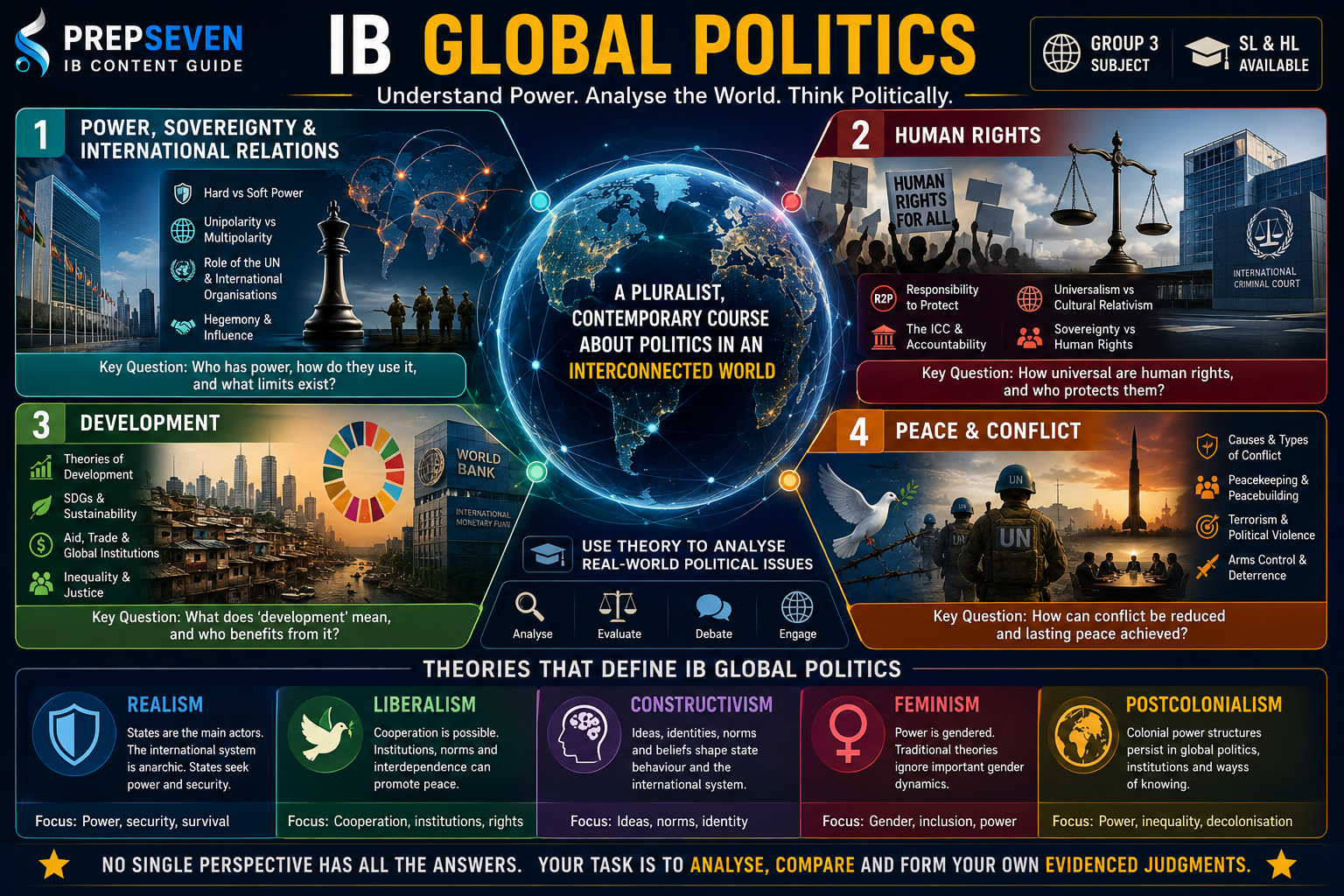
IB Global Politics is a course about understanding how political power works in a world that no state fully controls. It sits in Group 3 of the Diploma Programme and is available at both Standard Level and Higher Level. It is one of the most intellectually distinctive courses in the IB: it is explicitly pluralist, meaning it does not teach a single correct way of understanding world affairs, and it is deliberately contemporary, drawing on current events as the substance of analysis rather than treating them as illustrations of historical patterns.
The course is built around four core units: power, sovereignty and international relations; human rights; development; and peace and conflict. Each unit explores a central political concept and asks students to analyse real-world cases through the lens of competing theoretical frameworks: realism, liberalism, constructivism, and feminism among others. No single framework is treated as definitively correct. The course trains students to ask which framework is most useful for understanding a particular situation, and why.
What makes Global Politics genuinely different from other Group 3 subjects is the Engagement Activity, a substantial component that requires students to engage directly with a political issue in their own community, analyse that engagement through political theory, and write a detailed analytical report. There is nothing quite like it in any other IB course, and students who take it seriously often describe it as one of the most intellectually rewarding things they did in the diploma.
IB Global Politics is not a current events quiz. Students who follow the news closely but have not developed the analytical frameworks to interpret what they are reading will plateau around the mid-range. The course requires you to use political theory to make sense of events, not just describe them. A student who can describe the Ukraine-Russia conflict is not doing Global Politics. A student who can analyse it through the tensions between realist power balancing and liberal norms of sovereignty, discuss how constructivist accounts of Russian national identity complicate both interpretations, and evaluate what this implies for international order, is doing Global Politics.
SL vs HL: What the Difference Actually Means
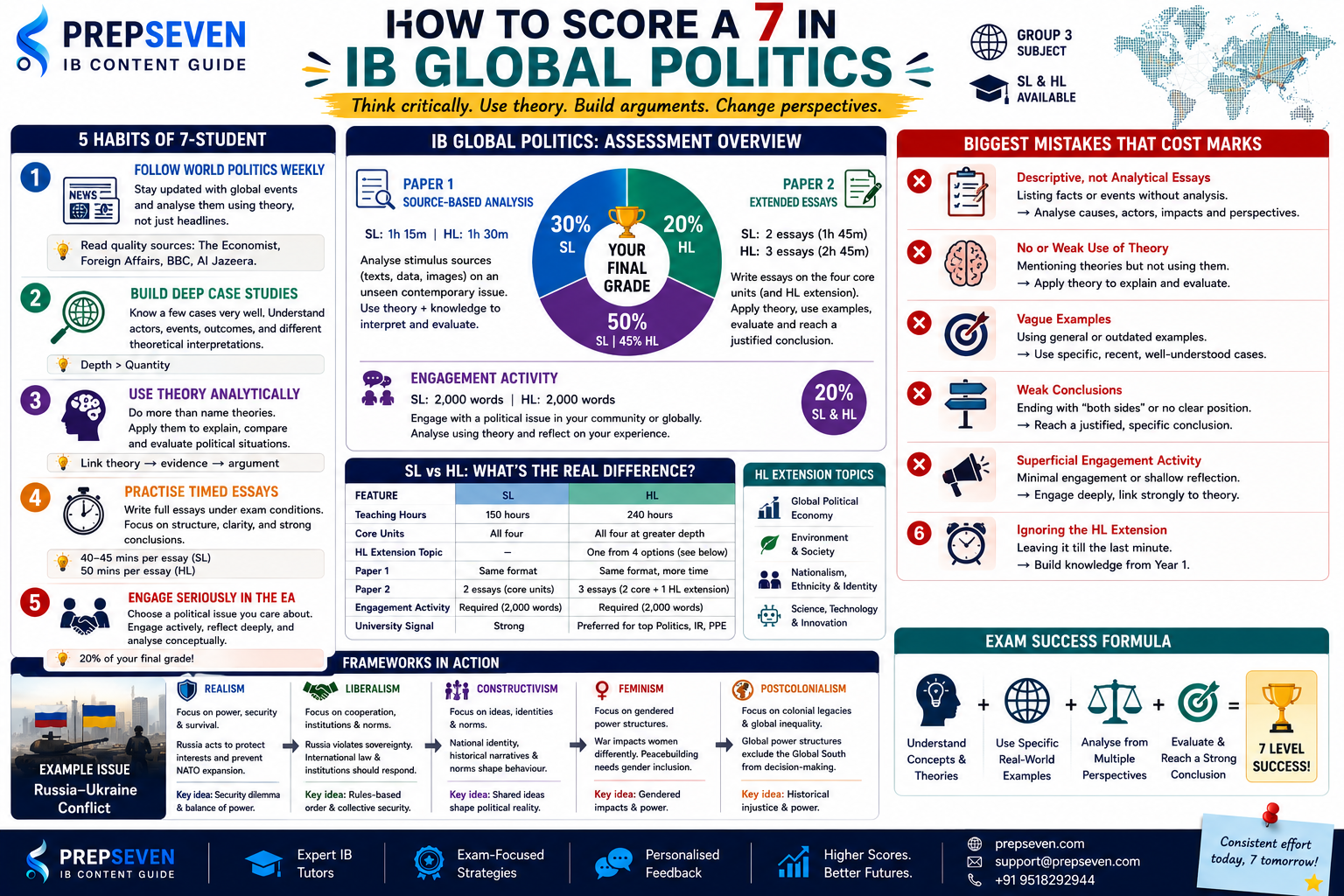
The difference between Global Politics SL and HL is substantive. HL students cover all the same core content as SL students but engage with it in greater depth, and the HL extension requires students to study one of four extension topics that add significant conceptual complexity to the course.
The HL extension topic is where the course reaches its highest level of conceptual complexity. Global Political Economy, for example, requires students to engage with international trade theory, global financial institutions, multinational corporations, and the political economy of development. Nationalism, Ethnicity and Identity requires engagement with theoretical debates about the construction of national identity, the politics of ethnicity, and the relationship between identity and conflict. Science, Technology and Innovation connects political theory to debates about AI governance, bioethics, and the geopolitics of technological competition. These are genuinely demanding intellectual territories that reward students who find them interesting.
If you are planning to study politics, international relations, philosophy, economics, PPE, law, or any social science at university, Global Politics HL is one of the most direct and relevant preparations in the IB. The analytical skills it develops, applying competing theoretical frameworks to real political situations, constructing arguments under time pressure, and engaging directly with a political issue in the world, are exactly what selective humanities and social science programmes look for and expect.
What the Syllabus Covers
The Four Core Units
The Four HL Extension Topics
Your school selects which HL extension topic to teach, and this choice shapes a significant portion of the HL course. Confirm which extension your school offers early in Year 1 and engage with it seriously from the start. The HL extension essay in Paper 2 carries substantial marks and requires the same depth of theoretical and empirical knowledge as the core unit essays.
Assessment Breakdown: How You Are Graded
Paper 1: Source-Based Analysis
Paper 1 is one hour fifteen minutes for SL and one hour thirty minutes for HL. It presents a set of stimulus sources, typically three to five documents including text extracts, data, images, and political cartoons, all focused on a specific contemporary global political issue. You answer structured questions that require you to interpret, contextualise, and evaluate these sources using your knowledge of global politics.
Paper 1 is more interpretive than most IB source-based papers. The questions do not just ask you to identify what a source says. They ask you to use the source in combination with your own political knowledge to analyse what is happening and why, to identify which political perspectives are represented or absent, and to evaluate the significance of the issue the sources address. A student who treats Paper 1 as a reading comprehension exercise will underperform. A student who uses the sources as a springboard for politically informed analysis will score significantly higher.
One distinctive feature of Paper 1 is that the stimulus material is drawn from a specific contemporary issue that students have not been told about in advance. This is the component that most directly tests whether students have developed the analytical flexibility to apply political concepts to unfamiliar situations. Students who have genuinely understood the four core units, rather than memorising examples, can approach any political scenario with a set of conceptual tools that work regardless of the specific topic.
Preparation for Paper 1 is not about predicting which issue will appear. It is about developing the flexibility to apply political theory to any issue quickly. The most effective preparation is regular practice analysing political news through the lens of the four course frameworks: which actors are involved, what forms of power are at play, how do realist and liberal interpretations differ, what does a human rights or development lens add to the analysis? Students who have practised this throughout both years arrive at Paper 1 with a mental toolkit that works on whatever the IB gives them.
Paper 2: Extended Essays
Paper 2 is one hour forty-five minutes for SL and two hours forty-five minutes for HL. At SL, you write two extended essays from four options covering the core units. At HL, you write two essays on core units and one essay on the HL extension topic, for three essays total. Each essay is worth fifteen marks.
The essay questions use demanding command terms: examine, evaluate, to what extent, compare and contrast, discuss. Each requires a different type of response, and students who conflate them consistently lose marks. Examine means investigate from different angles with supporting evidence. Evaluate means weigh the evidence and reach a justified conclusion about worth or significance. To what extent means argue a position on a scale, acknowledging both supporting and complicating evidence, and defend a specific conclusion. Discuss means present multiple perspectives with their reasoning and evidence, acknowledging complexity.
A strong Paper 2 essay in Global Politics does three things that weaker essays do not. It uses theoretical frameworks explicitly, naming realism, liberalism, constructivism, or other relevant perspectives and deploying them analytically rather than decoratively. It uses specific real-world examples with specific detail, not vague references to recent events or unnamed countries. And it reaches a justified, specific conclusion that follows from the argument it has constructed, rather than ending with a both sides have valid points hedge that the examiner recognises immediately as analytical avoidance.
The most common mark-losing pattern in Global Politics Paper 2 is what examiners describe as assertion without analysis: students make strong claims, cite examples, but do not explain how the example supports the claim or what it reveals about the broader theoretical issue at stake. Writing that China’s Belt and Road Initiative shows that states pursue power is assertion. Writing that the BRI reflects a realist understanding of economic statecraft as an extension of political influence, challenging liberal assumptions that interdependence reduces conflict by demonstrating that China uses interdependence strategically to build asymmetric dependency relationships that constrain partner states’ political choices, is analysis. The difference is in the intellectual work done between the claim and the example.
Engagement Activity
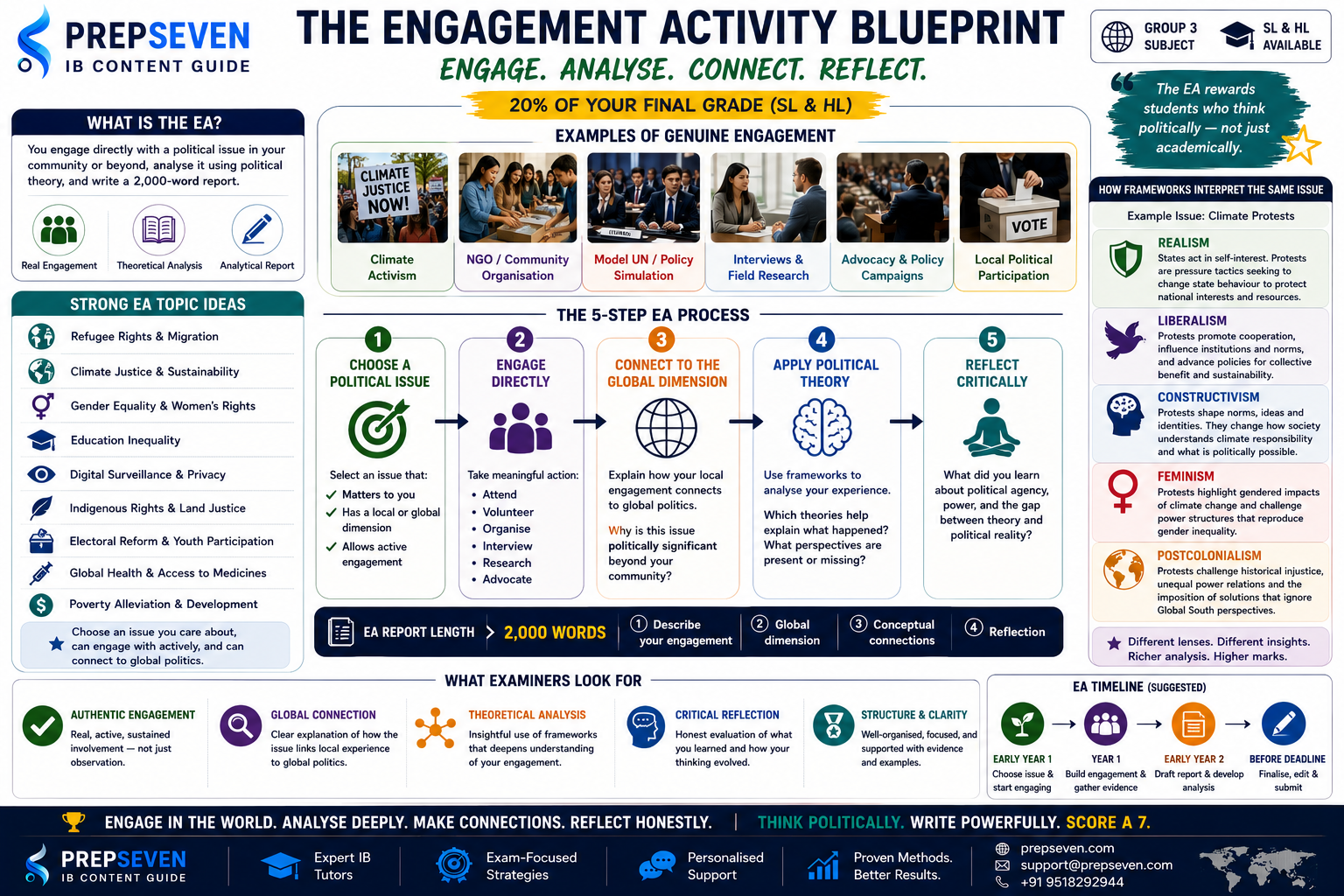
The Engagement Activity is one of the most distinctive components of any IB course. It requires you to engage directly with a political issue at any scale from local to global, analyse that engagement using the conceptual tools and frameworks of the course, and write a 2,000 word analytical report. It contributes 20% of your final grade at both SL and HL.
The engagement must be genuine and active, not observational. Attending a protest, organising a campaign, volunteering with a political organisation, participating in a Model UN conference, meeting with a local politician, conducting original research through interviews with affected community members, contributing to advocacy on a political issue: these are all legitimate engagements. Reading about an issue and writing a report about what you read is not.
The Engagement Activity report is structured around four sections: description of the local engagement, its connection to the global dimension, its conceptual links to the four core units and the relevant theoretical frameworks, and a personal reflection on what the engagement revealed about the nature of political agency and the relationship between theory and practice.
The third section, the conceptual connections, is where the most marks are available and where the most marks are consistently left on the table. Students who describe their engagement thoroughly but then make only surface-level connections to course content, mentioning that the issue relates to human rights or development without analysing how specific frameworks illuminate what they experienced, score in the middle range. Students who use specific theoretical frameworks to make sense of what they encountered, who can explain why a realist perspective would interpret the political dynamics of their engagement differently from a liberal or constructivist one, score at the top.
Choose your Engagement Activity topic early in Year 1 and treat the engagement itself as an ongoing process rather than a single event. The most compelling reports come from students who sustained genuine engagement with a political issue over time, who followed its development, who reflected on how their understanding changed, and who encountered the gap between political ideals and political reality in a way that genuinely informed their thinking. One afternoon at a Model UN conference produces a thin report. Six months of involvement with a community issue produces a rich one.
Political Theory in Practice: Using Frameworks to Earn Marks
Global Politics is unusual among IB subjects in that it explicitly requires students to use theoretical frameworks rather than simply knowing content. Understanding what the frameworks are and how to use them analytically, rather than just being able to define them, is the single most important skill the course develops and the single biggest differentiator between the middle grade bands and the top.
The most common mistake students make with theoretical frameworks is using them as labels rather than analytical tools. Writing that a realist would see this situation as involving power competition is a label. Writing that a realist analysis focuses on how Russia’s intervention in Ukraine reflects the logic of security dilemma: as NATO expanded eastward, Russia perceived an existential threat to its sphere of influence and responded with the logic of offensive realism, prioritising territorial buffer zones over liberal norms of sovereignty, and that this interpretation challenges the liberal narrative of an unprovoked violation of international law by suggesting that great power behaviour follows structural incentives rather than individual leader decisions, is an analytical tool. The second version earns marks. The first one does not.
What Actually Gets Students to a 7
They follow real world politics with analytical attention throughout both years
Global Politics is unique among IB subjects in that the world provides new material for the course constantly. The students who score highest are almost always those who follow current political events with genuine intellectual engagement throughout both years. Not just following what happens, but asking: which theoretical framework best explains this? What does this event reveal about the tensions between realism and liberalism? How does a postcolonial reading challenge the mainstream narrative here? This habit of analytical engagement with current events builds the political literacy that makes Paper 1 manageable and Paper 2 arguments vivid and specific.
They build a specific, well-understood case study bank
Global Politics essays require specific real-world examples deployed analytically. The students who score at the top have built a bank of political cases they understand deeply, cases where they know not just what happened but why, what the competing interpretations are, and how different theoretical frameworks would analyse the situation differently. The case study does not need to be dramatic or famous. A well-understood recent example from any region of the world, where the student can trace the political dynamics with specificity and theoretical insight, is more valuable than a vaguely recalled headline about a major event.
They treat every essay question as a specific invitation, not a general topic prompt
A very common underperformance pattern in Global Politics Paper 2 is students writing the essay they prepared rather than the essay the question asks for. The question might be: to what extent do non-state actors challenge state sovereignty in the contemporary international system? A student who has prepared on power and sovereignty might write everything they know about sovereignty, including material that is not directly relevant to the specific question of non-state actors. A student who reads the question carefully, identifies that it is specifically asking about the extent of non-state challenge, and constructs an argument that weighs the evidence for significant challenge against the evidence for state resilience, will score significantly higher. Read the question, identify the specific analytical task, and write to that task.
They engage with the Engagement Activity as a genuine intellectual project
The Engagement Activity report is 20% of the final grade and it is the component that most rewards genuine intellectual engagement over formulaic execution. Students who choose an engagement they genuinely care about, who engage with it seriously over time, and who approach the conceptual connections section with real analytical ambition, regularly produce work that scores at the top of the criteria. Students who choose an engagement for its convenience, engage minimally, and write the report as a formality, consistently produce work that scores in the middle range regardless of how capable they are in the exam papers. The Engagement Activity is the component that most directly measures whether a student has genuinely internalised the course.
They practise constructing arguments from multiple perspectives under timed conditions
The ability to construct a balanced, theoretically informed, evidence-based argument in forty-five minutes per essay is a skill that only develops through repeated timed practice. Students who only write Global Politics essays at home with unlimited time and access to notes consistently find that their essay quality drops significantly under exam conditions. Practise writing full timed responses to Paper 2 questions from Year 1 onwards, including choosing your evidence strategically within time limits and constructing a conclusion under pressure. The intellectual fluency that Paper 2 demands is a performance skill as much as a knowledge skill.
Common Mistakes That Cost Marks
A Realistic Year-by-Year Approach
Year 1 (Grade 11): Build Frameworks and Political Awareness
- Learn the four main theoretical frameworks thoroughly in the first term: what their core assumptions are, what kind of analysis they produce, and which types of political situations each is most useful for explaining. These frameworks are the analytical tools you will use for two years.
- Begin following political news regularly from week one. Choose two or three quality sources and read them with analytical attention: The Guardian, Foreign Affairs, The Economist, Al Jazeera English, or BBC World Service all provide coverage relevant to the course. Fifteen minutes a day of analytically engaged news reading builds political literacy that no amount of textbook revision can replicate.
- Choose your Engagement Activity topic by the end of Term 1 and begin your engagement as early as possible. The most compelling reports come from sustained engagement over time, not single events.
- Build a case study bank from the first core unit you study. For every major case discussed in class, write a structured note covering what happened, which actors were involved, which theoretical frameworks are most useful for analysis, and what specific data or outcomes you should remember.
- For HL students: engage with the HL extension content as it is introduced. Do not defer it to Year 2.
Year 2 (Grade 12): Deepen Analysis and Practise Performance
- Write at least four full timed Paper 2 essays under exam conditions before your mock exams. Focus the feedback specifically on argument structure, framework use, and conclusion quality. The ability to write a theoretically informed, evidence-based argument in forty-five minutes is a performance skill that requires practice.
- Practise Paper 1 using past paper stimulus material. Develop a consistent analytical approach: identify the actors, identify the political issue, apply the relevant theoretical frameworks, evaluate the sources in terms of perspective and limitations.
- Complete your Engagement Activity report and submit a full draft for teacher feedback before the end of Term 1. The conceptual connections section is where most marks are earned or lost, and the feedback cycle is where improvement happens.
- In the final revision period, build cross-unit connections. Global Politics questions sometimes span more than one core unit: a question about humanitarian intervention connects Peace and Conflict to Human Rights. A question about development NGOs connects Development to Power and Sovereignty. Practise questions that require this kind of cross-unit thinking.
How PrepSeven Helps You Score Higher in IB Global Politics
Global Politics rewards two things that are genuinely difficult to develop without feedback: the ability to use theoretical frameworks analytically rather than decoratively in exam essays, and the intellectual confidence to construct a specific, defended position under time pressure. Our Global Politics tutors are experienced IB examiners and teachers who have marked student work across all components and know exactly what distinguishes a 6 from a 7 in this course.
- Paper 2 essay sessions where you write a timed response and your tutor annotates it for framework use quality, argument structure, evidence specificity, and conclusion strength, showing you exactly what a top-band version of the same argument looks like.
- Paper 1 practice sessions where your tutor works through past stimulus material with you, building the analytical flexibility to apply political concepts to unfamiliar scenarios quickly and precisely.
- Framework development sessions that go beyond definitions to build genuine analytical fluency: using realism, liberalism, constructivism, and feminist theory as tools on real political cases until deploying them in essays feels natural rather than forced.
- Engagement Activity mentorship covering topic selection, engagement planning, and report writing, with particular attention to the conceptual connections section where the most marks are available and most students underperform.
Book your free demo lesson at prepseven.com and bring a Paper 2 essay question or a current political event you have been following. Your tutor will show you what analytically deploying political theory on that material looks like, and what separates a 6 from a 7 in this course.