
PrepSeven | IB Content Guide authored by Shankar Mutneja (Founder of Prepseven)
IB English A: Literature
What Is IB English A: Literature?
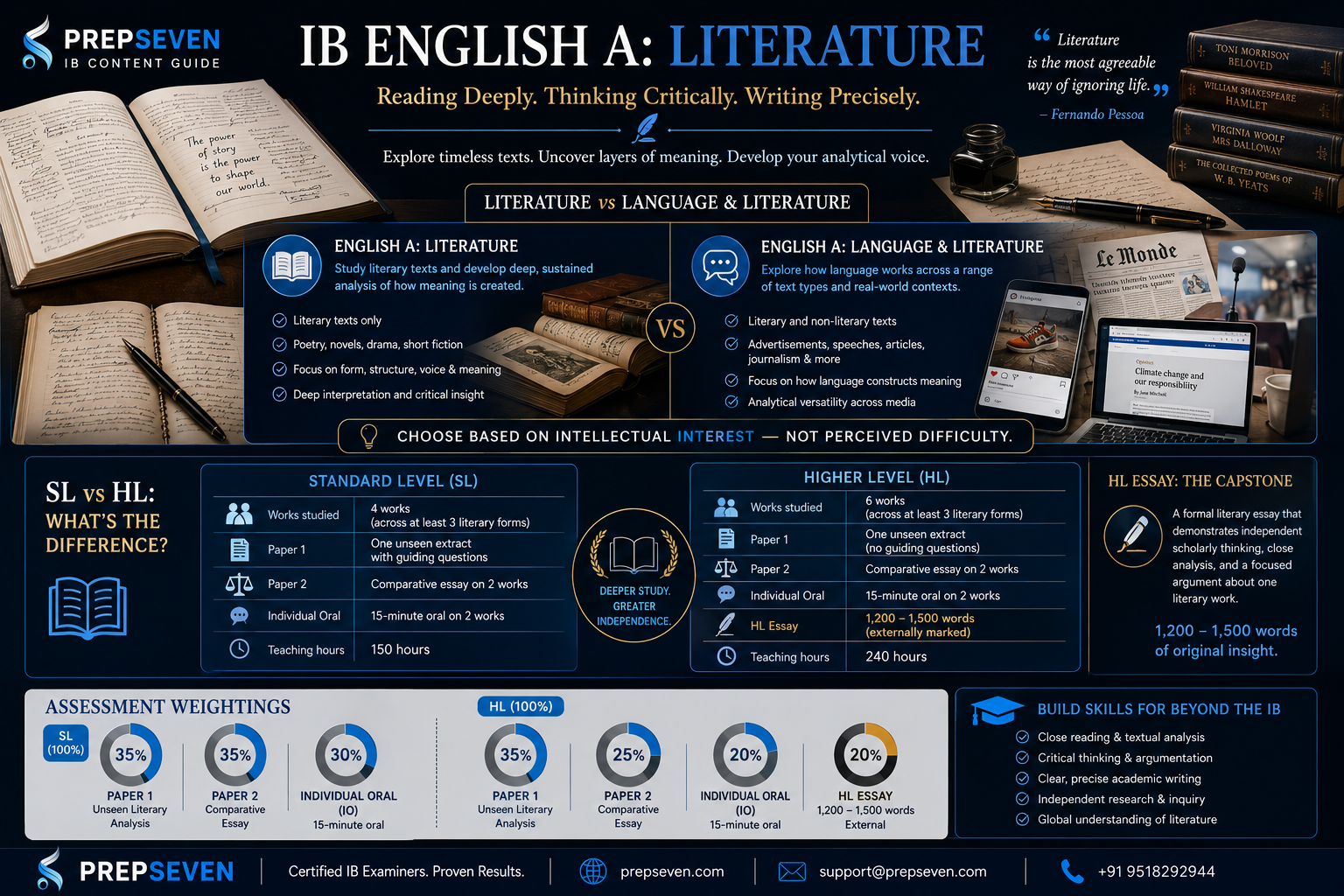
IB English A: Literature is a course about reading deeply. Not broadly, not quickly, but with the kind of sustained attention that pulls meaning out of the way a sentence is constructed, the way a scene is positioned within a larger structure, or the way a writer’s choice of a single word shifts the emotional register of an entire passage. It is one of two English A courses in the Diploma Programme. The other is Language and Literature. They are not interchangeable, and the differences between them matter when you are deciding which to take.
Literature focuses exclusively on literary texts: novels, plays, poetry, and short fiction. There are no advertisements, no political speeches, no journalism. Every text you study has been chosen because it repays sustained literary attention, because its language, form, and structure carry meaning that cannot be separated from the words on the page. The course exists to develop your ability to read that meaning, articulate it precisely, and connect it to broader questions about human experience.
The course is available at Standard Level and Higher Level. It sits in Group 1 of the IB Diploma Programme, and for students whose first language or strongest language is English, it is almost always the natural home.
IB English A: Literature is not a course for students who enjoy reading. It is a course for students who enjoy thinking about reading: why a text works the way it does, what it reveals about the time and place it came from, how it positions its reader, and what it means to call something literary. Students who arrive expecting to discuss their favourite novels and leave disappointed. Students who arrive ready to analyse are rewarded.
Literature vs Language and Literature: Getting the Choice Right
This is the decision that shapes your entire Group 1 experience and it deserves serious thought before Year 12 begins.
English A: Literature studies only literary texts and develops deep, sustained literary analysis. English A: Language and Literature studies both literary and non-literary texts and develops analytical versatility across different types of language use. They share some assessment components, the Individual Oral and Paper 2, but they are different courses with different Paper 1 formats and a different intellectual emphasis.
In practice, many schools offer one or the other rather than both, so your choice may be constrained by what your school provides. If you have the option, choose based on where your intellectual interest genuinely lies. Students who choose Literature because they think it sounds more prestigious, and Lang Lit because they think it sounds more manageable, tend to be wrong on both counts.
SL vs HL: What the Difference Really Means
The most visible difference between SL and HL in English A: Literature is the HL Essay, a 1,200 to 1,500 word formal literary essay that HL students submit for external marking and SL students do not write. But the differences go deeper than that one component.
HL students study more works than SL students and are expected to engage with those works at a greater depth of literary analysis. The HL Individual Oral draws on a wider range of studied texts. The HL Paper 1 unseen literary extract is typically more complex. And the HL Essay requires students to sustain a focused scholarly argument over several months of independent work in a way that SL students are never asked to do.
The absence of guiding questions on HL Paper 1 is more significant than it might appear. At SL, the guiding questions give you a loose scaffold for your analysis. At HL, you must impose your own analytical structure on an unfamiliar literary extract within the exam time. Students who have not practised this regularly struggle to produce a coherent, well-organised analysis under pressure. It is a skill that needs building throughout both years, not just before the exam.
Assessment Breakdown: What You Are Actually Graded On
Paper 1: Unseen Literary Analysis
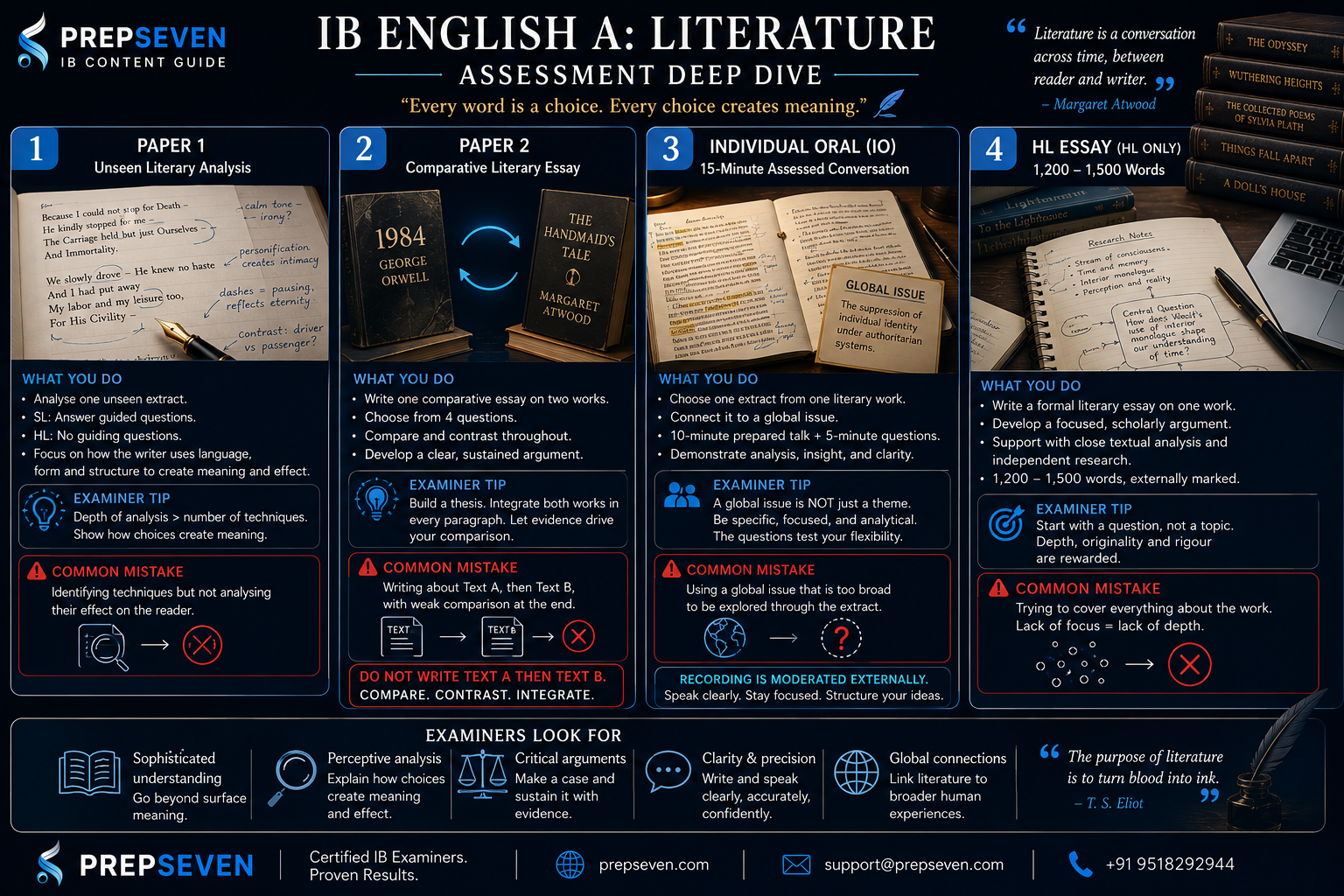
Paper 1 presents you with a literary extract you have never seen before. At SL you receive guiding questions to structure your analysis. At HL you receive no guidance at all. In both cases, the task is the same: write a literary analysis of the extract that demonstrates your understanding of how the writer has used language, form, and structure to create meaning and effect.
The extract could be from any literary form: a passage of prose fiction, a poem, an extract from a play, or occasionally a piece of literary non-fiction. You cannot predict what you will receive. What you can do is develop a flexible analytical approach that works across all literary forms so that the genre of the extract does not determine how well you perform.
The most consistent finding in IB examiner reports for Paper 1 is that students who perform poorly have identified literary techniques accurately but have not connected those techniques to meaning and effect. Writing that a poem uses enjambment is a starting point. Writing that the enjambment creates a sense of breathless momentum that mirrors the speaker’s emotional urgency, and that the sudden caesura in line nine ruptures that momentum to reflect the moment of reckoning the poem has been building toward, is what earns marks in the higher grade bands.
A habit that separates strong Paper 1 writers from average ones: they choose their evidence carefully rather than cataloguing every technique they notice. A focused analysis of three or four well-chosen moments in a text, each developed in depth, will almost always outscore a long list of techniques with surface-level commentary. Quality of analysis matters more than quantity of observations.
Paper 2: Comparative Literary Essay
Paper 2 is a two-hour exam in which you write one comparative essay on two literary works you have studied during the course. You choose from four questions, each of which is broad enough to apply to most works but specific enough to require genuine intellectual engagement.
The comparative element is not optional. The IB is explicit that Paper 2 requires you to compare and contrast. A response that writes about one work and then the other in separate sections, with a brief paragraph at the end noting similarities, does not meet the requirement. Comparison should be integrated throughout: each paragraph should move between both works, building an argument that develops across the essay as a whole.
The questions on Paper 2 will always be thematic or structural in nature. Something like: explore how endings are used to create meaning in the works you have studied, or discuss how power is represented through the relationships between characters. The best preparation is not memorising everything you know about each work. It is practising the construction of comparative arguments: what does it actually mean to say that two writers approach the same theme differently, and how do you demonstrate that through close reading rather than assertion?
Three things that are consistently present in Paper 2 responses that score 7 and consistently absent in responses that score 5: a genuine thesis in the opening paragraph that the rest of the essay develops and defends, specific textual evidence that is actually analysed rather than quoted and abandoned, and a comparative structure that treats the two works as genuine intellectual partners rather than separate entities that happen to appear in the same essay.
Individual Oral (IO)
The Individual Oral is a 15-minute assessed conversation between you and your teacher. You prepare a 10-minute talk and then answer questions for 5 minutes. You choose one extract from one literary work you have studied and connect it to a global issue of your choosing. Your analysis of the extract should demonstrate how the writer’s choices illuminate that global issue.
The global issue is the part of the IO that most students get wrong, and understanding why is important. A global issue is not a theme. It is not a topic. It is a specific, real-world concern with local and global dimensions that the literary text speaks to in a meaningful way. Identity is not a global issue. The suppression of individual identity under authoritarian systems of governance is a global issue. Gender is not a global issue. The way literary representations of femininity have been used to police women’s behaviour across different historical contexts is a global issue. The specificity of your framing directly determines the analytical depth your IO can reach.
The 5-minute question portion of the IO is assessed too, and many students prepare so thoroughly for their 10-minute talk that they neglect to think about what questions might follow. Your teacher will ask you to extend, qualify, or reconsider something from your prepared section. Students who treat their prepared talk as the finished product and have nothing left to say in the questions consistently score below their preparation would suggest. The questions are an opportunity to demonstrate analytical flexibility, not a test of whether you can remember what you just said.
One thing almost no student guide mentions about the IO: the recording matters. Your teacher records the oral and submits it to the IB for external moderation. External examiners listen to the recording and may mark it differently from your teacher. Speak clearly, stay focused on the literary text, and make sure your argument is audible and structured. An oral that sounds like a polished academic talk, even imperfect, will be moderated more generously than one that trails off or loses its thread.
HL Essay
The HL Essay is a 1,200 to 1,500 word formal literary essay written over several months and submitted for external marking. You choose one literary work from your course and develop an argument about it that goes beyond what your teacher has covered in class. It is the closest thing in the IB to university-level literary scholarship.
The HL Essay is assessed on the quality of the argument, the quality of the textual analysis, and the quality of the writing itself. It rewards students who have read widely around their chosen work, who have developed a focused and original line of inquiry, and who can sustain a rigorous analytical argument across 1,200 to 1,500 words without padding or repetition.
The most common failure mode in HL Essays is a lack of focus. Students choose a work they love and try to write about everything interesting they have noticed in it. The result is an essay that covers too much ground too shallowly. The best HL Essays ask a precise question about a limited aspect of a work and answer it with depth and rigour. An essay arguing that the recurring motif of mirrors in a specific novel functions as a structural metaphor for the protagonist’s fractured sense of self across three key scenes will almost always outscore an essay attempting to survey the novel’s major themes.
The Works You Will Study and Why Selection Matters
The IB prescribes a list of works for each language and each examination session, but your school selects the specific titles from that list. This matters more than students usually realise, because the texts your school chooses shape what you can write about in Paper 2 and the Individual Oral.
The IB requires that works studied in the Literature course span three areas of exploration and at least three literary forms. The areas of exploration are the same across all IB Group 1 courses.
These areas of exploration are not taught as separate units that you study one at a time. They are conceptual lenses that apply to every text throughout the course. Your Paper 2 essay and your IO talk will implicitly or explicitly draw on more than one of them, and the most sophisticated student responses tend to be those that are conscious of which lens is most productive for the specific question or work at hand.
Pay close attention early in Year 1 to which works your school has designated specifically for Paper 2. You can only write about a work in Paper 2 if it has been formally taught as part of your course, and your teacher will clarify which of the studied works are intended for the comparative essay. Begin building your analytical notes on those works from the very first lesson in which they are introduced.
What Actually Gets Students to a 7: The Habits That Separate Top Performers
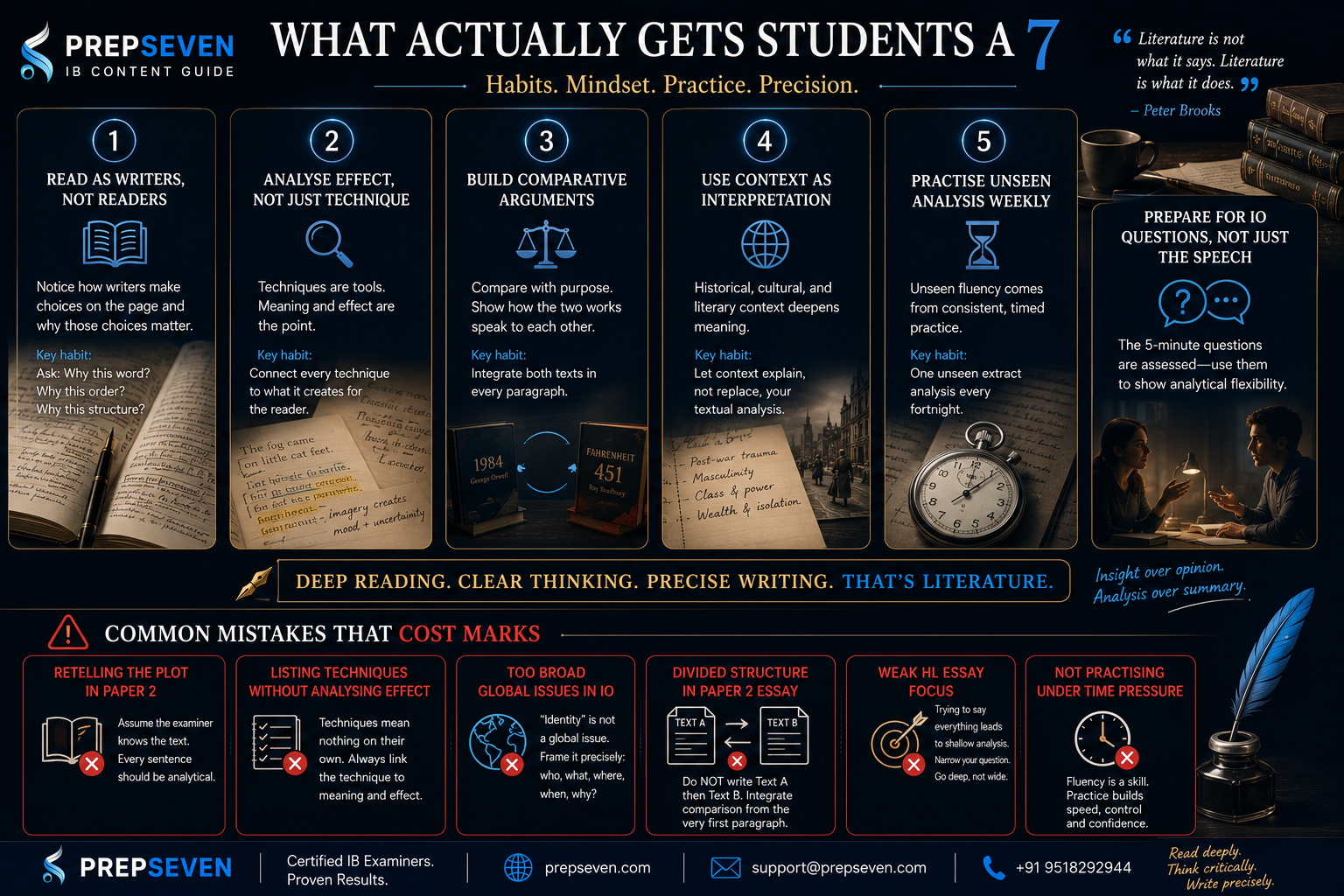
They read as writers, not just as readers
Strong Literature students develop the habit of noticing how a text achieves its effects, not just what those effects are. When you read a passage and feel unsettled, or moved, or implicated in something, the question to ask is not just what am I feeling but how has the writer made me feel this? What specific choices of diction, syntax, imagery, or structure have produced this response? This is the shift from reading to literary reading, and it is the fundamental skill the entire course is built to develop.
They develop a precise analytical vocabulary that is genuinely their own
There is a difference between knowing literary terms and being able to use them precisely. A student who writes that a poem uses juxtaposition has identified a technique. A student who writes that the juxtaposition of imagery associated with domestic warmth and imagery associated with industrial violence in the poem’s central stanza forces the reader to recognise that the speaker cannot hold these two aspects of her life apart, that the private and the economic are entangled in ways she cannot resolve, has used literary language as a tool for genuine insight. Build a vocabulary for talking about literary effect, not just literary technique.
They treat every text as a product of specific choices
One of the most useful habits in preparing for both Paper 1 and Paper 2 is the practice of asking: why this and not something else? Why does this poem end on a question rather than a statement? Why is this novel written in second person? Why does this scene occur before that one rather than after it? The assumption that every choice is meaningful, not accidental, and that your job is to explain what those choices achieve, is what drives analysis from description to argument.
They write Paper 2 thesis statements before anything else
Under exam conditions, students frequently start writing before they know what argument they are making. This produces essays that are coherent at the level of the paragraph but incoherent at the level of the essay as a whole, because each paragraph is making a different observation rather than contributing to a single developing argument. Before writing the first word of a Paper 2 essay, write one sentence that states your argument. Everything you write should develop and defend that sentence. If a paragraph does not contribute to your thesis, it should not be in the essay.
They prepare for the IO questions, not just the IO talk
The 5-minute question section of the IO is assessed but rarely practised. Students who have rehearsed their 10-minute prepared talk repeatedly but never practised responding to questions about it are often caught off guard by how hard it is to extend and qualify their own arguments under pressure. Practise with your teacher, with a tutor, with a classmate. Ask them to challenge a claim in your prepared section, to ask you to connect your global issue to a different moment in the text, or to ask what you would say if you had chosen a different extract. That kind of preparation is what makes the question section a showcase rather than a stumble.
They start the HL Essay with a question, not a topic
Students who approach the HL Essay by choosing a topic, such as memory in Mrs Dalloway or power in Macbeth, tend to produce essays that survey the topic rather than argue about it. Students who approach the HL Essay by formulating a precise question, such as what does Virginia Woolf’s use of free indirect discourse in specific scenes suggest about the relationship between memory and identity formation, have a direction that the essay can follow with real intellectual purpose. The question does not need to be fixed at the start, but the essay needs one before you are halfway through writing it.
Common Mistakes That Cost Marks
A Realistic Year-by-Year Approach
Year 1 (Grade 11): Read Actively and Build Foundations
- Annotate every text you study for technique, effect, and context from the very first lesson. Passive reading does not build the analytical habit. Active annotation does.
- Practise one unseen literary analysis per month, even informally. Write 300 to 400 words on a poem or prose extract and focus on depth of analysis over breadth.
- Begin building your global issue ideas for the IO as each work is studied. Keep a running list of possible global issues and the specific ways each text speaks to them.
- For HL students: start thinking about your HL Essay work and line of inquiry by the end of Term 2. You want a full year to develop your argument and revise your drafts.
- Build a comparative notes document for each pairing of works that might appear in Paper 2. Note structural similarities and differences, thematic parallels, and contrasting authorial approaches.
Year 2 (Grade 12): Consolidate and Perform
- Complete at least four full Paper 1 practices under timed exam conditions. For HL students, practise without guiding questions every time.
- Write and revise two full Paper 2 essays on different question types before your mock exams. Ask your teacher or tutor to mark them against the actual IB criteria.
- Finalise your IO extract choices by the start of Term 1 and practise your oral at least three times: once alone, once with a peer who can ask questions, and once with your teacher in a formal mock session.
- For HL students: submit your HL Essay draft to your teacher before the end of Term 1. Use every round of feedback to sharpen your argument and your textual analysis.
- In the final revision period, prioritise past Paper 2 questions and practise constructing thesis statements quickly. The ability to form a clear comparative argument under time pressure is the single most important exam skill in this course.
How PrepSeven Helps You Score Higher in IB English A: Literature
Our English A: Literature tutors are certified IB examiners and experienced DP teachers who have marked student work on the other side of the process. They understand the mark scheme from the inside, which means they can tell you not just what a good answer looks like but precisely why it earns the marks it does.
Here is what a typical engagement with a PrepSeven Literature tutor looks like in practice:
- Paper 1 sessions where your tutor gives you an unseen literary extract, you write your analysis under timed conditions, and they mark it against the exact IB criteria, annotating every paragraph to show what is earning marks and what is not.
- Paper 2 essay review sessions where your tutor identifies where your comparative argument loses its thread, where your textual evidence is being quoted rather than analysed, and where your thesis needs sharpening.
- IO preparation sessions where your tutor plays the examiner role, listens to your prepared talk, asks the kind of follow-up questions an IB examiner would ask, and gives you feedback on both the intellectual content and the clarity of your argument.
- HL Essay mentorship from the initial line of inquiry through to final draft, helping you develop the focused scholarly argument that distinguishes a 6 from a 7 at that level.
Book your free demo lesson at prepseven.com and experience what it feels like to have your literary analysis marked by someone who actually marks for the IB.