
PrepSeven | IB Content Guide authored by Shankar Mutneja (Founder of Prepseven)
IB Design Technology
The Complete Guide for IB DP Students and Parents
What Is IB Design Technology?
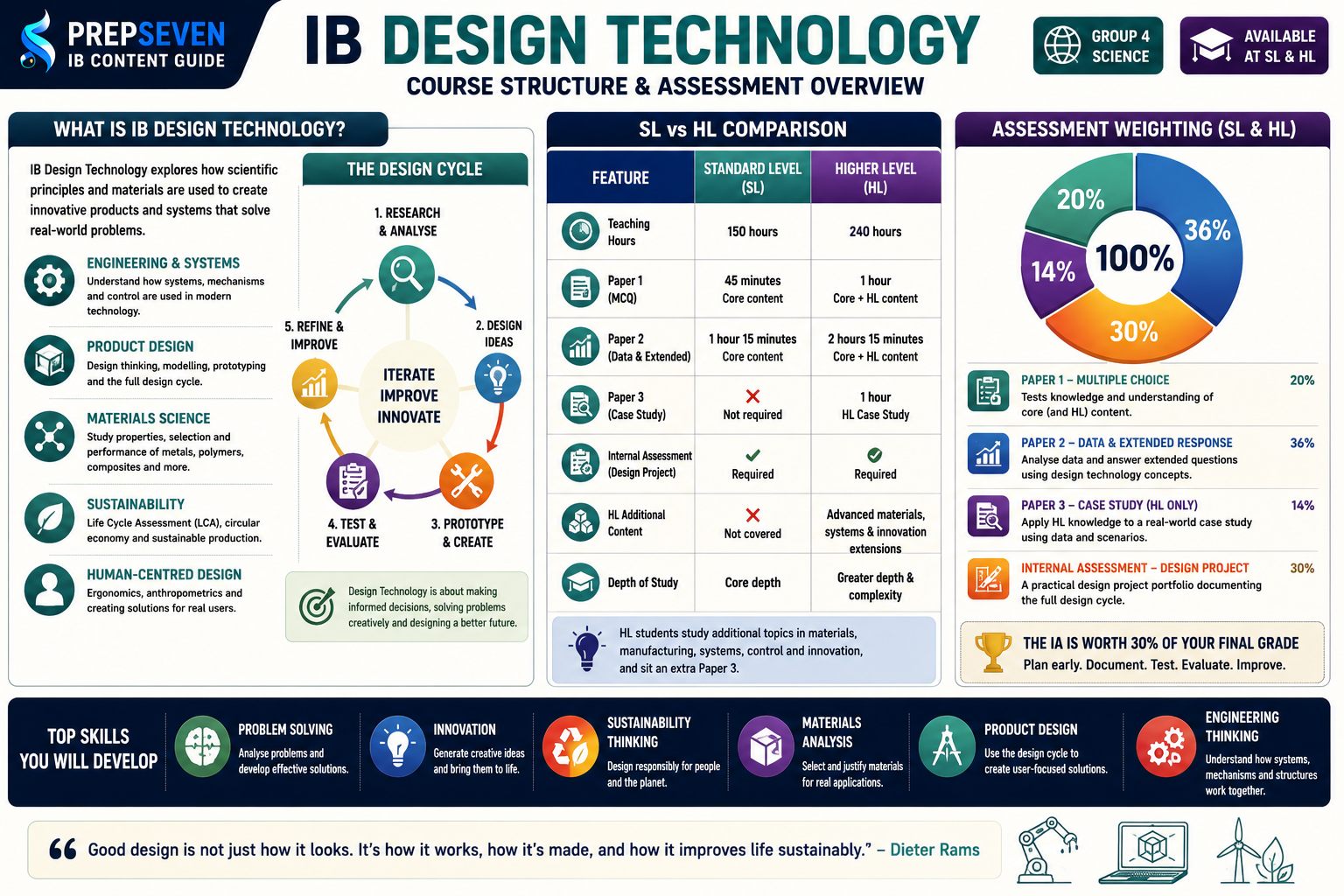
IB Design Technology is the Diploma Programme’s Group 4 science subject that sits at the intersection of engineering, materials science, systems thinking, and human-centred design. It is available at Standard Level and Higher Level and is one of the most genuinely interdisciplinary courses in the IB, requiring students to think simultaneously as scientists, engineers, designers, and critical consumers of technology. Unlike traditional physics or chemistry courses, Design Technology is explicitly concerned with how scientific and engineering principles translate into products, systems, and processes that affect human life.
The course is built around the idea that designed products are not neutral objects. Every design decision involves trade-offs between competing priorities: function versus aesthetics, durability versus sustainability, cost versus quality, user needs versus environmental impact. Design Technology students learn to analyse these trade-offs rigorously, to understand the physical and materials science underlying product behaviour, to engage with the full design cycle from brief to prototype to evaluation, and to place designed products in their social, cultural, and environmental contexts.
What makes Design Technology distinctive among Group 4 subjects is the internal assessment: a substantial design project in which students identify a genuine design need, develop and test a solution through a structured design cycle, and produce a portfolio documenting the entire process. This project, which is unlike anything in Biology, Chemistry, or Physics, is often the component students find most personally meaningful and, if poorly managed, the one that costs the most marks. The project rewards students who engage with the design process genuinely and organise their time carefully across both years.
Students sometimes choose IB Design Technology because they enjoy making things or are interested in engineering, and the course does reward those interests. But the analytical and written demands of the course are substantial, and students who expect it to be primarily hands-on practical work are often surprised by the conceptual rigour of the examined content. The students who achieve the best results bring both a genuine interest in how designed products work and the willingness to engage with the theory, systems thinking, and materials science that underpin the practical applications.
SL vs HL: What the Difference Really Involves
Design Technology is available at SL and HL, and the differences between the two levels go beyond the additional content to include the depth of analysis expected and the additional paper that HL students sit. Both levels cover a common core of content and complete the same internal assessment. HL students cover additional HL-only material and sit Paper 3, a data-based paper that tests the ability to apply knowledge in novel experimental contexts.
The decision between SL and HL should be driven by how central you want Design Technology to be in your Diploma and how much depth you want to go into on the engineering and materials science content. HL students who are considering engineering, product design, architecture, or materials science at university will find the HL content directly relevant and the additional analytical depth valuable. Students who want a solid Group 4 option without the depth of a conventional science subject, and who have strong interests in design and technology without wanting to pursue it at university, often find SL the right fit.
The HL Paper 3 is a case study paper that changes each year. HL students receive the case study topic in advance, typically in January before the May exam session, and are expected to study it in detail and be able to apply their knowledge to novel data and scenarios connected to it. Students who treat Paper 3 as an exam to be crammed the week before consistently underperform those who study the case study systematically across the weeks available. The advance release of the case study is an advantage, but only for students who use that time properly.
Syllabus Structure: What You Actually Study
The IB Design Technology syllabus is organised into a core that all students cover and HL-only extensions. The core is structured around several major topic areas that together build the conceptual framework for thinking about designed products systematically. Understanding how these topics connect to each other, rather than treating them as isolated units, is what allows students to apply their knowledge flexibly in the extended response questions in Paper 2.
The HL extension content deepens several of these topic areas with additional material on advanced manufacturing processes, materials at the nanoscale, systems and control, and innovation management. HL students cover this additional material in class and are assessed on it in Paper 2 and Paper 3. The HL content rewards students who are genuinely interested in how things are made at an engineering level and who want to understand the systemic dimensions of design and technology beyond individual product analysis.
Assessment Breakdown: Every Component Explained
Paper 1: Multiple Choice
Paper 1 is a multiple choice exam covering the core content at SL and both core and HL content at HL. At SL it is 45 minutes; at HL it is one hour. Despite being multiple choice, Paper 1 is not straightforward to score highly in, because many questions test conceptual understanding and the ability to apply knowledge in unfamiliar contexts rather than simple recall. Questions that present a design scenario and ask which material or process would be most appropriate, or which sustainability principle is being applied, require genuine understanding rather than memorised facts.
The most effective preparation for Paper 1 is working through past papers under timed conditions and identifying the topic areas where your conceptual understanding is weakest. Multiple choice exam performance in Design Technology is a direct function of conceptual clarity rather than content coverage. Students who can explain why an answer is correct, not just which answer is correct, consistently score higher than those who recognise the right answer on familiar questions but struggle when the scenario is presented differently.
One of the most common Paper 1 failure modes is confusing similar but distinct concepts: the difference between ductility and malleability, between accuracy and precision in measurement, between closed-loop and open-loop control systems, or between planned obsolescence and functional obsolescence. These distinctions are frequently tested in multiple choice questions precisely because they are easy to confuse. Build a concept differentiation log as you study, noting pairs or groups of similar concepts and the specific distinctions between them. This log is one of the most effective revision tools for Paper 1.
Paper 2: Data Analysis and Extended Response
Paper 2 is the most substantial written exam and the one where the quality of analytical thinking is most visible. At SL it is one hour fifteen minutes; at HL it is two hours fifteen minutes. The paper includes shorter data analysis questions, which require interpretation of graphs, tables, or product images, and extended response questions, which require sustained analytical writing about design scenarios, materials, processes, sustainability issues, or human factors.
The extended response questions in Paper 2 are where the difference between students who have deeply understood the course and those who have surface knowledge is most evident. A question asking students to evaluate the sustainability of a given product requires not just knowledge of sustainability principles but the ability to apply them specifically to the product described, weigh competing considerations, and produce a structured argument that reaches a justified conclusion. Generic responses that list sustainability concepts without connecting them to the specific scenario consistently score in the mid-band regardless of how much content they include.
Data analysis questions require careful reading of quantitative and qualitative data presented in tables, graphs, or diagrams and the ability to extract relevant information, identify trends, and connect observations to design technology concepts. Students who have practised reading and interpreting data across a range of formats throughout the course find these questions more manageable than those who have primarily practised extended writing.
Paper 3 (HL Only): Case Study
Paper 3 is a one-hour HL-only paper built around an advance release case study. HL students receive the case study topic, typically a real-world product, technology, or design scenario, several months before the May exam, and the questions in Paper 3 require them to apply their knowledge of the case study and the broader HL content to novel data and scenarios connected to it. The paper includes data-based questions and analytical questions that require HL-level depth of response.
The case study changes each year and covers a different area of the HL syllabus. Past case studies have covered topics including specific manufacturing processes, advanced materials, control systems, and sustainability case studies in industrial design contexts. Students who study the case study systematically across the weeks available, who understand the relevant science and engineering in depth, and who have practised applying that knowledge to novel data, are in the strongest position when the exam arrives.
Paper 3 is the component where students most clearly benefit from going beyond the case study document itself. The case study introduces the context, but the questions test your ability to apply Design Technology principles to that context, and that requires depth of understanding that the case study document alone does not provide. When the case study is released, identify which areas of the HL syllabus it connects to and deepen your understanding of those areas through your textbook and notes, not just through the case study text. The exam tests Design Technology knowledge applied to a case study context, not just knowledge of the case study itself.
Internal Assessment: The Design Project
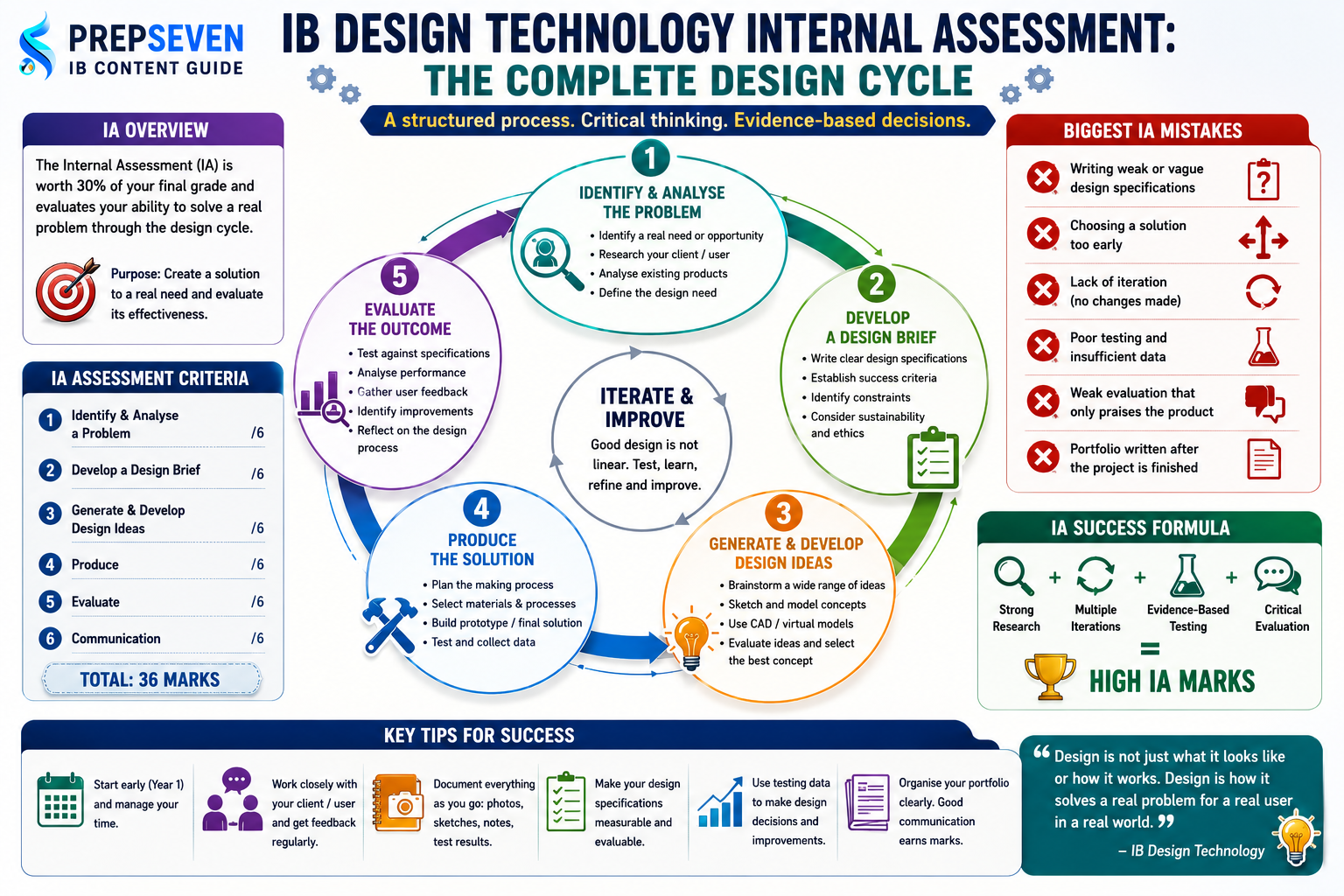
The Internal Assessment is the most distinctive component of IB Design Technology and the one that most clearly reflects the course’s core purpose. Students identify a genuine design need or opportunity, develop a design brief in consultation with a client or user group, generate and develop design ideas through a structured design cycle, produce and test a prototype or solution, and evaluate the outcome against the original design criteria. The entire process is documented in a portfolio, which is submitted for marking.
The IA is worth 30% of the final grade at both SL and HL and is marked against six criteria that together assess the full design cycle from identification of the need through to critical evaluation of the outcome. The criteria are: Identify and Analyse a Problem; Develop a Design Brief; Generate and Develop Design Ideas; Produce; Evaluate; and Communication. Each criterion is assessed on a scale of 0 to 6, giving a maximum of 36 marks before conversion to the final grade contribution.
The most important thing to understand about the IA is that it rewards genuine engagement with the design process, not the quality of the final product. A student who identifies a genuine user need, conducts rigorous research and analysis, generates multiple design ideas and evaluates them systematically, produces a prototype that partially meets the brief, and evaluates the outcome honestly with specific reference to the original design criteria, will score higher than a student who produces a technically impressive product but documents the process poorly or skips the evaluation of how well the outcome meets the brief.
The Evaluate criterion is where marks are most consistently lost in the IA, and it is the criterion that most clearly rewards genuine engagement with the design process over the production of an impressive outcome. A strong evaluation does not simply say the product looks good or works well. It tests the outcome systematically against each design specification established in the brief, identifies specifically where the outcome meets those specifications and where it falls short, explains why any shortfalls occurred, and proposes concrete and feasible modifications that would address them. An evaluation that praises the outcome without specific critical testing against the brief earns low marks regardless of how good the product is.
The Design Cycle: How to Actually Use It
The design cycle is the conceptual framework that structures the IA and that the course uses throughout to describe how designers work. In simplified form it runs through four stages: inquiring and analysing, developing ideas, creating the solution, and evaluating. But students who treat the design cycle as a linear checklist, moving mechanically from one stage to the next, miss what it is actually describing. Real design is iterative. Designers move back and forth between stages, discovering through prototyping that their analysis was incomplete, revising their brief in light of testing, and returning to ideation when initial concepts prove unworkable.
The most common IA failure mode is treating the design cycle as a documentation template rather than a genuine process. Students who decide on their final solution early and then retrospectively document a design process that leads inevitably to that solution produce portfolios that examiners recognise as post-hoc justifications. The indicators of genuine iterative process are specific: designs that were considered and rejected with reasons, prototypes that revealed problems leading to revisions, testing results that informed changes to the design, and an evaluation that is genuinely critical rather than congratulatory.
The Develop a Design Brief criterion is where the quality of analytical thinking about design requirements is most visible. A design brief that specifies only general requirements, such as the product must be functional and attractive, is not a brief that can be evaluated against. A strong design brief specifies measurable or observable success criteria: the product must support a load of at least 10 kg, the product must be operated with one hand, the product must be producible for under 15 dollars at scale. These specific criteria make the evaluation criterion achievable because there is something concrete to evaluate against.
Write your design specifications before you have decided on your solution, not after. Design specifications describe what any successful solution would need to achieve, not what your specific solution does achieve. Students who write specifications that happen to match their chosen solution are not writing specifications. They are writing a description. The test of a good specification is whether it could be used to evaluate a design you have not yet conceived. If your specifications cannot distinguish between a good solution and a mediocre one, they are not specific enough.
Materials Science: The Analytical Foundation
Materials science is the content area that most students find most demanding in Design Technology and that most directly determines performance on Paper 1 and Paper 2. Understanding materials is not just about knowing what different materials are called. It requires understanding the relationship between material structure at the atomic and microstructural level and the properties that structure produces, and understanding how those properties make materials more or less suitable for different applications and manufacturing processes.
The four main material families in the Design Technology syllabus are metals, polymers, composites, and smart materials, with ceramics and glass also covered. Each family has characteristic properties that stem from its structure, and the properties within each family vary significantly depending on composition and processing. Understanding why steel is harder than aluminium, why carbon fibre composites are strong in tension but relatively weak in compression, why thermoplastics can be reformed by heating while thermosets cannot, and why shape memory alloys return to a previous shape when heated, requires engaging with the materials science at a level deeper than memorising a properties table.
The extended response questions in Paper 2 that ask students to evaluate material selection for a given application are among the highest-mark questions in the paper and among the most consistently underperformed. A strong material selection evaluation identifies the specific properties required by the application, assesses how well the candidate materials meet each requirement, considers manufacturing implications, cost, sustainability, and end-of-life considerations, and reaches a justified conclusion that weighs these factors against each other. A weak response lists properties of the materials without connecting them to the specific requirements of the application.
Sustainability and Life Cycle Assessment: Beyond the Basics
Sustainability appears throughout the Design Technology course and is examined in every paper. Most students have a working understanding of the broad concept, but the course requires a more specific and analytical engagement with sustainability than most students initially bring. In particular, the Life Cycle Assessment framework is a conceptual tool that students need to be able to apply rigorously rather than just describe.
A Life Cycle Assessment analyses the environmental impact of a product across its entire life: extraction of raw materials, manufacturing, distribution, use phase, and end of life. The power of LCA as a design tool is that it often reveals that the phase with the highest environmental impact is not the most obvious one. A product that uses relatively modest energy to manufacture but requires significant energy throughout its use phase, such as a household appliance, has a different environmental priority than a product whose entire impact is concentrated in the manufacturing phase. Design interventions that address the wrong life cycle stage waste resources without meaningfully reducing impact.
Students who understand LCA at this level can engage analytically with sustainability questions that ask not just whether a product is sustainable but where in its life cycle the most significant impacts occur, what design decisions could reduce those impacts, and what trade-offs those decisions would introduce. This kind of specific, contextual analysis is what the top band in Paper 2 extended response questions rewards.
The distinction between recyclability and being recycled is one of the most important in the sustainability section and one of the most frequently confused. A material that is technically recyclable but for which no viable recycling infrastructure exists, or where contamination makes recycling impractical, is not actually recycled. Students who claim a material’s recyclability as a straightforward sustainability advantage without considering whether recycling actually occurs in the real context of the product are making an error that examiners consistently flag. Engage with sustainability claims critically. Design Technology rewards sceptical analysis over optimistic assertion.
Human Factors and Ergonomics: More Than Just Measurements
Human factors and ergonomics is one of the most heavily examined topic areas in Design Technology and one of the most conceptually rich. At its surface level it involves anthropometric data: the measurement of human body dimensions and the use of those measurements in design to ensure products fit their users. But the topic extends significantly beyond dimensional fit to encompass cognitive ergonomics, how products support or hinder human mental processes, affective design, how products make users feel, and the systemic analysis of how human error interacts with product and system design.
Anthropometric data raises questions that are more complex than they first appear. Designing for the 50th percentile user means designing for nobody in particular, and yet designing for the full range of human variation is often impractical. The concept of the design population specifying which segment of the user population the design must accommodate is a more rigorous approach, and understanding it allows students to critically evaluate the trade-offs in real design decisions. A product designed to accommodate the 5th to 95th percentile of adult users is explicitly excluding the smallest 5% and largest 5%. Whether that exclusion is acceptable depends on who those excluded users are and what the consequences of exclusion are for them.
Cognitive ergonomics is the area where many students have less background knowledge but where some of the most interesting design questions arise. How products communicate their intended operation, what Norman calls affordances and signifiers, how error is prevented by design rather than by user vigilance, and how information is presented to support rather than overwhelm human decision-making, are all cognitive ergonomics questions that appear in examination scenarios. Students who have engaged with Don Norman’s The Design of Everyday Things, or with case studies of product failures attributable to cognitive ergonomics errors, have a conceptual framework for these questions that students who have only studied the anthropometric dimension of the topic lack.
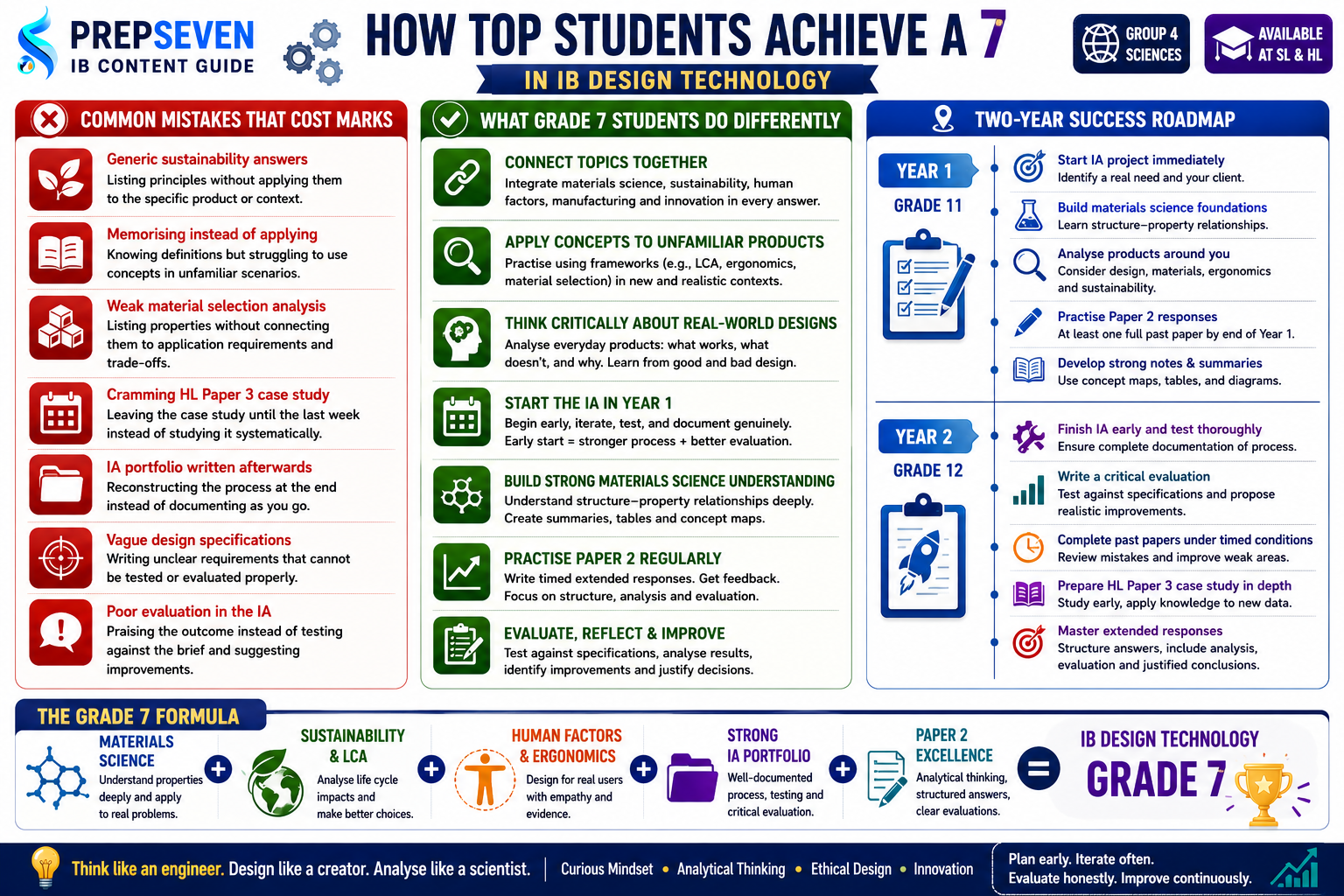
What Actually Gets Students to a 7
They connect concepts across topic areas rather than studying them in isolation
The extended response questions in Paper 2 that earn the highest marks are those that draw on multiple topic areas simultaneously. A question about a product design decision might require integrating materials science, sustainability, human factors, and innovation concepts in a single coherent analysis. Students who have studied each topic in isolation and cannot make these connections under exam pressure consistently score in the mid-band on extended response questions even when their individual topic knowledge is solid. Build the habit of asking how each new concept connects to what you already know from other topics throughout the course.
They start the IA early and document genuinely
The IA accounts for 30% of the final grade and is entirely within the student’s control. Students who begin the design project in Term 1 of Year 1, who document their design process as it unfolds rather than reconstructing it at the end, who build genuine iteration into their development process, and who write their evaluation with specific and critical reference to the original design specifications, consistently achieve high IA marks. Students who leave the IA until Year 2 and produce a portfolio that documents a neat and implausibly linear design process consistently achieve lower marks than their exam performance would suggest they are capable of.
They practise applying knowledge to unfamiliar scenarios
Design Technology exams consistently present familiar concepts in unfamiliar contexts. A student who has only practised applying the LCA framework to examples used in class will struggle when Paper 2 presents an LCA question about a product they have not encountered before. The skill being tested is the ability to apply the analytical framework, not to recall a specific answer. Building this transferable application skill requires deliberately practising with unfamiliar scenarios throughout both years: asking not just what the answer is but how the analytical framework applies to this new context.
They engage with real design critically throughout the course
The students who produce the most compelling extended responses are those who have developed a genuine critical perspective on designed products and the design decisions behind them. They have noticed when products they use daily solve problems elegantly and when they fail their users unnecessarily. They have read about design failures and what caused them. They think about the sustainability implications of the products around them. This ongoing critical engagement with the designed world is not formally assessed in isolation but it feeds the quality of analytical thinking in every component, and it is not something that can be developed in the weeks before the exam.
Common Mistakes That Cost Marks
A Realistic Year-by-Year Approach
Year 1 (Grade 11): Build Foundations and Begin the IA
- Begin your Internal Assessment project in Term 1 of Year 1. Identify your design need and client or user group as early as possible and start documenting your problem analysis and research. The IA benefits more from early start and genuine process documentation than from concentrated effort close to submission. Students who begin in Year 2 consistently produce weaker portfolios than those who begin in Year 1.
- Build your materials science knowledge systematically from the beginning of the course. Use the topic structure to build a materials properties reference that you actively review and update throughout both years. Materials science is the content area where conceptual understanding compounds: later topics make more sense to students who have solid foundations in the earlier ones.
- Develop the habit of analysing designed products critically in everyday life. When you encounter a product, ask how it was made, what material decisions were made and why, how it handles end of life, whether the human factors have been well considered. This ongoing critical engagement builds the analytical thinking that Paper 2 extended responses require, and it is a habit built over two years rather than a skill acquired through exam preparation.
- For HL students, build your understanding of the HL extension content progressively rather than treating it as additional material to be covered separately. The HL content deepens the core topics rather than replacing them, and students who integrate HL-level thinking throughout both years find Paper 2 and Paper 3 significantly more manageable than those who treat HL content as a separate revision task.
- Complete at least one full Paper 2 practice under timed conditions before the end of Year 1, using a past paper or teacher-produced equivalent. Identify which question types you find most difficult and which topic areas your responses are weakest in. This early diagnostic shapes your study priorities for Year 2.
Year 2 (Grade 12): Deepen, Complete, and Refine
- Complete and submit your IA portfolio with a finished, tested product and a genuinely critical evaluation. Do not leave the evaluation until the last days before submission. The evaluation criterion requires systematic testing against the design specifications, and producing a strong evaluation requires time to conduct tests, analyse results, and write analytical conclusions. A rushed evaluation that is added at the end of a strong portfolio is one of the most common and most preventable sources of lost IA marks.
- Work through past Paper 1 and Paper 2 questions systematically from Term 1 of Year 2. For every question you answer incorrectly or partially, identify whether the error was a conceptual misunderstanding, a terminology issue, or a failure to apply knowledge to the scenario, and address the underlying cause. Past paper work that identifies and corrects the causes of errors is significantly more effective revision than past paper work that simply provides mark-scheme answers.
- For HL students, when the Paper 3 case study is released, create a structured study plan for the weeks between its release and the exam. Identify the HL syllabus areas it connects to, read those sections of your textbook and notes in detail, and practise applying that knowledge to scenarios connected to the case study topic. Do not rely on the case study document alone.
- In the final four to six weeks before the exam, focus revision on the topic areas where Paper 2 extended response performance has been weakest in your practice. These are the highest-mark questions in the paper and the ones where targeted preparation produces the most significant mark improvements. Build model answers for the most common extended response question types in your weak areas, checking them against the mark scheme and getting teacher feedback.
- Practice writing timed extended responses without referring to notes across all topic areas, focusing on structuring arguments that apply specific concepts to specific scenarios rather than listing general knowledge. The skill being tested in Paper 2 is analytical application, and that skill requires practice under timed conditions to become reliable under exam pressure.
How PrepSeven Helps You Score Higher in IB Design Technology
IB Design Technology rewards students who can think analytically across multiple content areas simultaneously and apply that thinking to unfamiliar scenarios under timed conditions. The difference between a 5 and a 7 is almost always in the quality of extended response answers and, particularly for the IA, in how systematically the design process has been documented and evaluated. Our Design Technology tutors are certified IB examiners and experienced educators who know exactly what the mark schemes reward and where students consistently leave marks on the table.
- Paper 2 extended response sessions where your tutor marks your practice responses against the IB mark scheme, shows you precisely where your analysis is generic rather than scenario-specific, where material selection evaluations fail to connect properties to application requirements, and what a top-band response to the same question looks like.
- IA portfolio review sessions where your tutor assesses each criterion of your design project against the IB assessment criteria, identifies where the evaluation criterion needs more specific testing against the design brief, where the design specifications need greater precision, and what additions would move the portfolio into the top mark band.
- Materials science conceptual sessions where your tutor works through the material families and properties that appear most frequently in exam questions, building the deep understanding of structure-property relationships that Paper 2 data analysis and extended response questions require.
- Sustainability and LCA analytical sessions where your tutor develops your ability to apply LCA frameworks to novel products, building the specific and critical sustainability analysis that distinguishes top-band extended responses from mid-band ones.
- HL Paper 3 case study preparation sessions where your tutor works through the case study with you, identifies the HL syllabus connections, and develops your ability to apply DT knowledge to novel data and scenarios in the format Paper 3 presents.
Book your free demo lesson at prepseven.com. Bring a recent Paper 2 extended response you have written, an IA evaluation section, or a materials selection question you have practised. Your tutor will show you exactly where the analysis is strong and where it needs development, and what the preparation looks like that closes the gap between your current performance and your target grade.