
PrepSeven | IB Content Guide authored by Shankar Mutneja (Founder of Prepseven)
IB Chinese Ab Initio
The Complete Guide for IB DP Students and Parents
What Is IB Chinese Ab Initio?
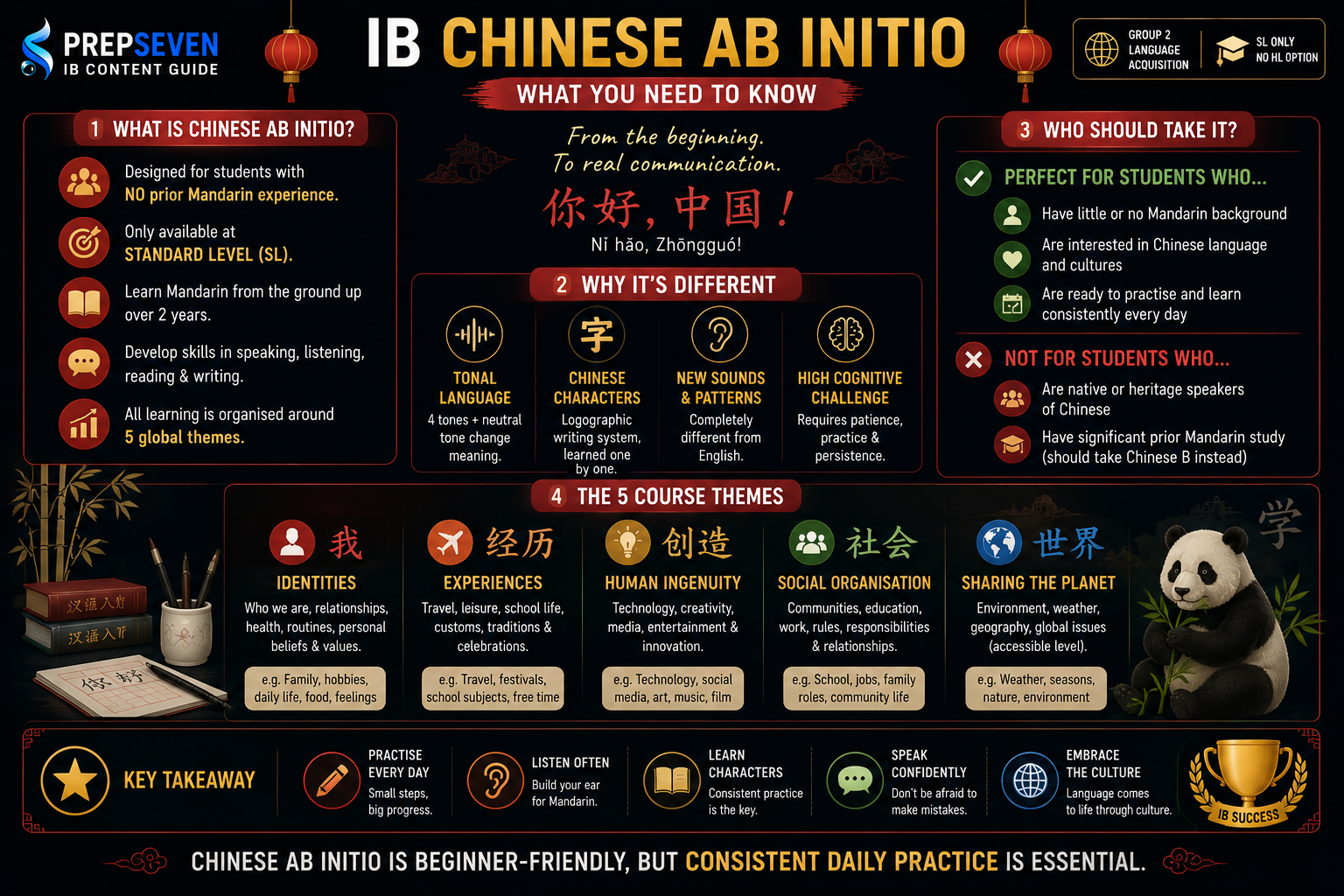
IB Chinese Ab Initio is the Diploma Programme’s language course for students who have little to no prior experience with Mandarin Chinese. Ab initio, which is Latin for from the beginning, means exactly what it says. This course is designed for genuine beginners in Mandarin, and it is the only IB language course where having zero background in the target language is not just acceptable but expected. Students who have studied Mandarin before at school or grown up in a Mandarin-speaking household are not eligible for this course and should be studying Chinese B instead.
The course runs over two years and is only available at Standard Level. There is no Higher Level option for ab initio. In that time, students go from having no functional knowledge of Mandarin to being able to understand and produce the language in a defined range of everyday contexts. The course is organised around five themes, the same five used across all IB language courses, which provide the content framework through which language is learned and practised throughout the two years.
What makes IB Chinese Ab Initio different from every other ab initio language course in the IB is the writing system. Students in French Ab Initio or Spanish Ab Initio are learning a new language but using an alphabet that shares significant features with English. Students in Chinese Ab Initio are learning a language with a completely different phonological system, a tonal structure that has no equivalent in most European languages, and a logographic writing system in which each character represents a syllable and carries meaning independently. The cognitive demand of Chinese Ab Initio is genuinely higher than most other ab initio languages, and students who make the choice to take it should do so with a clear understanding of what that involves.
Students sometimes choose Chinese Ab Initio because they believe it will be easier to score well in than Chinese B, or because they want a language requirement without the workload of a language B course. This is a miscalculation. Chinese Ab Initio is genuinely demanding for a beginner, the writing system alone requires sustained daily practice across both years, and students who do not commit to that practice consistently underperform their expectations. The right reason to choose Chinese Ab Initio is genuine interest in Mandarin and Chinese-speaking cultures.
Who This Course Is For
IB Chinese Ab Initio is designed for students with no prior formal study of Mandarin, or at most very limited exposure, such as a handful of Mandarin lessons in primary school that did not continue. The IB’s guidance on eligibility is that students should not have been educated in a Mandarin-medium school, should not be native or heritage speakers of Mandarin, Cantonese, or other Chinese languages, and should not have undertaken significant prior Mandarin study.
In practice, the students who do best in Chinese Ab Initio are those who are genuinely curious about Mandarin and Chinese-speaking cultures, who are willing to invest time in character practice and listening exposure outside of class, and who approach the course understanding that progress in Mandarin requires patience in a way that progress in a related European language does not. Mandarin is consistently ranked among the most linguistically distant languages from English, and the first few months of Chinese Ab Initio, when tones, characters, and an entirely unfamiliar phonological system are all new simultaneously, are the hardest. Students who persist through that initial difficulty find that Mandarin becomes increasingly learnable as patterns emerge and vocabulary accumulates.
The most common experience among Chinese Ab Initio students is a feeling of overwhelm in the first term, followed by a marked shift somewhere around the middle of Year 1 when enough vocabulary and character knowledge has accumulated that the language starts to feel learnable rather than alien. This shift does not happen at the same time for every student. Students who practise characters and listening daily reach it faster. Students who only engage with Mandarin in class reach it much later, if at all. The difference in outcomes between these two approaches is significant by the time the exam arrives.
The Five Themes: What You Study
The entire Chinese Ab Initio course is organised around five themes that appear across both years and that provide the content through which language is taught and practised. These themes are not just administrative labels. They determine which vocabulary you study, which text types you encounter, and what you are expected to discuss in the oral and produce in writing. Understanding what each theme covers, and building vocabulary systematically around each one, is foundational to good exam preparation.
Theme | Core Content Areas | Example Contexts in Mandarin |
Identities | Personal information, family, physical descriptions, daily routines, hobbies, health and lifestyle | Introducing yourself and family, describing a typical day, discussing food and eating habits |
Experiences | Travel and transport, leisure activities, celebrations and festivals, school life | Talking about Chinese festivals such as Spring Festival and Mid-Autumn Festival, describing school subjects and timetables |
Human Ingenuity | Technology and media, creativity, entertainment, innovation in everyday life | Discussing social media platforms widely used in China, describing how technology is used in daily life |
Social Organisation | Community and neighbourhoods, work and professions, education systems, rules and responsibilities | Discussing Chinese schools and the education system, talking about family roles and social relationships |
Sharing the Planet | Environment and nature, weather and climate, geographical features, global issues at an accessible level | Talking about seasons and weather in China, discussing environmental problems in simple Mandarin |
The reason it matters to understand these themes before you study them is that vocabulary in Chinese Ab Initio is thematic rather than alphabetical. Unlike learning a European language where you might encounter vocabulary roughly in order of frequency, Mandarin vocabulary in this course is grouped around the themes you will be tested on. A student who organises their character and vocabulary study thematically, building clusters of words around identities, experiences, and social organisation, arrives at the exam with vocabulary that is ready to deploy in context rather than scattered across unconnected lists.
Assessment Breakdown: How You Are Graded
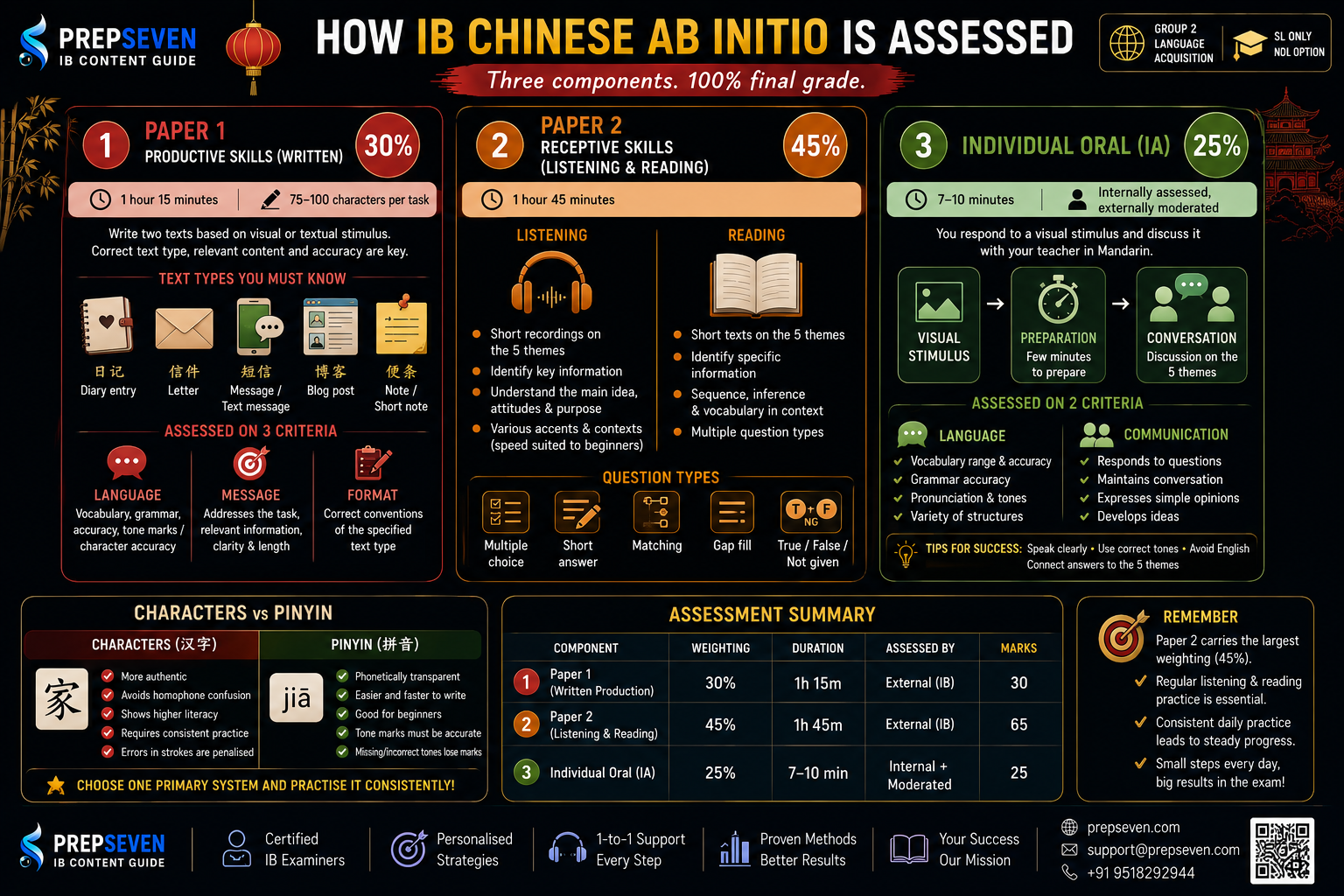
Chinese Ab Initio is assessed through three components: Paper 1, Paper 2, and the Individual Oral. Understanding what each component tests and how much it contributes to the final grade shapes where you invest your preparation effort.
Paper 1: Productive Skills (Written)
Paper 1 is one hour and fifteen minutes and tests your ability to produce written texts in Mandarin. You are given two tasks based on visual or textual stimulus material and asked to write a response in a specified text type. Each task is typically between 75 and 100 characters in length, which is relatively short but demands precise and accurate language within that constraint. The text types you need to know and be able to produce include diary entries, messages and text messages, letters, blog posts, notes, and short descriptive paragraphs.
Paper 1 is assessed on three criteria: language, message, and format. Language looks at vocabulary accuracy and range, grammatical accuracy, and the correct use of tones in pinyin if pinyin is used rather than characters. Message looks at whether your response addresses the task directly, whether it contains sufficient relevant information, and whether it communicates clearly. Format looks at whether you have correctly applied the conventions of the specified text type.
The character count targets in Paper 1 are absolute, not approximate. A response that is significantly shorter than the specified word or character count loses marks on the message criterion regardless of how accurate the language in the response is. Equally, a response that is significantly longer does not earn additional marks but may introduce more errors. Practise hitting the target length accurately during timed practice sessions, so that calibrating the length of your response becomes automatic before the exam.
Paper 2: Receptive Skills (Listening and Reading)
Paper 2 is one hour forty-five minutes and tests listening comprehension and reading comprehension. The listening section uses recordings of spoken Mandarin in contexts related to the five themes, and the reading section presents written texts in Mandarin that students must understand and answer questions about.
The listening tasks test whether you can identify specific information from spoken Mandarin, understand the general message of a short recording, and identify attitudes or purposes where these are made clear in what is said. The recordings in Chinese Ab Initio are spoken at a pace appropriate for the level, which means slower and more clearly articulated than authentic native-speed Mandarin, but students who have not built listening exposure through regular practice outside class still find them challenging. The phonological patterns of Mandarin, including the four tones and the sounds that do not exist in English, need to become familiar through repeated exposure rather than theoretical knowledge.
The reading tasks test comprehension of written Mandarin texts. At the ab initio level, the characters and vocabulary used in reading texts are limited to what a student at this level could reasonably be expected to have encountered, but the quantity and density of characters still exceeds what students who have only studied characters in class can process comfortably. Students who read Mandarin texts regularly outside of class, even simple ones, build the character recognition speed that makes Paper 2 reading feel manageable rather than laborious.
Component | Weight | Duration | Assessed By | Marks |
Paper 1 (Written production) | 30% | 1h 15m | External (IB) | 30 |
Paper 2 (Listening and reading) | 45% | 1h 45m | External (IB) | 65 |
Individual Oral (IA) | 25% | 7-10 minutes | Internal + Moderated | 25 |
Individual Oral (IA)
The Individual Oral is worth 25% of the final grade and is assessed internally by the teacher, with external moderation by the IB. Students are shown a visual stimulus related to one of the five themes and have a few minutes of preparation time before conducting a conversation with their teacher in Mandarin. The oral lasts between seven and ten minutes and is assessed on language and communication.
The language criterion looks at vocabulary range and accuracy, grammatical accuracy, pronunciation and tones, and the variety of sentence structures used. The communication criterion looks at whether the student can respond to questions directly, maintain a conversation in Mandarin, express simple personal opinions, and develop ideas beyond single-word or single-phrase responses.
At the ab initio level, the oral is not expected to be fluent or sophisticated. It is expected to be functional and communicative. The IB recognises that students are beginning learners of Mandarin, and the assessment criteria are calibrated accordingly. What is expected is clear and reasonably accurate communication in Mandarin on topics connected to the five themes, with the ability to respond to questions and sustain a simple conversation. What costs marks is an inability to go beyond prepared phrases, excessive reliance on English, or pronunciation and tonal errors that make responses difficult to understand.
Tones matter enormously in Mandarin, and they matter in the oral. Mandarin has four tones plus a neutral tone, and the same syllable pronounced with different tones means completely different things. A student who consistently applies incorrect tones in the oral loses marks on the pronunciation component of the language criterion, and in some cases produces statements that are genuinely unclear or unintentionally funny. Practise tones out loud, not just in your head. Reading characters and knowing the pinyin is not the same as being able to produce the correct tone under conversational pressure.
The Writing System: Characters, Pinyin, and What the Exam Requires
The Chinese writing system is the most distinctive challenge of IB Chinese Ab Initio and the one that most consistently determines outcomes. Mandarin uses logographic characters, each of which represents a syllable and typically carries a specific meaning. Characters are not assembled from an alphabet. They are learned individually and holistically, which means that reading and writing in Mandarin requires a large bank of memorised characters rather than the ability to decode an unfamiliar word phonetically.
Pinyin is the romanisation system used to represent the sounds of Mandarin. It uses Latin letters with diacritic marks to indicate the four tones and is widely used in Mandarin education as a learning tool and as an input method for typing on digital devices. In IB Chinese Ab Initio, students may produce written work in characters, in pinyin with tone marks, or in a combination of both. The IB does not mandate character use, but it does assess the accuracy of whatever system is used.
Students who produce Paper 1 responses entirely in pinyin can achieve high marks if their pinyin is accurate, tone marks are correctly placed, and the response meets the message and format criteria. Students who produce responses in characters demonstrate a higher level of literacy but only benefit from this if their character production is accurate. An incorrectly written character can be more confusing to a marker than a correctly written pinyin equivalent. The practical question is which system you can use most accurately under timed exam conditions, and the answer depends on how much character practice you have done across two years.
| Characters | Pinyin with tone marks |
Advantage | Demonstrates higher literacy; avoids ambiguity between homophones; how Mandarin is actually written | Phonetically transparent; easier to produce quickly; avoids character stroke errors |
Risk | Incorrect characters are penalised; stroke errors can change meaning; requires significant sustained practice | Tone marks must be accurate or meaning changes; some markers find dense pinyin harder to read |
Best for | Students who have built consistent character practice across both years | Students with accurate tonal production who have not built sufficient character fluency |
Whatever system you use in the exam, practise it consistently in that form across both years. Students who switch between characters and pinyin depending on whether they can remember a character produce inconsistent scripts that are harder to mark and that do not demonstrate the systematic accuracy that the language criterion rewards. Choose your primary production method in Year 1 and practise it consistently.
Tones: The Most Underestimated Part of the Course
Mandarin is a tonal language. Every syllable is pronounced with one of four tones, or in some cases a neutral tone, and the tone is as much a part of the word as its consonants and vowels. The four tones are the first tone, a high level tone; the second tone, a rising tone; the third tone, a falling then rising tone; and the fourth tone, a sharply falling tone. The same syllable ma, for example, means mother in the first tone, hemp in the second tone, horse in the third tone, and to scold in the fourth tone.
For students who have grown up speaking non-tonal languages, which includes most students taking Chinese Ab Initio, producing tones accurately and consistently is the part of the course that requires the most dedicated practice. It is not possible to learn tones by reading about them. They are a motor skill as much as a linguistic one, and they are learned by hearing them correctly modelled and then practising producing them out loud, repeatedly, until they become automatic.
The most common mistake ab initio students make with tones is treating them as something to think about rather than something to produce automatically. A student who pauses before each word to remember its tone will not maintain a conversation in the oral, and a student who produces tone marks in pinyin from memory rather than from genuine tonal knowledge will produce errors that cost marks on the language criterion. Tonal accuracy is built through speaking practice, not through study.
The most effective tone practice is simultaneous listening and repeating, known as shadowing. Find a slow, clearly articulated Mandarin audio source, listen to a phrase, and then repeat it immediately at the same pitch and rhythm as the original. Do this for ten minutes every day from the beginning of Year 1. The goal is not to understand what you are shadowing at first. The goal is to train your voice and ear to produce and recognise the four tones accurately before you need to produce them under exam pressure.
Building Vocabulary: The Thematic Approach
Vocabulary acquisition in Chinese Ab Initio is more demanding than in most other ab initio language courses because every new word requires learning not just its meaning and pronunciation but also its written form, whether in characters or pinyin with tones. This means that each vocabulary item has more dimensions to it than a word in a European language, and the investment required to truly own a piece of Mandarin vocabulary is correspondingly greater.
The most effective approach is to build vocabulary thematically and to study each item in three ways simultaneously: its meaning, its pronunciation and tones, and its written form. Students who study vocabulary only as character-meaning pairs without practising pronunciation are building reading literacy without speaking ability. Students who study vocabulary only through audio without connecting it to written forms are building listening ability without the literacy needed for Paper 1 and Paper 2 reading. All three dimensions need to be practised together.
Theme | High-priority vocabulary categories | Why it matters for the exam |
Identities | Family members, personal descriptions, daily routine verbs, food and drink, health vocabulary | Appears in almost every oral as the personal introduction section; high frequency in Paper 1 stimulus tasks |
Experiences | Transport vocabulary, leisure activities, time expressions, festival and celebration names | Festivals and travel contexts appear frequently in Paper 2 reading and listening texts |
Human Ingenuity | Technology words, media vocabulary, verbs for communication and creating | Technology theme appears regularly in ab initio texts; accessible for students who use Chinese tech products |
Social Organisation | School and education vocabulary, job and profession words, community and neighbourhood terms | School and work contexts are among the most common text types in Paper 2 and stimuli in Paper 1 |
Sharing the Planet | Weather and season vocabulary, environment words, geographic terms, problem and solution verbs | Weather descriptions appear in listening texts; environmental topics appear in reading passages at this level |
Spaced repetition is the most evidence-backed method for vocabulary retention and is particularly well-suited to Mandarin vocabulary because of the multiple dimensions each item has. Digital flashcard systems that use spaced repetition algorithms, such as Anki, allow you to study characters, pinyin, tones, and meanings together and to review items at the interval at which the research shows retention is maximised. Students who build a spaced repetition deck at the beginning of Year 1 and add to it consistently as new vocabulary is introduced in class arrive at the exam with a genuinely accessible vocabulary bank rather than a collection of half-remembered items.
What the Oral Actually Demands
The Individual Oral in Chinese Ab Initio is the component where the gap between students who have practised speaking Mandarin regularly and those who have not is most starkly visible. Language learning research consistently shows that speaking ability in a new language develops through speaking practice, not through study, and students who only speak Mandarin during class lessons arrive at the oral with significantly less fluency than those who have found ways to speak outside of class.
The oral format is straightforward. You see a visual stimulus, have a short preparation time, and then have a conversation with your teacher in Mandarin. The teacher will ask questions related to the stimulus and to the themes it connects to. You need to describe what you see, express simple opinions about it, connect it to the themes, and respond to the teacher’s questions in Mandarin.
The most common performance problem in the oral is what might be called the phrase-book response: a student who has memorised a set of prepared phrases and can produce them fluently but cannot respond flexibly when the teacher asks a question that their phrases do not cover. A phrase-book student can say my name is, I live in, I have two sisters, my hobby is basketball. A genuinely communicative student can say all of those things and also respond to do you prefer indoor or outdoor activities, why do you think festivals are important, and what would you do if you could travel to China. The difference is not the quantity of vocabulary known but the ability to deploy it flexibly in response to unprepared questions.
Practise the oral with questions you have not seen in advance. Give yourself the visual stimulus, take two minutes of preparation, and then ask a friend, family member, or tutor to ask you questions about it in Mandarin, or ask questions from a list you have not reviewed. The discomfort of having to respond to an unexpected question is exactly the discomfort the exam will produce, and practising with that discomfort across both years is what makes it manageable rather than panic-inducing on the day.
What Actually Gets Students to a 7
They practise speaking Mandarin every single day
The students who perform best in the oral are without exception those who have found ways to speak Mandarin outside of class throughout both years. This does not require access to a native speaker. It means speaking aloud while reviewing vocabulary, recording yourself producing sentences and listening back, finding a language exchange partner online, or working with a tutor. The auditory and motor patterns required for Mandarin pronunciation are built through physical practice, not through silent study.
They know their text type conventions inside out
Paper 1 asks you to produce a specific text type, and marks are allocated for format as well as language and message. Students who have practised writing each of the main text types in Mandarin throughout both years know exactly what conventions apply, when to use formal versus informal register, how to open and close a letter versus a diary entry, and what structural features a blog post in Chinese looks like. Students who have only practised freewriting lose format marks that are entirely recoverable through specific preparation.
They engage with Mandarin audio outside class from Year 1
Paper 2 listening comprehension builds on auditory processing skills that develop slowly through extended exposure. Students who listen to Mandarin audio outside of class from the beginning of Year 1, starting with material aimed at beginners and gradually increasing difficulty, build listening comprehension that classroom instruction alone cannot produce. Even fifteen minutes of daily Mandarin listening on top of class time compounds significantly across two years.
They treat character or pinyin accuracy as non-negotiable
Whether using characters or pinyin, accuracy in the written system is a core part of the language criterion. Students who are careless about character strokes or who omit tone marks from pinyin consistently lose marks that have nothing to do with their communicative ability. Build the habit of accuracy in your primary written system from the very first week of the course, and never let sloppiness become comfortable.
They connect vocabulary to genuine cultural knowledge
The students who produce the most interesting and specific oral and written responses are those who know something real about Chinese-speaking cultures beyond the classroom. They know that Spring Festival involves specific foods, family reunions, red envelopes, and dragon dances. They know that WeChat is used differently from WhatsApp. They know that the gaokao creates enormous pressure for Chinese secondary school students. This cultural specificity produces responses that are more than generic descriptions of images, and examiners notice the difference between a student who is linguistically performing and a student who is genuinely communicating.
Common Mistakes That Cost Marks
The Mistake | What to Do Instead |
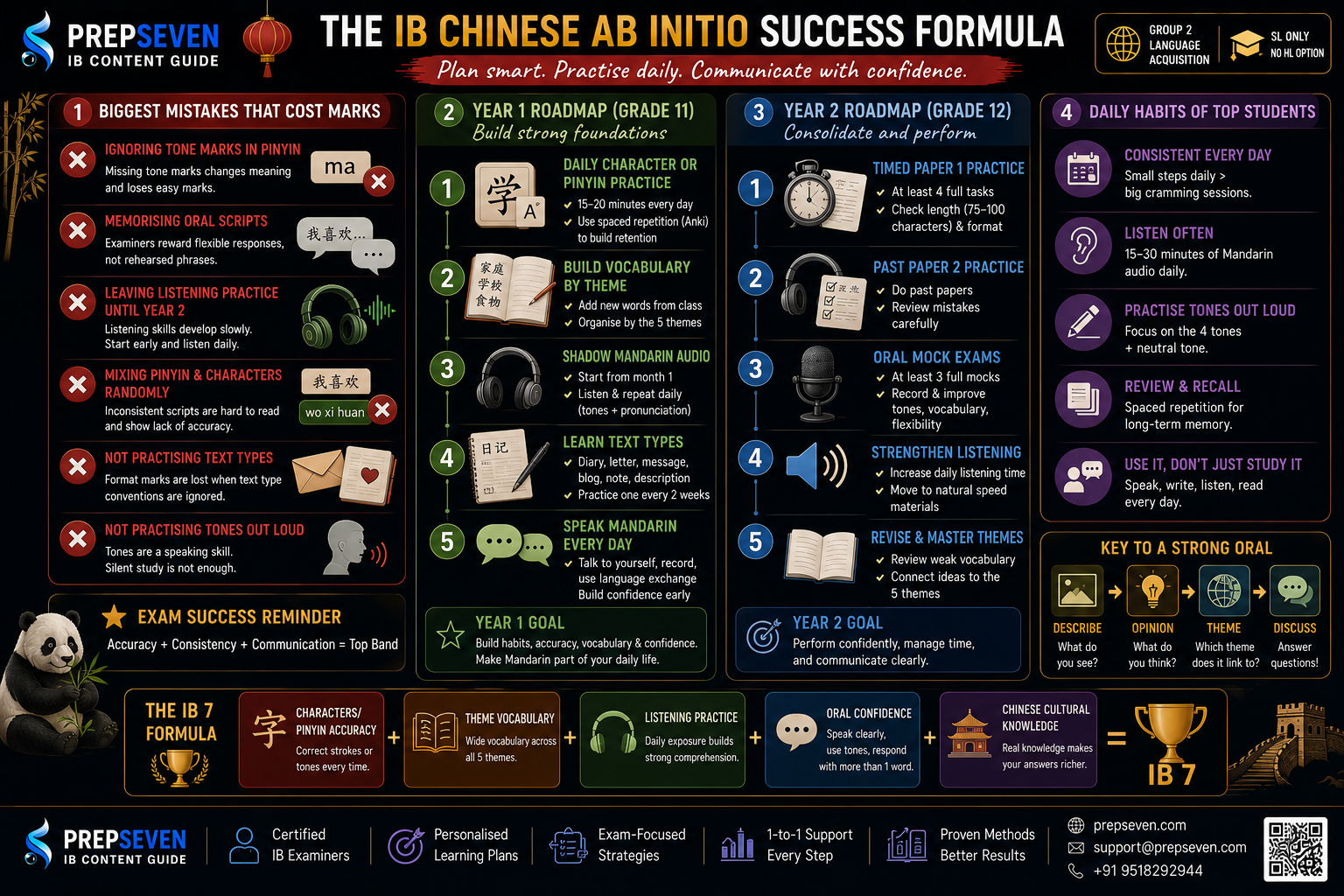
Omitting tone marks from pinyin responses | Treat tone marks as compulsory, not optional. Pinyin without tone marks is incomplete and loses marks on the language criterion. Build the habit of writing tone marks correctly from Week 1. |
Responding to the oral with memorised phrases only | Practise responding to unexpected questions from Year 1 Term 2. Flexibility under conversational pressure is what separates mid-band oral performers from top-band ones. |
Producing Paper 1 responses that are too short | Practise timed writing tasks and count your characters or words. The message criterion penalises significantly short responses. Know what 75 and 100 characters of Mandarin look like before the exam. |
Ignoring text type format requirements in Paper 1 | Learn and practise each of the main text type formats explicitly. A diary entry, a letter, and a blog post all have different conventions in Mandarin, and format marks are lost when those conventions are ignored. |
Treating listening practice as something to do only in class | Find at least one source of Mandarin audio for beginners and listen to it daily outside of class. YouTube channels for Mandarin learners, beginner podcasts, or graded audio materials are all viable options. |
Switching inconsistently between characters and pinyin | Choose your primary production system in Year 1 and use it consistently. Mixed-system scripts are harder to mark and signal inconsistency that the language criterion penalises. |
Not practising tones out loud | Tones are a spoken skill. Reading about tones or writing them on flashcards is not the same as being able to produce them correctly in speech. Shadow native audio daily to build tonal accuracy. |
A Realistic Year-by-Year Approach
Year 1 (Grade 11): Building from Zero
Start character or pinyin practice from Week 1 of Year 1 and do it every day without exception. Even fifteen minutes of daily practice accumulates significantly over two years. Use Anki or a similar spaced repetition system to add new vocabulary from each lesson and review it consistently.
Begin shadowing Mandarin audio from the first month of the course. Find audio that is slow and clearly articulated, aimed at beginners, and shadow short phrases after each listening. This builds tonal and phonological accuracy in the first year when it is easiest to establish correct patterns.
Practise at least one text type in Mandarin every two weeks throughout Year 1. Rotate through diary entries, informal messages, short descriptions, and simple letters. Getting feedback from your teacher on format and language accuracy in Year 1 means you arrive at the exam knowing what each text type looks like.
Build a thematic vocabulary list for each of the five themes as they are introduced in class. Organise your vocabulary cards or notes by theme, not by lesson date. This thematic organisation makes pre-exam revision significantly more efficient.
Practise speaking Mandarin out loud when reviewing vocabulary and grammar. Name objects around you in Mandarin. Describe your day to yourself in Mandarin. The habit of turning thoughts into spoken Mandarin, however simply, builds the oral fluency that the Individual Oral demands.
Year 2 (Grade 12): Consolidating and Performing
Complete at least four timed Paper 1 practice tasks under exam conditions before your mock exam. Write in the text types that are most likely to appear, check your character or word count against the target, and get teacher feedback on all three criteria: language, message, and format.
Work through past Paper 2 listening and reading tasks from the beginning of Year 2. The IB publishes past papers for Chinese Ab Initio, and working through them systematically is the most direct preparation for the format and level of difficulty you will face.
Complete at least three full oral practices in exam conditions before your actual Individual Oral. Record each practice and listen back. Identify where tones are consistently incorrect, where vocabulary is thin, and where your answers are too brief or too dependent on memorised phrases.
Increase your daily Mandarin listening exposure in Term 2 of Year 2. Transition from beginner-level material to content that is slightly above your comfort level. The exam listening passages are spoken at a pace appropriate for ab initio but are still faster and more natural than most beginners expect.
In the final four weeks before the exam, focus Paper 1 preparation on the text types you have found hardest to format correctly, and focus Paper 2 preparation on the listening section if it has been your weaker component throughout practice sessions.
How PrepSeven Helps You Score Higher in IB Chinese Ab Initio
IB Chinese Ab Initio is one of the most rewarding language courses in the IB Diploma for students who engage with it fully, and one of the most unforgiving for those who underestimate what genuine beginner acquisition of Mandarin requires. The students who reach the top bands are those who have had expert guidance on tone production, character literacy, text type conventions, and oral technique from early in the course, before poor habits become entrenched. Our Chinese Ab Initio tutors are certified IB examiners and experienced Mandarin language teachers who know exactly where marks are won and lost in this course.
Oral preparation sessions where your tutor conducts a full simulated Individual Oral with you, assesses your performance against both language and communication criteria exactly as an IB moderator would, and identifies the specific adjustments to tone accuracy, vocabulary range, and conversational flexibility that will move you into the top band.
Paper 1 written task sessions where your tutor marks your responses against the IB criteria and shows you exactly where your format, language accuracy, and message development are losing marks, and what a full-band response to the same task looks like.
Character and pinyin accuracy sessions where your tutor works through the specific characters and tonal patterns that appear most frequently in the course and builds the accuracy in your primary written system that the language criterion rewards.
Listening comprehension sessions using Mandarin audio at ab initio level, with targeted work on the types of specific information and attitude questions that consistently appear in Paper 2 and that students without regular listening practice find unexpectedly difficult.
Thematic vocabulary building sessions organised around the five IB themes, building the vocabulary clusters that allow confident production in both written tasks and the oral.
Book your free demo lesson at prepseven.com. Bring a vocabulary list from a recent class, or try describing a simple image in Mandarin before the session. Your tutor will assess your tonal accuracy, vocabulary range, and oral fluency, and give you a clear picture of where your preparation stands and what the most efficient path to your target grade looks like.