
PrepSeven | IB Content Guide authored by Shankar Mutneja (Founder of Prepseven)
IB Chemistry
What Is IB Chemistry?
IB Chemistry is the study of matter at the atomic and molecular level and the transformations that matter undergoes. It sits in Group 4 of the Diploma Programme alongside Biology, Physics, and Environmental Systems and Societies, and it is available at both Standard Level and Higher Level. Chemistry HL is one of the most rigorous pre-university science courses available anywhere, and a strong grade in it is one of the most widely recognised signals of scientific aptitude at university admissions level.
The course covers atomic structure, bonding, energetics, kinetics, equilibrium, acids and bases, redox chemistry, organic chemistry, and measurement and data processing. At HL, each of these areas is extended significantly, and additional topics in organic chemistry, spectroscopy, and energy are added. The connecting thread across all topics is a way of thinking: constructing models of how matter behaves, testing those models against experimental evidence, and understanding their limitations.
What makes IB Chemistry genuinely demanding is that it operates simultaneously at multiple levels of representation. A single reaction can be described at the macroscopic level, what you observe happening; at the submicroscopic level, what is happening at the atomic and molecular scale; and at the symbolic level, how chemists represent it with equations, notation, and diagrams. Students who can move fluently between these three levels understand chemistry. Students who can only operate at one level, usually the symbolic, find the more conceptual questions in the exam significantly harder than expected.
IB Chemistry is not a memorisation course in the way that some students assume before starting it. There is content to know, but the exam is primarily testing whether you understand chemical concepts deeply enough to apply them in unfamiliar contexts, interpret experimental data, and evaluate the quality of evidence. Students who have memorised reactions and definitions without understanding the underlying chemistry tend to plateau around the 5 to 6 range. The top band requires genuine conceptual understanding.
SL vs HL: Understanding the Real Difference
The decision between Chemistry SL and HL is one of the most consequential course choices in the IB for students interested in science-related university programmes. The difference is substantial in content, depth, and the level of mathematical and conceptual demand.
Feature | SL | HL |
Teaching hours | 150 hours | 240 hours |
Paper 1 | 30 MCQ, 45 minutes | 40 MCQ, 1 hour |
Paper 2 | Short and extended response, 1 hour 15 min | Short and extended response, 2 hours 15 min |
Paper 3 | Data analysis and one option, 1 hour | Data analysis and one option, 1 hour 15 min |
HL-only core content | N/A | Atomic structure depth, bonding extensions, energetics depth, kinetics depth, equilibrium extensions, organic chemistry extensions, spectroscopy |
University signal | Accepted for most science-related degrees | Required or strongly preferred for medicine, chemistry, biochemistry, pharmacy, and related fields at most universities |
The HL-only content in IB Chemistry is not simply more of the same. It includes some of the most conceptually rich material in the course: molecular orbital theory, Born-Haber cycles, rate equation derivation, buffer calculations, d-block chemistry, and extensive organic mechanisms including electrophilic and nucleophilic addition and substitution. These topics require genuine conceptual understanding developed over time, not surface-level revision in the weeks before the exam.
If you are considering medicine, dentistry, pharmacy, biochemistry, chemical engineering, or any chemistry-related degree, research the specific entry requirements for your target programmes before finalising your course choice. Most medical and chemistry programmes at universities in the UK, Europe, the US, and across Asia require Chemistry HL and often specify a minimum grade of 6 or above. Discovering this after choosing SL is a problem with no straightforward solution.
The New IB Chemistry Syllabus
IB Chemistry underwent a significant syllabus revision, with the new curriculum first assessed in May 2025. If you are currently studying IB Chemistry, you are almost certainly on the new syllabus. The structure has changed from the previous topic-numbered format, and the assessment approach has been updated to place greater emphasis on conceptual understanding and experimental skills.
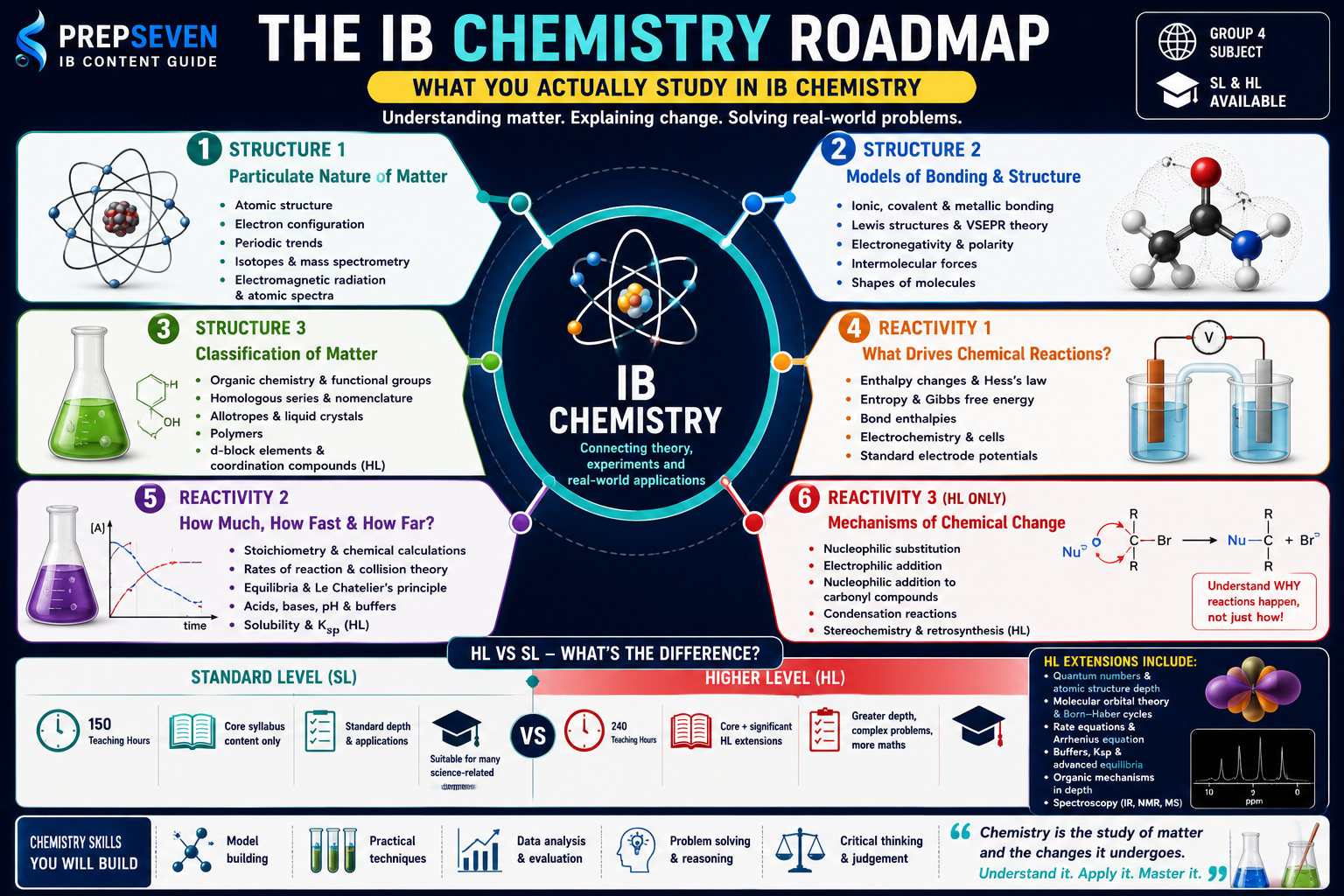
The new syllabus is organised into five themes: Structure 1 (Models of the Particulate Nature of Matter), Structure 2 (Models of Bonding and Structure), Structure 3 (Classification of Matter), Reactivity 1 (What Drives Chemical Reactions?), and Reactivity 2 (How Much, How Fast and How Far?), plus Reactivity 3 (What Are the Mechanisms of Chemical Change?) at HL. This thematic organisation reflects a more conceptual approach than the previous topic-by-topic structure.
If you are using revision resources, past papers, or guides produced before 2025, be aware that while the underlying chemistry is the same, the framing of topics and the way questions are structured may differ from the current exam. Always check with your teacher which past papers are most relevant to your specific syllabus year.
Past papers from the previous syllabus remain useful for practising chemical problem-solving, stoichiometry, equilibrium calculations, and organic mechanisms. The underlying chemistry does not change when the syllabus does. What changes is the way questions are framed and which topics are grouped together. Your teacher is the best guide to which past papers align most closely with your specific exam.
What the Syllabus Covers
Theme | Core Content | Key HL Extensions |
Structure 1: Particulate Nature of Matter | Atomic structure, electron configuration, the periodic table, isotopes, mass spectrometry, electromagnetic radiation and atomic spectra | Quantum numbers, subshell notation, ionisation energy trends in depth, more complex spectroscopy |
Structure 2: Models of Bonding and Structure | Ionic, covalent, and metallic bonding, Lewis structures, VSEPR theory, intermolecular forces, electronegativity, polarity | Molecular orbital theory, hybridisation, delocalization, Born-Haber cycles, lattice enthalpy |
Structure 3: Classification of Matter | Functional groups in organic chemistry, homologous series, naming compounds, allotropes, liquid crystals, polymers | d-block chemistry, coordination compounds, colour and magnetism in transition metals |
Reactivity 1: What Drives Chemical Reactions? | Enthalpy changes, Hess’s law, bond enthalpies, entropy, Gibbs free energy, electrochemical cells, standard electrode potentials | Born-Haber cycles, Gibbs energy and spontaneity in depth, cell potential calculations |
Reactivity 2: How Much, How Fast and How Far? | Stoichiometry, rate of reaction, collision theory, activation energy, equilibrium, Le Chatelier, acid-base equilibria, pH, buffers, Ksp | Rate equations and order of reaction, Arrhenius equation, Henderson-Hasselbalch, buffer calculations, solubility product calculations |
Reactivity 3: Mechanisms of Chemical Change (HL only) | Reaction mechanisms in organic chemistry: nucleophilic substitution, electrophilic addition, nucleophilic addition, condensation reactions | Full HL extension including stereochemistry, reaction pathway selection, retrosynthesis at basic level |
Reactivity 2 is the theme that carries the most exam weight and is the one where most students either build a strong foundation or develop gaps that compound into later topics. Stoichiometry, equilibrium, and acid-base chemistry are interconnected in the exam in ways that students who have revised them in isolation often discover too late. A student who cannot calculate pH from a Ka value, set up an equilibrium expression, or balance a redox equation under time pressure will struggle across multiple question types in both Paper 1 and Paper 2.
Assessment Breakdown: How You Are Graded
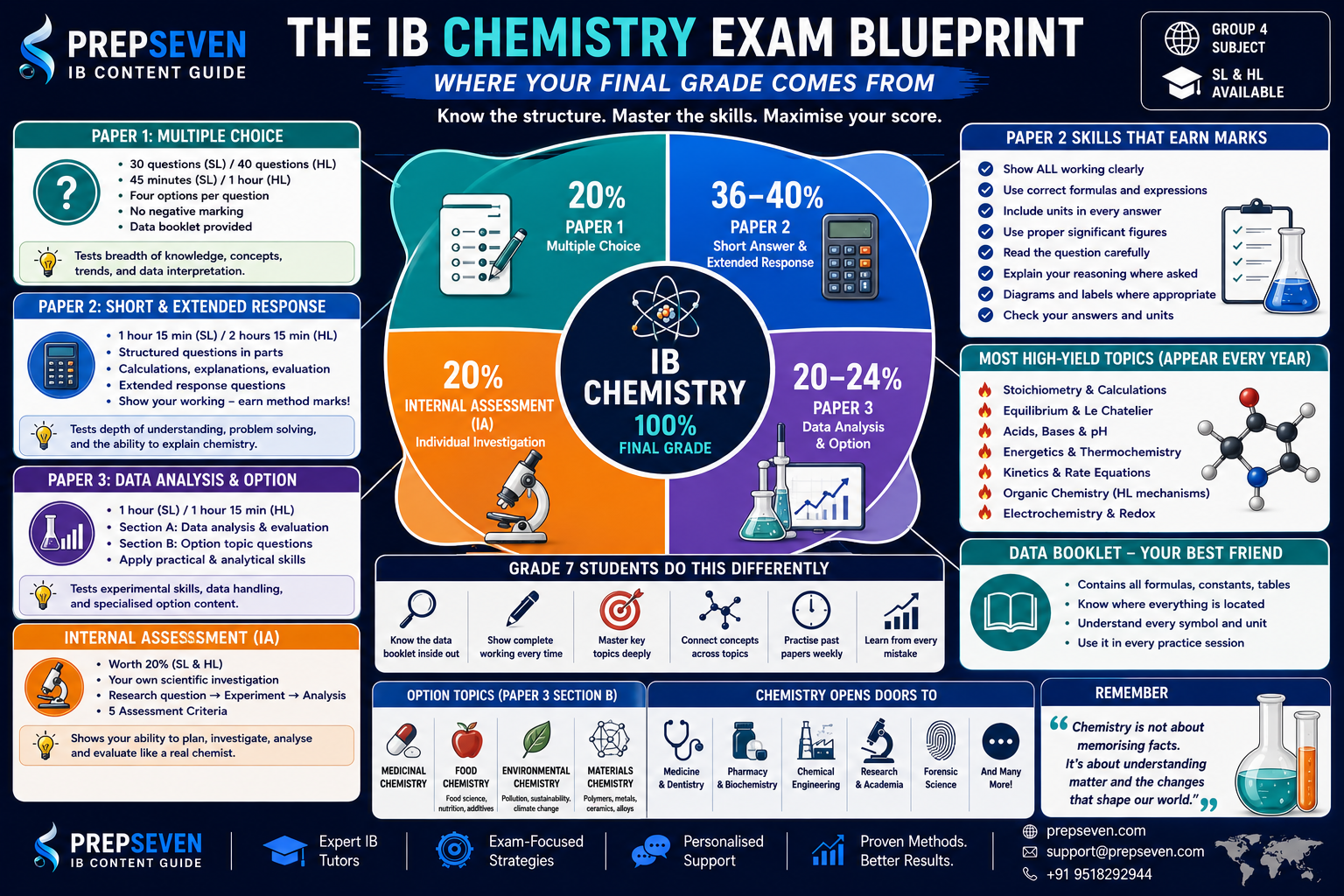
Paper 1: Multiple Choice
Paper 1 is entirely multiple choice: 30 questions at SL in 45 minutes, 40 questions at HL in one hour. Four options per question, no negative marking. The questions are not trivial recall items. Many require multi-step reasoning, data interpretation, or the application of a principle to an unfamiliar molecule or reaction.
The data booklet is provided in Paper 1 and contains all the formulae, constants, and tables you need. Students who know the data booklet well, who can find any piece of information in it instantly and understand what every symbol in every formula means, navigate Paper 1 significantly faster than those who search under time pressure. Work with the data booklet throughout both years, not only in the exam.
A pace of roughly 90 seconds per question is what Paper 1 demands at both SL and HL. Students who spend too long on a single uncertain question run out of time for questions they know well. The correct strategy for an uncertain question is to eliminate obvious wrong answers, make your best choice, mark the question for review, and move on. Return to marked questions if time allows. Never leave a question unanswered because there is no negative marking.
Paper 2: Short Answer and Extended Response
Paper 2 is the longest paper at both levels and the one where working is most directly rewarded. It contains structured short-answer questions and extended response questions. The structured questions build through parts, typically starting with accessible recall and moving to calculation or analysis. The extended response questions require multi-step problem solving and occasionally short explanatory paragraphs.
Working is essential in Paper 2. In calculation questions, marks are allocated for the correct equation or expression, the correct substitution with units, and the correct final answer with units. A student who makes an arithmetic error but shows correct method and units can earn three of four available marks. A student who writes only the final answer earns one mark if it is correct and nothing if it is wrong. Show every step, every unit, and every intermediate result.
The extended response questions in Paper 2 often ask students to explain or evaluate in short paragraphs rather than calculate. These questions test conceptual understanding: can you explain why the reaction rate increases with temperature in terms of the Maxwell-Boltzmann distribution and the fraction of molecules with energy above the activation energy? Can you evaluate why a buffer resists pH change when a small amount of acid is added? These questions require the ability to connect the macroscopic observation to the submicroscopic explanation with chemical precision.
Units are a consistent source of avoidable mark loss in Paper 2. Every numerical answer needs units unless the quantity is dimensionless. An enthalpy change without kJ per mol, a rate constant without its correct units, or a concentration expressed as a number without mol per dm cubed will lose the unit mark. Over an entire paper this adds up to several marks that required no additional chemistry to earn. Build the habit of checking units on every numerical answer before moving to the next question.
Paper 3: Data Analysis and Option Topic
Paper 3 has two sections. Section A presents experimental data and asks you to analyse it: processing raw data into results, calculating uncertainties, plotting graphs, interpreting relationships, and evaluating experimental methodology. Section B presents questions on the option topic your school has chosen from Medicinal Chemistry, Food Chemistry, Environmental Chemistry, and Materials Chemistry.
Section A rewards students who have genuinely engaged with the Internal Assessment process. The skills it tests, expressing uncertainty in measurements, propagating uncertainty through calculations, interpreting graphs, and evaluating sources of error in an experimental context, are exactly the skills the IA develops. Students who understand the IA process find Section A of Paper 3 significantly more manageable than those who treated it as a box-ticking exercise.
The option topic is the most directly reviable part of IB Chemistry. Because you know which option your school has selected, the content is completely predictable in advance. Students who have worked through the option content systematically, with past option questions and model answers, consistently score well here even if other parts of the course are less secure. Treat the option as a gift: it is fixed, it is reviable, and it is worth a significant portion of Paper 3.
Internal Assessment: The Individual Investigation
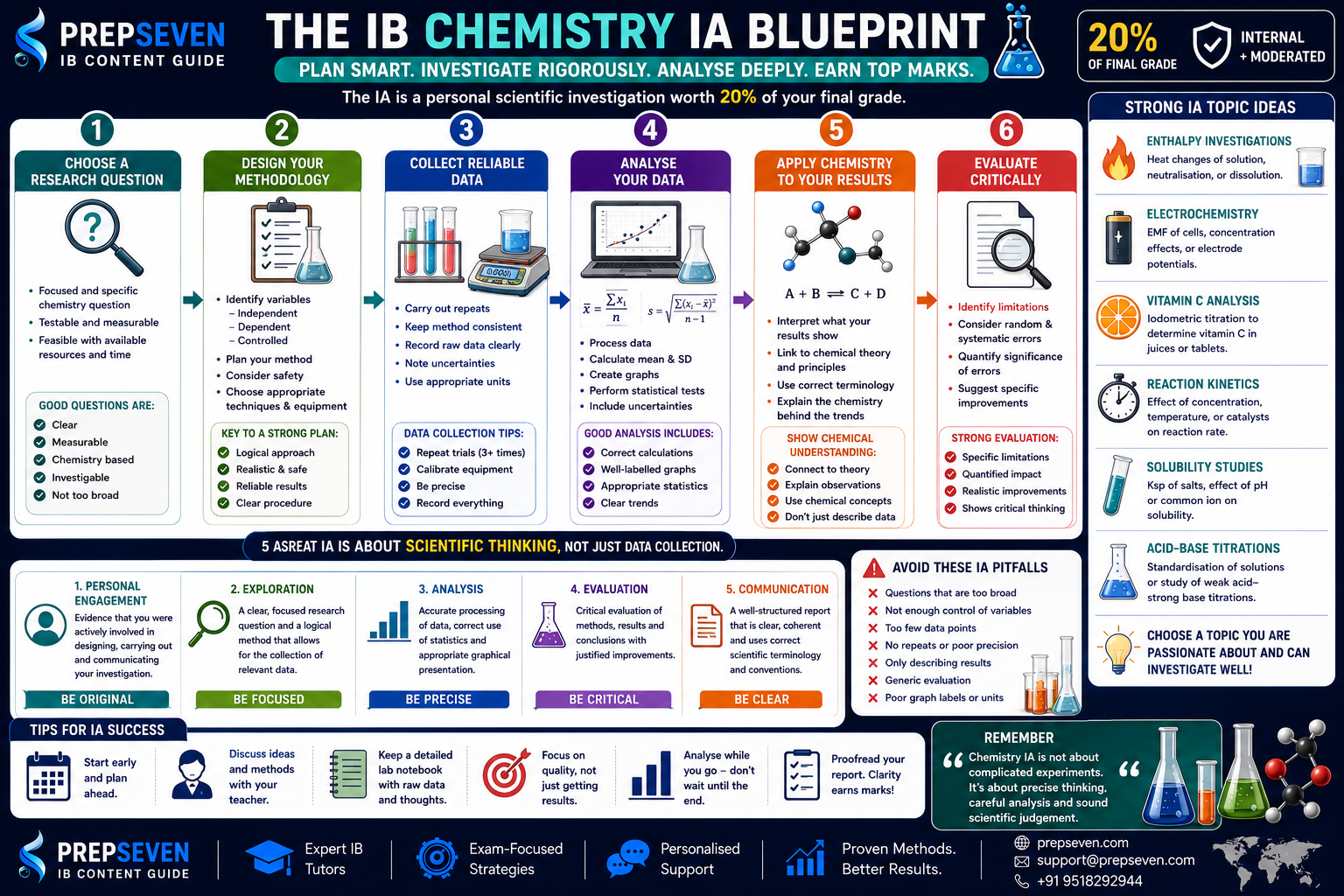
The Chemistry IA is an individual scientific investigation worth 20% of the final grade. You design your own experiment, collect data, process and analyse it, and write a report of typically ten to fifteen pages. It is assessed on Personal Engagement, Exploration, Analysis, Evaluation, and Communication.
The Exploration criterion is where the IA is won or lost in the planning phase. A well-defined, focused research question with a clear independent variable, dependent variable, and controlled variables is the foundation of everything that follows. Students who choose questions that are too broad, that involve too many uncontrolled variables, or whose data cannot be meaningfully analysed with the equipment available, find that the subsequent Analysis and Evaluation criteria are almost impossible to score well on regardless of how carefully they execute the experiment.
The Evaluation criterion is where most IA marks are left on the table. A strong evaluation identifies specific sources of systematic and random error, explains quantitatively how significant each source is relative to the measured uncertainty, and proposes specific and realistic modifications that would address each limitation. Generic statements like the sample size was small or all experiments have sources of error earn minimal credit. Specific, quantified, chemically reasoned evaluation of the methodology earns marks in the highest criterion band.
IA topic selection is one of the most important decisions of the two years. The best investigations have a clear, testable hypothesis derived from chemical theory, a straightforward experimental design that can produce enough data for meaningful statistical analysis, and variables that can be controlled well enough in a school laboratory setting. Investigations that are too ambitious, that rely on equipment your school does not have, or that produce data too noisy to analyse clearly, consistently produce disappointing IA scores regardless of the effort invested. Discuss feasibility thoroughly with your teacher before committing to a topic.
Component | SL Weight | HL Weight | Assessed By |
Paper 1 (Multiple choice) | 20% | 20% | External (IB) |
Paper 2 (Short and extended response) | 40% | 36% | External (IB) |
Paper 3 (Data analysis and option) | 20% | 24% | External (IB) |
Internal Assessment (Individual investigation) | 20% | 20% | Internal + Moderated |
The Topics That Separate 6s from 7s
Across IB Chemistry examiner reports, certain topics consistently separate students in the high-performing group from those in the very top band. These are not necessarily the hardest topics conceptually. They are topics where genuine understanding produces a qualitatively different kind of answer from surface knowledge.
Equilibrium and Le Chatelier’s Principle
Equilibrium is one of the most consistently examined topics across all three papers and one of the most consistently misunderstood. Students at the 5 to 6 level can apply Le Chatelier’s principle correctly to predict the direction of shift when conditions change. Students at the 7 level can explain why the system shifts in terms of the relative rates of forward and reverse reactions and what happens to the equilibrium constant under different conditions. They also understand that changing the concentration of a pure solid or liquid does not affect the equilibrium position, and why, which is a nuance that many students miss.
Acid-Base Chemistry and pH Calculations
pH calculations at HL extend well beyond the simple strong acid and strong base cases. Buffer calculations, Ka and Kb relationships, the pH of salt solutions from hydrolysis, and solubility product calculations all require genuine algebraic fluency combined with chemical understanding. Students who have only practised one or two types of pH calculation find Paper 2 HL acid-base questions significantly harder than those who have worked through the full range. Every pH calculation type should be practised to the point of automaticity before the exam.
Organic Chemistry Mechanisms at HL
Reactivity 3 at HL introduces organic reaction mechanisms: nucleophilic substitution, electrophilic addition, nucleophilic addition to carbonyl compounds, and condensation reactions. These are not recipes to memorise. They are explanations of why reactions happen in terms of electron density, bond polarity, and the relative stability of intermediates and products. Students who treat mechanisms as sequences of steps to reproduce without understanding the underlying electron movement consistently make errors when questions present slightly unfamiliar substrates or conditions. Understanding the principle behind each mechanism allows you to reason through an unfamiliar case.
Experimental Design and Uncertainty
This overlaps with the IA and Paper 3, but it deserves mention separately because it is a conceptual domain that many students treat as peripheral. IB Chemistry examiners consistently note that students struggle with questions about experimental design: identifying appropriate controls, explaining why a specific technique reduces a particular source of error, or calculating the propagated uncertainty in a derived quantity. These are not difficult questions if you have genuinely understood the experimental process. They are nearly impossible to answer well if you have only memorised procedures without understanding why each step is done.
What Actually Gets Students to a 7
They understand the data booklet deeply, not just superficially
The IB Chemistry data booklet contains every formula, constant, and table a student needs for the exam. Students who know how to use every piece of information in it, who understand what every symbol represents and when each formula applies, have a significant advantage over those who know that the booklet exists but have to search for things under time pressure. Work through the data booklet systematically early in Year 1 and refer to it in every practice session throughout both years. By the time of the exam, using it should feel completely natural.
They practise showing working even when they could skip steps
In Paper 2, every step of working is potentially worth a mark. Students who practise showing all their working in every exercise throughout two years arrive at the exam with a habit that earns them method marks even when they make arithmetic errors. Students who skip steps during practice because they can do the calculation mentally discover in the exam that the habit of not showing working costs them marks they could have earned. Build the habit of complete working in every practice session, not just in formal exam practice.
They connect macroscopic, submicroscopic, and symbolic representations
A student who can balance a redox equation, draw the Lewis structure of the products, explain the electron transfer in terms of oxidation states, and describe what a chemist would observe at the macroscopic level is working at the level of understanding that the top band requires. A student who can only do one of these is working at a lower level. When you study any reaction or process, consciously ask yourself: what do I observe? What is happening at the molecular level? How do chemists represent this symbolically? Building this triple-level thinking throughout both years is what produces genuine chemical understanding rather than surface knowledge.
They do not leave the option topic until the end
The option topic is the most directly reviable part of IB Chemistry. Every student knows in advance which option their school has chosen. Students who revise the option systematically throughout Year 2 and practise past option questions arrive at Paper 3 Section B with reliable, well-prepared content that consistently produces marks. Students who leave the option until the final weeks of revision find it has more content than they expected and practise it less thoroughly than they should. Treat it as a scheduled, prioritised part of your Year 2 revision from the start.
They review errors as diagnostic information
In practice papers, students who look at a wrong answer, identify specifically why their reasoning failed, and practise similar questions until that failure mode no longer occurs improve faster than those who simply note the correct answer and move on. In chemistry, errors tend to have patterns: sign errors in enthalpy calculations, forgetting to double equilibrium expressions, applying Le Chatelier to a system that is not at equilibrium. Keeping a personal error log and targeting revision at recurring error patterns is among the most efficient preparation strategies available.
Common Mistakes That Cost Marks
The Mistake | What to Do Instead |
Writing final answers without showing working in Paper 2 | Show every equation, every substitution with units, and every intermediate result. Method marks are worth more than answer marks across a whole paper. |
Giving numerical answers without units | Every numerical answer needs units unless the quantity is dimensionless. Check units before moving to the next question. |
Applying Le Chatelier without checking whether the system is at equilibrium | Le Chatelier’s principle applies only to systems already at equilibrium. Check this condition before predicting a shift. |
Treating organic mechanisms as sequences to memorise rather than principles to understand | Understand the electron movement and the chemical reasoning behind each mechanism. This allows you to reason through unfamiliar cases rather than only recognising familiar ones. |
Writing generic IA evaluation statements | Identify specific sources of error, quantify their significance, and propose specific methodological improvements. Generic limitations earn minimal credit. |
Not practising significant figures and rounding consistently | Match significant figures to the precision of the data given. Excessive or insufficient precision is penalised. Check every answer before moving on. |
Leaving option topic revision to the final weeks of Year 2 | The option is fully reviable and predictable. Schedule it as a regular part of Year 2 revision from the beginning rather than treating it as an afterthought. |
A Realistic Year-by-Year Approach
Year 1 (Grade 11): Build Foundations and Laboratory Habits
Engage with each new topic by understanding the chemical principle before practising problems. Ask why each equation takes the form it does, why each trend exists, and what the molecular-level explanation is for each macroscopic observation.
Work with the data booklet from the first lesson. Every time you use a formula or constant, find it in the booklet and check every symbol. By Year 2, navigating the booklet should be completely automatic.
Build the habit of showing complete working in every exercise, including homework and class problems. This habit needs to be automatic by the exam, and it only becomes automatic through consistent practice from the start.
Begin your IA preparation in Term 2 of Year 1. Identify a research question, discuss feasibility with your teacher, and start planning your methodology before the formal IA period begins.
For HL students: engage with HL-only content as it is introduced. Do not defer topics like Born-Haber cycles, rate equations, or organic mechanisms to Year 2. They need time to develop genuine understanding.
Year 2 (Grade 12): Consolidate and Practise Under Exam Conditions
Complete at least six full past paper sets under timed conditions before your mock exams, covering all three papers. Mark them using the official mark scheme and build an error log of the specific question types where you consistently lose marks.
Review your error log weekly and target the specific topic areas and calculation types where your error rate is highest. Targeted practice on known weaknesses is significantly more efficient than general revision.
Complete your IA and submit a full draft for teacher feedback before the end of Term 1. Focus the revision on the Evaluation section and the uncertainty analysis, which are consistently the criteria where most marks are lost.
Revise the option topic systematically in Term 2. Work through all past option questions for your school’s chosen option and build a complete set of model answers that you understand fully.
How PrepSeven Helps You Score Higher in IB Chemistry
IB Chemistry requires two things that are genuinely difficult to develop in isolation: deep conceptual understanding of chemical principles that allows you to handle unfamiliar applications, and the calculation fluency to work through multi-step problems quickly and accurately under time pressure. Our Chemistry tutors are certified IB examiners and experienced teachers who know where students lose marks in each component and what it takes to stop losing them.
Paper 2 marking sessions where your tutor marks your practice responses exactly as an IB examiner would, annotating every step for working completeness, unit accuracy, significant figure discipline, and conceptual reasoning quality.
Conceptual sessions where your tutor works through the underlying chemistry of a topic with you, not just the calculations, until you have the kind of understanding that handles unfamiliar applications rather than only familiar ones.
IA mentorship from research question design through to final draft, with particular attention to the Exploration criterion in the planning phase and the Evaluation criterion in the write-up, which are where most IA marks are made or lost.
Option topic intensive sessions for students who want to secure the Paper 3 Section B marks that are the most predictable and directly reviable in the entire course.
Book your free demo lesson at prepseven.com. Bring a topic you are finding conceptually difficult or a past paper question where your working keeps going wrong. Your tutor will show you where the chemical reasoning is breaking down and how to build the understanding that makes the correct approach feel obvious rather than forced.