
PrepSeven | IB Content Guide authored by Shankar Mutneja (Founder of Prepseven)
IB Biology
What Is IB Biology?
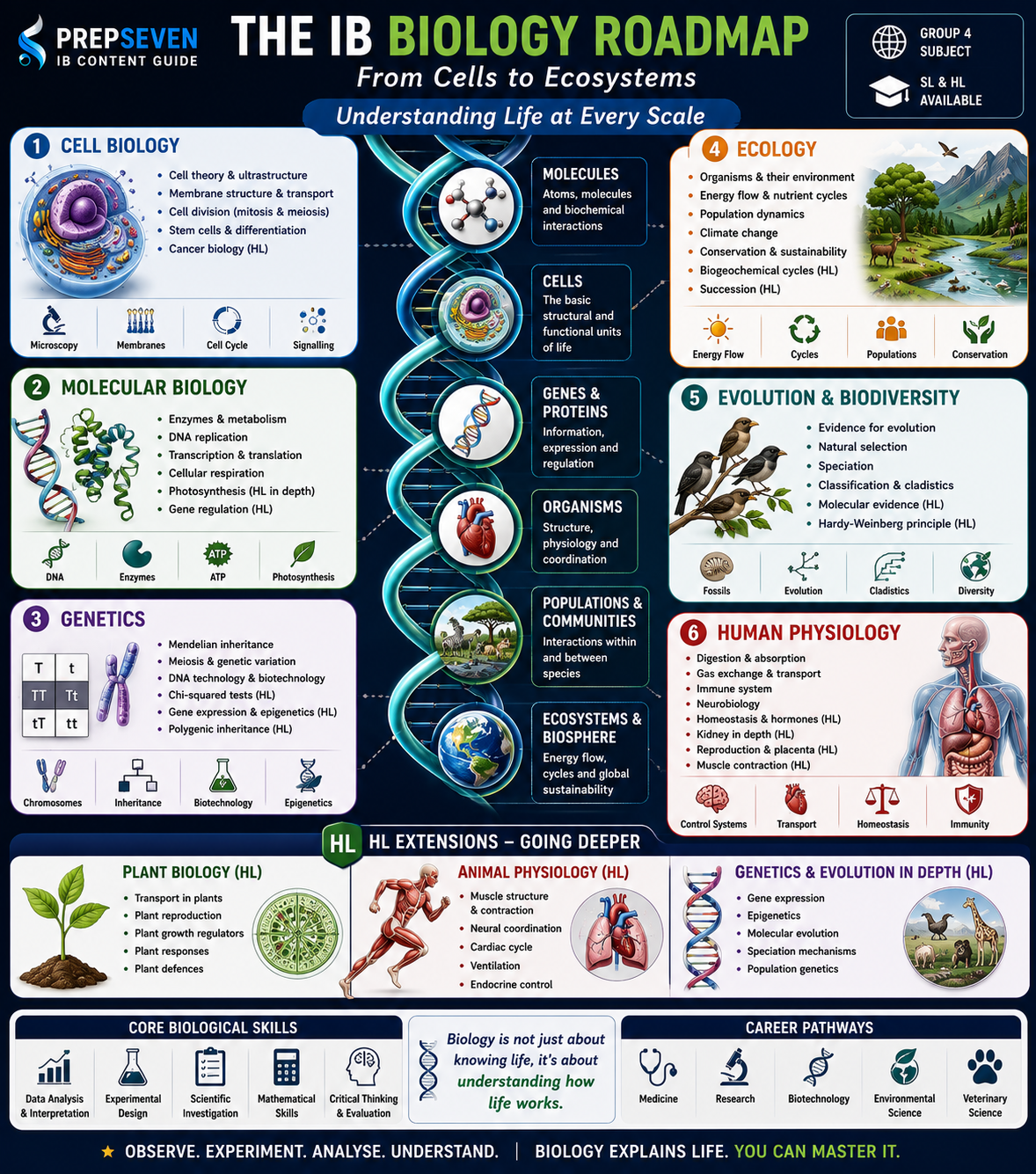
IB Biology is the study of living systems at every scale from molecules to ecosystems, and the processes that allow life to sustain, reproduce, and evolve. It sits in Group 4 of the Diploma Programme alongside Chemistry, Physics, and Environmental Systems and Societies, and is available at both Standard Level and Higher Level. Biology HL is one of the most content-rich pre-university science courses available, and for students targeting medicine, biology-related degrees, or health sciences, a strong HL grade is one of the most widely recognised signals of scientific ability at university level.
The course covers cell biology, molecular biology, genetics, ecology, evolution, and human physiology as its core areas, with additional topics in plant biology, genetics and evolution in depth, and animal physiology at HL. At its best, IB Biology is not a memorisation exercise. It is a course about understanding how life works at every level of organisation, and how the same principles, energy flow, information transfer, feedback regulation, and natural selection, apply whether you are studying a single enzyme or an entire ecosystem.
What makes IB Biology genuinely demanding is the sheer volume of content combined with the expectation that students can apply that content analytically rather than simply recall it. A student who has memorised the steps of meiosis but cannot explain why crossing over during prophase I increases genetic variation has not understood the biology. A student who can explain the adaptive advantage of genetic recombination in terms of natural selection and environmental change has understood it at the level the IB actually tests.
IB Biology has more content than most other IB subjects and that content volume surprises many students who assumed it would be primarily about understanding rather than knowing. Both are required. The understanding is what gets you to the top band, but you cannot demonstrate understanding without the content knowledge to illustrate it. Students who try to understand their way through the course without building the factual foundation, or who build the factual foundation without developing genuine biological understanding, both end up scoring below their potential.
SL vs HL: What the Difference Really Involves
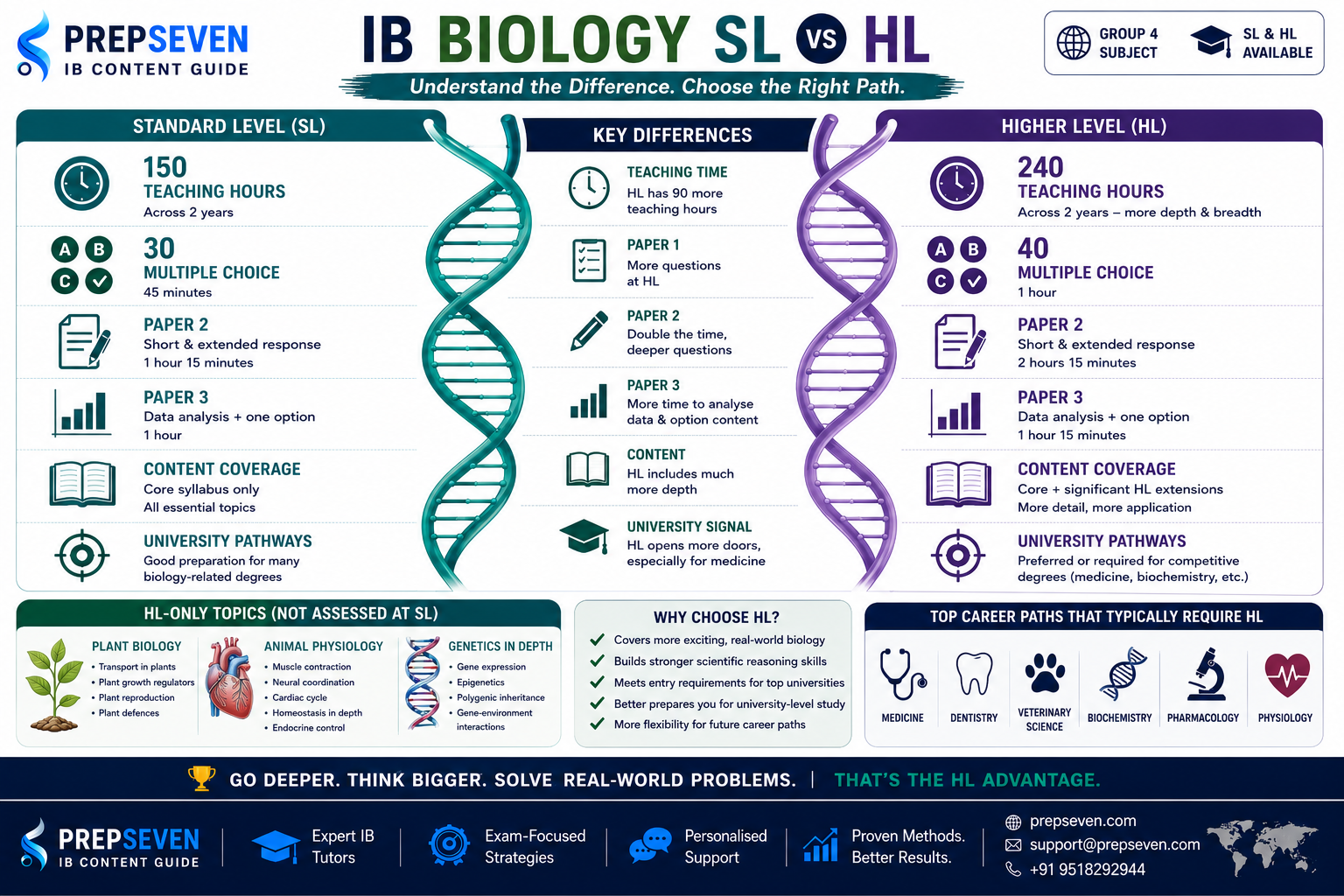
The gap between Biology SL and HL is the largest of the three main IB sciences in terms of content volume. HL students cover significantly more material in every core area, sit an additional section in Paper 2, and face questions in Paper 3 that require deeper analytical engagement with HL-only content.
Feature | SL | HL |
Teaching hours | 150 hours | 240 hours |
Paper 1 | 30 MCQ, 45 minutes | 40 MCQ, 1 hour |
Paper 2 | Short and extended response, 1 hour 15 min | Short and extended response, 2 hours 15 min |
Paper 3 | Data analysis and one option, 1 hour | Data analysis and one option, 1 hour 15 min |
HL-only content | N/A | Additional content in cell biology, molecular biology, genetics, ecology, and dedicated HL topics in plant biology, animal physiology, and genetics in depth |
University signal | Accepted for most biology and health-related degrees | Required or strongly preferred for medicine, dentistry, veterinary science, and most biological science degrees at selective universities |
The HL-only content in IB Biology Tutor India covers some of the most conceptually rich and clinically relevant material in the course: the detailed biochemistry of cellular respiration and photosynthesis, the mechanisms of immunity at the molecular level, the regulation of the heart and ventilation, plant responses to the environment, and the detailed genetics of gene expression and inheritance. These topics require sustained engagement throughout both years, not cramming in the final weeks before the exam.
Medicine, dentistry, veterinary science, biochemistry, physiology, pharmacology, and most biological science degrees at selective universities in the UK, Europe, North America, and Asia require Biology HL and typically specify a minimum grade of 6 or above. If any of these pathways are possibilities for you, research the specific requirements for your target programmes before finalising your course choice. Choosing SL when the programmes you are targeting require HL is a mistake that is very difficult to rectify after the fact.
The New IB Biology Syllabus
IB Biology underwent a significant syllabus revision with the new curriculum first assessed in May 2025. If you are currently studying IB Biology, you are almost certainly on the new syllabus. The structure has changed from the previous topic-numbered format to a thematic organisation, and the assessment approach has been updated to place greater emphasis on conceptual understanding and the application of biological knowledge to novel situations.
The new syllabus is organised into two broad areas: Unity and Diversity, which explores the common features of living organisms and the variety of life, and Form and Function, which explores how biological structures relate to their roles. Within these areas, the content spans molecules and cells, nucleic acids and proteins, evolution and biodiversity, and the physiology of organisms.
Students using revision resources or past papers from before 2025 should be aware that while the underlying biology is unchanged, the framing of topics and the way exam questions are structured may differ from the current exam. Ask your teacher which past papers are most relevant to your specific syllabus year before committing to a revision strategy based on older materials.
The underlying biology in IB Biology does not change when the syllabus does. The same principles of cell structure, molecular biology, genetics, and ecology apply in every version of the course. What changes is the way topics are organised and the specific framing of exam questions. Past papers remain excellent practice for biological reasoning and data analysis even when the topic numbering differs from the current syllabus.
What the Syllabus Covers
Topic Area | Core Content | Key HL Extensions |
Cell Biology | Cell theory, prokaryotic and eukaryotic cells, membrane structure and transport, cell division, stem cells | Membrane proteins in depth, cell signalling, the cell cycle regulation, cancer biology |
Molecular Biology | Metabolism, DNA structure and replication, transcription and translation, cellular respiration, photosynthesis | Enzyme inhibition in depth, metabolic pathways, oxidative phosphorylation, light-dependent and light-independent reactions in detail |
Genetics | DNA and chromosomes, Mendelian inheritance, meiosis, genetic modification and biotechnology | Chi-squared tests, polygenic inheritance, gene-environment interactions, gene expression and epigenetics |
Ecology | Species and ecosystems, energy flow, carbon cycling, climate change, conservation | Nitrogen and phosphorus cycles, succession, population dynamics and carrying capacity |
Evolution and Biodiversity | Natural selection, evidence for evolution, classification, cladistics | Speciation mechanisms, Hardy-Weinberg principle, molecular evidence for evolution |
Human Physiology | Digestion, transport, defence against disease, gas exchange, neurobiology | Hormonal control, the kidney in depth, reproduction and the placenta, muscle contraction |
Plant Biology (HL) | Not assessed at SL | Transport in plants, plant reproduction, plant growth regulators, plant defences |
Molecular Biology is the topic area that most consistently challenges students and carries the most exam weight. The details of DNA replication, transcription, and translation must be understood at the molecular level, not just the conceptual level. The steps of cellular respiration, including glycolysis, the link reaction, the Krebs cycle, and oxidative phosphorylation, and the stages of photosynthesis at HL, require the ability to trace molecules through each stage and explain what is happening at each step. Students who understand these processes at the level of specific molecules and electron carriers rather than as abstract summaries are the ones who score well on the extended response questions in Paper 2.
Assessment Breakdown: How You Are Graded
Paper 1: Multiple Choice
Paper 1 is 30 questions at SL in 45 minutes and 40 questions at HL in one hour. Four options per question, no negative marking. The questions test a wide range of the syllabus and include data interpretation, diagram analysis, and application of biological concepts to unfamiliar scenarios alongside straightforward recall.
The multiple choice questions in IB Biology are more challenging than they appear. Options are carefully crafted to distinguish between students who genuinely understand a concept and those who have partially memorised it. A question about the products of glycolysis, for example, might offer four options that are all partially correct in different ways, with only one fully accurate answer that requires precise knowledge of the exact number of ATP molecules produced and where. Superficial knowledge produces wrong answers on these questions. Precise knowledge produces correct ones.
The data booklet is available in Paper 1 and contains the formulae and reference material relevant to the course. Students who are familiar with what the booklet contains and can locate relevant information quickly are at an advantage in questions that require formula application or reference to specific values. Use the data booklet throughout both years so that navigating it under time pressure becomes automatic.
Paper 2: Short Answer and Extended Response
Paper 2 is one hour fifteen minutes at SL and two hours fifteen minutes at HL. It contains short structured questions that test breadth across the syllabus and extended response questions that test depth of understanding and the ability to construct a biological argument.
The extended response questions in Paper 2 are where Biology grades are most dramatically differentiated. A question asking students to explain the process of DNA replication might be worth eight marks. A student who writes that the double helix unwinds and new strands are built using complementary base pairing earns two or three marks. A student who explains the role of helicase in unwinding the double helix, the formation of the replication fork, the synthesis of RNA primers by primase, the addition of nucleotides by DNA polymerase in the 5 to 3 direction, the discontinuous synthesis of the lagging strand through Okazaki fragments, the removal of primers by DNA polymerase I, and the sealing of nicks by DNA ligase, earns the full eight marks. The difference is not intelligence. It is the depth of knowledge and the precision of its expression.
Diagrams are a significant feature of Paper 2. You may be asked to draw and label diagrams of cells, organelles, molecules, graphs, or biological processes. Diagrams must be drawn clearly, labelled accurately, and where required, include specific structural features. A diagram of a mitochondrion that shows the outer membrane, inner membrane, cristae, matrix, and intermembrane space earns more marks than one that shows a generic double membrane structure. Practise drawing key biological diagrams from memory throughout both years.
The command terms in Paper 2 matter enormously. Outline means give the main points without detail. Describe means state what something looks like or how it happens. Explain means give reasons for why something happens. Evaluate means judge the value or significance with evidence. Discuss means consider multiple perspectives with evidence. Students who write a description when the question says explain, or who outline when the question says discuss, lose marks that the wrong type of response cannot earn regardless of how accurate the biology is. Check the command term before writing a single word of any answer.
Paper 3: Data Analysis and Option Topic
Paper 3 has two sections. Section A presents experimental data in the form of graphs, tables, or described procedures and asks you to process, interpret, and evaluate it. Section B presents questions on the option topic your school has chosen from Neurobiology and Behaviour, Biotechnology and Bioinformatics, Ecology and Conservation, or Human Physiology.
Section A of Paper 3 is where genuine experimental understanding is tested. Questions ask you to calculate statistical measures, interpret the significance of results, identify sources of error and explain their effect on data quality, evaluate the validity and reliability of experimental designs, and suggest improvements to methodologies. A student who has treated every biology practical as a passive experience where they followed instructions and recorded results will find Section A significantly harder than a student who has engaged actively with why each step was done and what each result means.
The option topic carries a fixed, predictable portion of Paper 3 and is fully reviable in advance. Every student knows which option their school teaches. Students who revise the option content systematically and practise past option questions arrive at Section B with reliable, well-prepared material. Students who leave it late consistently find it has more depth than expected. Treat the option as a scheduled and prioritised component of Year 2 revision from the start.
Internal Assessment: The Individual Investigation
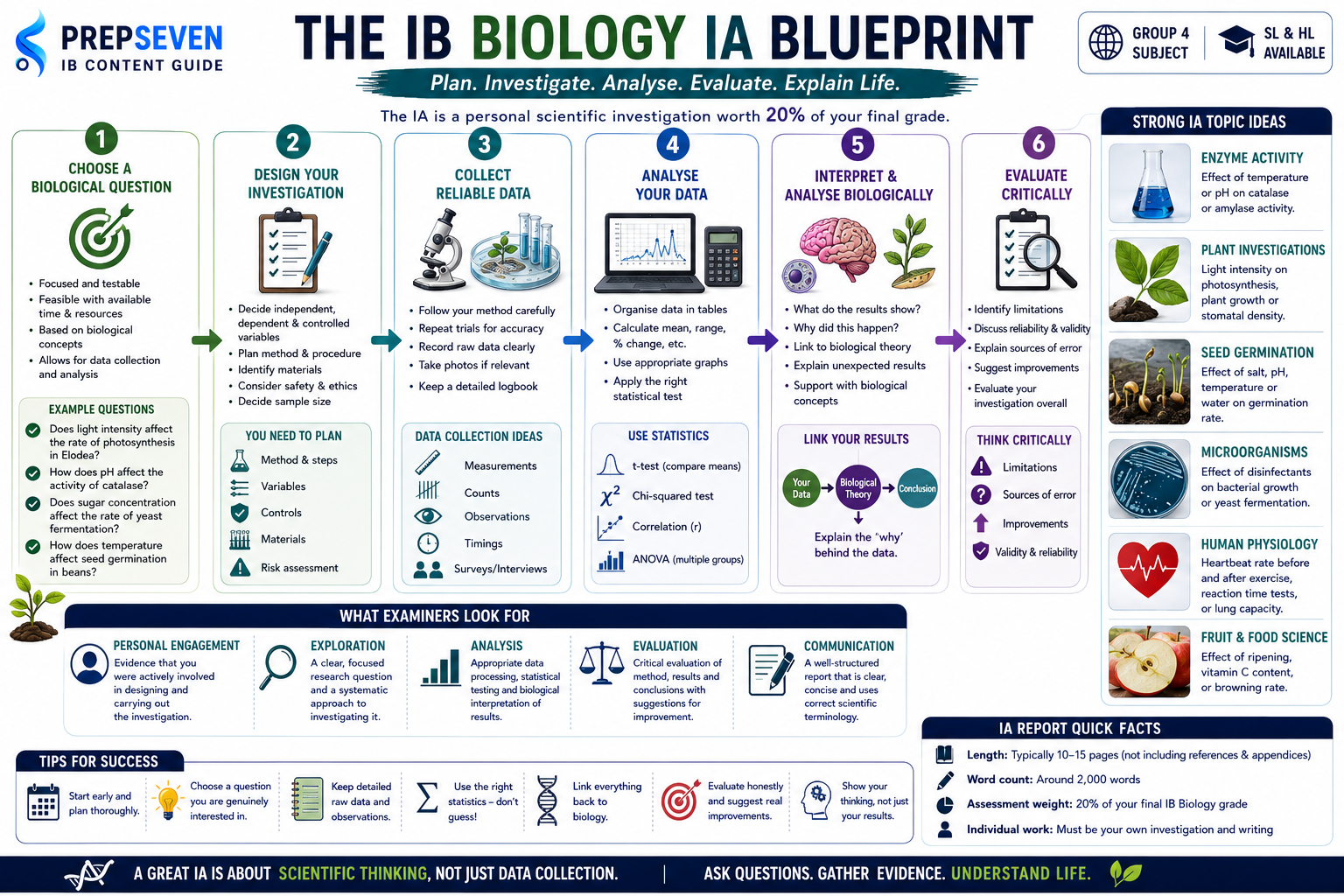
The Biology IA is an individual scientific investigation worth 20% of the final grade. You design your own experiment, collect data, process and analyse it, and write a report of typically ten to fifteen pages. It is assessed on Personal Engagement, Exploration, Analysis, Evaluation, and Communication.
Biology offers a particularly wide range of feasible IA topics because of the variety of living systems that can be investigated in a school setting. Enzyme activity experiments, seed germination studies, the effect of environmental variables on plant growth, microorganism culture investigations, fruit ripening studies, and physiological measurements on human subjects are all examples of investigations that have produced strong IAs. The common thread in strong IAs is not the ambition of the topic but the quality of the experimental design and the rigour of the analysis and evaluation.
The Analysis criterion is where the gap between competent and excellent IAs is most visible. A competent analysis presents the data in appropriate graphs and tables, calculates means and standard deviations, and describes what the data shows. An excellent analysis explains what the data means biologically, uses statistical tests to determine whether observed differences are significant, connects the findings to the biological theory in the introduction, and discusses unexpected results in terms of what they might indicate about the biology rather than dismissing them as errors.
The choice of statistical test in the IA matters and is itself assessed as part of the Analysis criterion. A t-test is appropriate for comparing the means of two groups where the data is normally distributed. A chi-squared test is appropriate for categorical data where you are testing whether an observed distribution fits an expected one. A correlation coefficient is appropriate for testing whether two variables are linearly related. Using the wrong statistical test, or using no statistical test at all when one is clearly appropriate, indicates a gap in analytical understanding that the criterion penalises. Discuss the appropriate statistical approach with your teacher before you collect your data.
Component | SL Weight | HL Weight | Assessed By |
Paper 1 (Multiple choice) | 20% | 20% | External (IB) |
Paper 2 (Short and extended response) | 40% | 36% | External (IB) |
Paper 3 (Data analysis and option) | 20% | 24% | External (IB) |
Internal Assessment (Individual investigation) | 20% | 20% | Internal + Moderated |
The Content Volume Problem: How to Manage It
IB Biology has more content than any other IB science and more content than most Group 3 subjects. This is simply a fact about the course, and students who underestimate it pay the price in the final months before the exam when they discover how much material they have not yet consolidated.
The most effective way to manage the content volume is to build structured notes for each topic as it is taught, rather than trying to learn everything from scratch in Year 2. A student who arrives in Year 2 with clear, organised notes covering every SL and HL topic studied in Year 1 is in a fundamentally different position from one who has loose, incomplete notes and a half-remembered set of textbook chapters. The organisation of your notes is itself a study tool. Notes that connect topics, that show how the molecular biology of DNA relates to the genetics of inheritance, or how the biochemistry of respiration connects to the physiology of gas exchange, are significantly more useful for revision than notes that treat each topic in isolation.
Active recall is the most efficient revision strategy for high-volume content. Rather than rereading notes, close them and try to reproduce the key points from memory. Write out the steps of cellular respiration without looking. Draw and label the stages of meiosis without notes. Explain the mechanism of enzyme inhibition to an imaginary student. The effort of trying to retrieve information from memory, even when it requires looking things up, builds retention far more effectively than passive rereading. Students who use active recall throughout both years consistently arrive at the exam with significantly better retention of the content than those who study through passive review.
One of the most useful active recall exercises in IB Biology: after studying a topic, close your notes and write a one-page summary of everything you can remember about it. Then open your notes and add in red ink everything you missed. Over time, the red additions decrease. When a one-page summary from memory contains almost no red additions, you have genuinely learned that topic. This exercise takes longer than rereading but produces retention that lasts through the exam.
What Actually Gets Students to a 7
They know the molecular biology in precise detail
Molecular Biology is consistently the highest-weighted topic area in IB Biology exams and the one where the gap between a 5 and a 7 is most visible in extended response answers. The students who score at the top are not those who know that DNA replication involves unwinding and copying the strands. They are the ones who can name the enzymes involved, specify the direction of synthesis, explain the difference between leading and lagging strand synthesis, and describe what happens when a replication error occurs and how proofreading mechanisms address it. This level of detail is not memorisation for its own sake. It is the level at which the IB exam questions are pitched, and a response that operates at a lower level of precision will not earn the marks the question allocates.
They understand biological processes in terms of function, not just mechanism
A student who can describe the steps of the light-dependent reactions of photosynthesis has learned the mechanism. A student who can also explain why the light-dependent reactions must produce both ATP and NADPH, why these specific products are required for the Calvin cycle, and what would happen to the organism if one of the photosystems failed to function, understands the process in terms of its biological function. IB Biology extended response questions almost always test functional understanding rather than mechanical description. Asking yourself why after every mechanism you learn is the habit that builds this level of understanding.
They practise drawing diagrams under timed conditions
Paper 2 regularly asks students to draw and label biological diagrams. Diagrams of cells, organelles, chromosomes during cell division, the structure of DNA, synapses, nephrons, the heart, and many other structures appear in past papers. Students who have practised drawing these from memory, accurately and with correct labels, arrive at the exam able to produce correct diagrams quickly. Students who have not practised them in timed conditions often find that their diagram attempts take too long, are inaccurate, or are missing specific features that carry marks. Build a set of key diagrams that you practise drawing from memory weekly from Year 1.
They use command terms to structure every answer
The IB publishes a specific list of command terms with defined meanings. Describe, explain, outline, discuss, compare, evaluate, and analyse each demand a different type of response. Students who check the command term before writing any answer and structure their response accordingly consistently score higher than those who default to the same response type regardless of what the question asks. A particularly common mistake is writing a description when the command term is explain: describing what happens in a biological process earns partial marks, but explaining why it happens in terms of biological principles earns the full allocation.
They engage seriously with data analysis throughout both years
Paper 3 Section A tests data analysis skills that are built through genuine engagement with experimental work throughout both years, not through last-minute cramming. Students who actively engage with every practical during the course, who ask what each measurement means, what sources of error exist, and what the data shows biologically, develop the analytical fluency that Section A demands. Students who go through practicals passively and do not engage with the data critically consistently find Section A harder than the content-based sections, even though it requires no additional content knowledge beyond what they have already learned.
Common Mistakes That Cost Marks
The Mistake | What to Do Instead |
Writing descriptions when the command term says explain | Check the command term before writing. Explain means give biological reasons for why something happens, not just what happens. |
Learning molecular biology at a conceptual level without specific molecular detail | Know the specific enzymes, molecules, and directional constraints in each molecular biology process. The exam questions are pitched at this level of precision. |
Not practising biological diagrams from memory under timed conditions | Build a set of key diagrams and practise drawing them from memory weekly. Diagram questions appear regularly in Paper 2 and reward students who have prepared them explicitly. |
Underestimating the content volume and starting consolidation too late in Year 2 | Build structured notes as each topic is taught in Year 1 and Year 2. Do not rely on being able to learn everything from scratch during exam revision. |
Using the wrong statistical test in the IA or using no statistical test at all | Discuss the appropriate statistical approach with your teacher before collecting data. The choice of statistical test is assessed as part of the Analysis criterion. |
Treating practical work as a passive experience | Engage actively with the purpose, methodology, and results of every practical. This builds the analytical fluency that Paper 3 Section A tests directly. |
Leaving option topic revision to the final weeks of Year 2 | The option is fully predictable and reviable. Schedule it as a regular part of Year 2 revision from the start of Term 2. |
A Realistic Year-by-Year Approach
Year 1 (Grade 11): Build Foundations and Active Recall Habits
Build structured notes for every topic as it is taught. Do not let a unit end without having organised, complete notes that you understand. The content volume in Biology means that gaps in Year 1 notes compound into serious problems in Year 2 revision.
Start using active recall from the beginning of Year 1. After each lesson or unit, close your notes and write out what you can remember before checking. Build the gap between what you can retrieve and what you actually know, then close that gap.
Practise drawing ten key biological diagrams from memory every week. Include cell structures, organelles, chromosomes at different stages of division, the structure of DNA, and any other diagrams introduced in class. Accuracy under time pressure develops only through repeated practice.
Engage actively with every practical throughout Year 1. Ask why each step is done, what each result means biologically, and what sources of error exist. This builds the analytical habits that Paper 3 Section A tests.
Begin your IA preparation in Term 2 of Year 1. Identify a research question, discuss statistical approach and feasibility with your teacher, and plan your methodology before the formal IA period begins.
Year 2 (Grade 12): Consolidate and Perform
Complete at least six full past paper sets under timed conditions before your mock exams, covering all three papers. Mark using the official mark scheme and build an error log categorised by topic and by type of error.
Target your revision specifically at the topics where your practice paper error rate is highest. Biology’s content volume means that undifferentiated revision is significantly less efficient than targeted revision based on your actual performance data.
Complete your IA and submit a full draft for teacher feedback before the end of Term 1. Focus the revision on the Analysis and Evaluation criteria, which are where most IA marks are won or lost.
Revise the option topic systematically in Term 2. Work through all past option questions for your school’s option and build complete model answers you fully understand.
In the final four weeks before exams, focus on Molecular Biology above all other topics. It carries the most weight, its extended response questions are the highest-value questions in Paper 2, and the level of detail required rewards thorough preparation more than any other topic area.
How PrepSeven Helps You Score Higher in IB Biology
IB Biology requires two things that are genuinely difficult to develop without expert support: the depth of molecular and physiological knowledge that Paper 2 extended response questions demand, and the data analysis fluency that Paper 3 Section A tests. Our Biology tutors are certified IB examiners and experienced teachers who have marked student work across all components and know exactly what distinguishes a 6 from a 7 in this course.
Paper 2 extended response sessions where your tutor marks your answers exactly as an IB examiner would, showing you precisely where your biological detail is insufficient, where your command term response is the wrong type, and what a full-mark answer to the same question looks like.
Molecular biology deep-dive sessions for the topics that carry the most exam weight: DNA replication, transcription and translation, cellular respiration, and photosynthesis at HL. Your tutor works through each process at the level of specific enzymes and molecules until you can explain every step with precision.
IA mentorship from research question design through to final draft, with particular attention to the Analysis criterion including statistical test selection and biological interpretation of results, and the Evaluation criterion where most IA marks are left on the table.
Option topic intensive sessions for students who want to secure the Paper 3 Section B marks that are the most predictable and directly reviable in the entire course.
Book your free demo lesson at prepseven.com. Bring a recent Paper 2 extended response question or a molecular biology topic you want to understand more deeply. Your tutor will show you the difference between a 5-band and a 7-band response, and what the biological understanding looks like that produces one rather than the other.